


Formula for Radius of Turn

Fleet Manager

Joined: Apr 2001
Aviation Qualifications: ATPL
Posts: 7,447
Likes: 310
From: various places .....
This chart may be of use to some. It was knocked up many years ago for a mate who ran an I/F procedural trainer school and wanted several charts to simplify briefings. He's long out of the workforce and I have no continuing interest in copyright so I've deidentified it and you are welcome to use it if it is of any value to you.
As I recall it made life in the Link Trainer a bit easier but, as we all know, rule of thumb and watching the needles tends to be the go in the air.
I note that a few posters have been at pains to show concern about consistency of units.
That's all fine but, at the end of the day, you can use whatever units you choose just so long as you do the conversion calculations to make the equations correct ... I think that speeds in megafurlongs/fortnight or deci-lightyears/weekend would be rather cute ... but, somehow, I don't think that will take off ...

As I recall it made life in the Link Trainer a bit easier but, as we all know, rule of thumb and watching the needles tends to be the go in the air.
I note that a few posters have been at pains to show concern about consistency of units.
That's all fine but, at the end of the day, you can use whatever units you choose just so long as you do the conversion calculations to make the equations correct ... I think that speeds in megafurlongs/fortnight or deci-lightyears/weekend would be rather cute ... but, somehow, I don't think that will take off ...

Joined: Jun 2004
Posts: 1,843
Likes: 0
From: Australia
I've never seen so much discussion over what should be a relatively straight-forward matter
The application of the various simplifications (e.g. 1% of TAS) is good in practice. Perhaps the original poster needed something more accurate, as may be required when working out OEI Escape Routes etc.
The two formulae given below apply 2 different constants, one for entry speed in Knots, the other for entry speed in Km/Hr.
If Entry speed is in Knots :-
R = TAS^2 X .02698711 / Tan AoB
If Entry speed is in Km/Hr :-
R = TAS^2 X .00786818 / Tan AoB
Example : TAS = 200 Kt (370.4 Km/Hr) at Bank angle 25 degrees.
R = 200^2 X .02698711 / Tan 25 = 2314.96 M....... OR
R = 370.4^2 X .00786818 / Tan 25 = 2314.96 M
If you want the answer in Km, divide by 1000
The application of the various simplifications (e.g. 1% of TAS) is good in practice. Perhaps the original poster needed something more accurate, as may be required when working out OEI Escape Routes etc.
The two formulae given below apply 2 different constants, one for entry speed in Knots, the other for entry speed in Km/Hr.
If Entry speed is in Knots :-
R = TAS^2 X .02698711 / Tan AoB
If Entry speed is in Km/Hr :-
R = TAS^2 X .00786818 / Tan AoB
Example : TAS = 200 Kt (370.4 Km/Hr) at Bank angle 25 degrees.
R = 200^2 X .02698711 / Tan 25 = 2314.96 M....... OR
R = 370.4^2 X .00786818 / Tan 25 = 2314.96 M
If you want the answer in Km, divide by 1000
Fleet Manager
Joined: Apr 2001
Aviation Qualifications: ATPL
Posts: 7,447
Likes: 310
From: various places .....
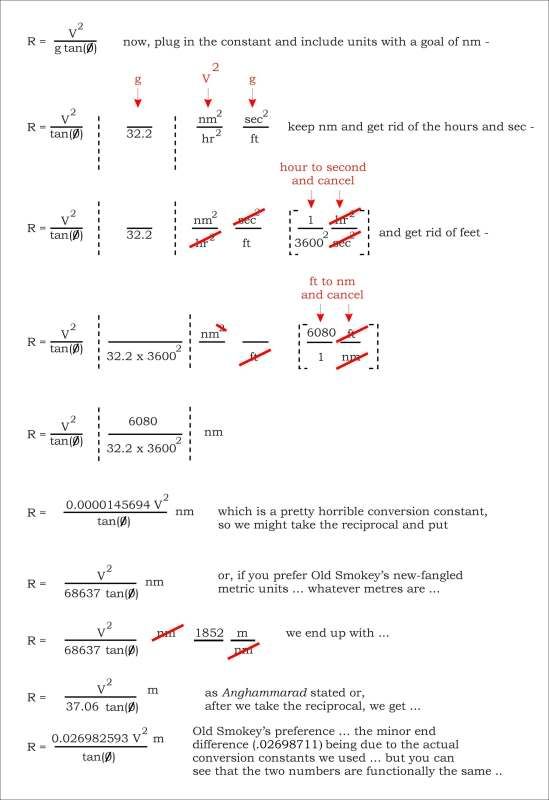
For those of us who have an engineering or similar background, unit conversion is routine bread and butter stuff. For those who are not comfortable with such antics, you might like to see how it is done -
The sequence requires that you keep rigorous track of the variables, constants and units .. which I have separated below to make it a bit easier to follow.
Explanation -
Using speed, V, in kts, g in ft/sec^2 and I want the answer to be radius in nm. You might just as easily have started with some other units - makes no difference to the technique.
To change units, we use the "trick" of multiplying by unity ("1") which doesn't change the value of an expression. We can extend this by noting that dividing something by itself is "1" eg 4/4 = 1. The secret, then, lies in further extending this to account for different units which represent the same quantity. So, for instance, we can say that 1nm/1nm = 1 which is the same as saying that 1nm/6080ft = 1. (or you might chose to use 6076.131 as the conversion - depends on what reference you look up). This then allows us to cancel out unwanted units and we just carry the resulting numbers into the main calculation. This last bit is very important and the source of much error when folk start learning about unit conversions.
At the second line we need to get rid of the hour, second, and feet units. To make it easier to follow we can do it in two stages.
To get rid of the hours and seconds, we note that
1 hour = 60 x 60 seconds = 3600 seconds
as we have to get rid of hours^2 and seconds^2 (whatever those units might represent physically is not a concern) we can square the conversion units to come up with
1 hour^2 = 3600^2 seconds^2 which gives the unity expression
1/3600^2 with units hr^2/sec^2. Whether you put the hours or seconds on the top line is determined by the original equation. In this case we want to get rid of hr^2 on the bottom and sec^2 on the top so it makes sense to insert hr^2/sec^2 as in the graphic.
To get rid of feet, we note that
1 nm = 6080 feet (or some similar conversion value) so the unity expression is
1 = 6080/1 with units ft/nm as we need to cancel out ft on the bottom in the original expression
Notice that I now end up with nm as the only unit on the RHS of the equation and this is what I needed. Note also that I have taken the conversion units (3600^2 and 6080) into the constants expression so that I don't lose track of them.
If we do the arithmetic to simplify the numbers we get 0.0000145694 as the conversion constant. As that is a dreadful number to work with, I prefer to replace it by the reciprocal on the bottom line. All this means is I note that
1/2 = 0.5/1, so
0.0000145694/1 = 1/68637
To convert to metres, we note that
1 = 1852/1 with units m/nm so that we can cancel out the nm and to get to Old Smokey's version we do the reciprocal trick.
Note that the small difference in constants is a consequence of which values go into the intermediate steps. It may be important to the academic purist but, functionally, the end result is sufficiently similar not to worry too much about it .. all depends on the reference table from which you pick your conversion constants.
The sequence requires that you keep rigorous track of the variables, constants and units .. which I have separated below to make it a bit easier to follow.
Explanation -
Using speed, V, in kts, g in ft/sec^2 and I want the answer to be radius in nm. You might just as easily have started with some other units - makes no difference to the technique.
To change units, we use the "trick" of multiplying by unity ("1") which doesn't change the value of an expression. We can extend this by noting that dividing something by itself is "1" eg 4/4 = 1. The secret, then, lies in further extending this to account for different units which represent the same quantity. So, for instance, we can say that 1nm/1nm = 1 which is the same as saying that 1nm/6080ft = 1. (or you might chose to use 6076.131 as the conversion - depends on what reference you look up). This then allows us to cancel out unwanted units and we just carry the resulting numbers into the main calculation. This last bit is very important and the source of much error when folk start learning about unit conversions.
At the second line we need to get rid of the hour, second, and feet units. To make it easier to follow we can do it in two stages.
To get rid of the hours and seconds, we note that
1 hour = 60 x 60 seconds = 3600 seconds
as we have to get rid of hours^2 and seconds^2 (whatever those units might represent physically is not a concern) we can square the conversion units to come up with
1 hour^2 = 3600^2 seconds^2 which gives the unity expression
1/3600^2 with units hr^2/sec^2. Whether you put the hours or seconds on the top line is determined by the original equation. In this case we want to get rid of hr^2 on the bottom and sec^2 on the top so it makes sense to insert hr^2/sec^2 as in the graphic.
To get rid of feet, we note that
1 nm = 6080 feet (or some similar conversion value) so the unity expression is
1 = 6080/1 with units ft/nm as we need to cancel out ft on the bottom in the original expression
Notice that I now end up with nm as the only unit on the RHS of the equation and this is what I needed. Note also that I have taken the conversion units (3600^2 and 6080) into the constants expression so that I don't lose track of them.
If we do the arithmetic to simplify the numbers we get 0.0000145694 as the conversion constant. As that is a dreadful number to work with, I prefer to replace it by the reciprocal on the bottom line. All this means is I note that
1/2 = 0.5/1, so
0.0000145694/1 = 1/68637
To convert to metres, we note that
1 = 1852/1 with units m/nm so that we can cancel out the nm and to get to Old Smokey's version we do the reciprocal trick.
Note that the small difference in constants is a consequence of which values go into the intermediate steps. It may be important to the academic purist but, functionally, the end result is sufficiently similar not to worry too much about it .. all depends on the reference table from which you pick your conversion constants.


Joined: Dec 2006
Posts: 2,486
Likes: 8
From: The No Transgression Zone
J_T despite my humor I think it's nice to see folks [in the technical fraternity] who still know what they are doing and what they talking about and don't consider pedantry at all; I have received innumerable educational benefits from you all from a humble student of the art,...
May you find marry a gorgeous AND experienced computer to write your polar plots
from a humble student of the art,...May you find marry a gorgeous AND experienced computer to write your polar plots
Joined: Mar 2007
Posts: 570
Likes: 21
From: Another Planet.
NOMOGRAM OF TURNING PERFORMANCE.
In the halcyon days when Bett Windsor's Flying Club (aka the RAF) flew real aeroplanes, without all these clever wiggly amps and gigabytes to help, we were issued with a small card/piece of paper which if I recall correctly had three/four lines of figures on it.
Angle of bank was one, TAS was another, radius of turn was the third and possibly "g" force was the fourth.
All one had to do was to put a straight edge along 2 of the values and read off the other(s) where the edge intersected the line of values.
All this tan theta and mental maths was obviously too hard for the top guns of the period and it sounds like a prime example of KEEP IT SIMPLE.
Has the K I S S principle been abandoned forever in favour of geeks and shiny touchscreens?
To the OP, I appreciate this cribsheet is not a formula but it seemed to be worth that fine institutions efforts to educate their pilot and navs.
Can any ex RAF/FAA exiles out there recall the nomogram and put what's left of my mind at ease, please?!
Angle of bank was one, TAS was another, radius of turn was the third and possibly "g" force was the fourth.
All one had to do was to put a straight edge along 2 of the values and read off the other(s) where the edge intersected the line of values.
All this tan theta and mental maths was obviously too hard for the top guns of the period and it sounds like a prime example of KEEP IT SIMPLE.
Has the K I S S principle been abandoned forever in favour of geeks and shiny touchscreens?
To the OP, I appreciate this cribsheet is not a formula but it seemed to be worth that fine institutions efforts to educate their pilot and navs.
Can any ex RAF/FAA exiles out there recall the nomogram and put what's left of my mind at ease, please?!
Guest
Posts: n/a
 K.I.S.S.
φ is a Bank °
Turn Radius (r) in NM = TAS^2 / 68649 / tg φ °
Turn Radius (r) in sec=TAS / 19.07 / tg φ °
for calculatons on mobile phone calculator
Radius in NM for (φ 30°) = TAS*TAS /39683
(φ 15°) = TAS*TAS/ 18382
(φ 10°) = TAS*TAS/ 12107
for calculations from one's "top of head"
TAS 199 kt φ30 r=1 NM
φ16 r=2 NM
φ11 r=3 NM
Radius in SECONDS (φ 28°) ~ TAS / 10
(φ 15°) ~ TAS / 5
(φ 10°) ~3 xTAS /10
Turning Point= Radius (NM or KM) * tg (( next CRS – present CRS) /2)
Turn Radius (r) in NM = TAS^2 / 68649 / tg φ °
Turn Radius (r) in sec=TAS / 19.07 / tg φ °
for calculatons on mobile phone calculator
Radius in NM for (φ 30°) = TAS*TAS /39683
(φ 15°) = TAS*TAS/ 18382
(φ 10°) = TAS*TAS/ 12107
for calculations from one's "top of head"
TAS 199 kt φ30 r=1 NM
φ16 r=2 NM
φ11 r=3 NM
Radius in SECONDS (φ 28°) ~ TAS / 10
(φ 15°) ~ TAS / 5
(φ 10°) ~3 xTAS /10
Turning Point= Radius (NM or KM) * tg (( next CRS – present CRS) /2)
Last edited by Green Guard; 3rd September 2013 at 11:02.

Joined: May 2002
Posts: 1,210
Likes: 56
From: Melbourne, Australia
we were issued with a small card/piece of paper which if I recall correctly had three/four lines of figures on it
Last edited by djpil; 3rd September 2013 at 11:36.

Joined: Aug 2013
Posts: 30
Likes: 0
From: PA
What is the context of the OP need for turn radius?
R= NM
Figure your true airspeed TAS, tailwind component TW, and FAA std bank angle of 18 degrees;
R= (V KTAS + V KTW)^2 * 0.0000449
Non-standard bank angle;
R= [(V KTAS + V KTW)^2 * (1.4589*10^-5)] / tan(desired bank angle)
Given a turn, what is your bank angle;
Bank Angle= tan^-1 {[(V KTAS + V KTW)^2 * (1.4589*10^-5)] / R}
R= NM
Figure your true airspeed TAS, tailwind component TW, and FAA std bank angle of 18 degrees;
R= (V KTAS + V KTW)^2 * 0.0000449
Non-standard bank angle;
R= [(V KTAS + V KTW)^2 * (1.4589*10^-5)] / tan(desired bank angle)
Given a turn, what is your bank angle;
Bank Angle= tan^-1 {[(V KTAS + V KTW)^2 * (1.4589*10^-5)] / R}
Last edited by underfire; 3rd September 2013 at 22:58.
Joined: Mar 2006
Posts: 118
Likes: 0
From: Earth
Rule of thumb for turning radius
Hi,
I was told in training as a general rule of thumb, 1% of G/S for 25-30 degree AOB for a 90 degree turn.
For example joining a DME arc at 90 deg with a G/S of 200kt, you need to initiate the turn 2nm before the arc so as not to overshoot the arc.
Of course we don't always join the DME arc at 90deg. Say if you join at 45deg, you need only 1nm in the above example.
Same applies for QDR intercepts if you are told to fly over a VOR to intercept a radial outbound.
I was told in training as a general rule of thumb, 1% of G/S for 25-30 degree AOB for a 90 degree turn.
For example joining a DME arc at 90 deg with a G/S of 200kt, you need to initiate the turn 2nm before the arc so as not to overshoot the arc.
Of course we don't always join the DME arc at 90deg. Say if you join at 45deg, you need only 1nm in the above example.
Same applies for QDR intercepts if you are told to fly over a VOR to intercept a radial outbound.

