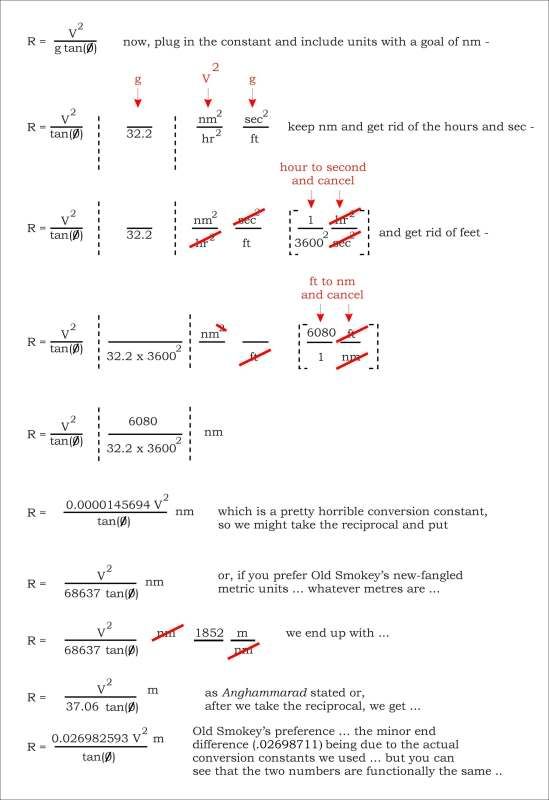
For those of us who have an engineering or similar background, unit conversion is routine bread and butter stuff. For those who are not comfortable with such antics, you might like to see how it is done -
The sequence requires that you keep rigorous track of the variables, constants and units .. which I have separated below to make it a bit easier to follow.
Explanation -
Using speed, V, in kts, g in ft/sec^2 and I want the answer to be radius in nm. You might just as easily have started with some other units - makes no difference to the technique.
To change units, we use the "trick" of multiplying by unity ("1") which doesn't change the value of an expression. We can extend this by noting that dividing something by itself is "1" eg 4/4 = 1. The secret, then, lies in further extending this to account for different units which represent the same quantity. So, for instance, we can say that 1nm/1nm = 1 which is the same as saying that 1nm/6080ft = 1. (or you might chose to use 6076.131 as the conversion - depends on what reference you look up). This then allows us to cancel out unwanted units and we just carry the resulting numbers into the main calculation. This last bit is very important and the source of much error when folk start learning about unit conversions.
At the second line we need to get rid of the hour, second, and feet units. To make it easier to follow we can do it in two stages.
To get rid of the hours and seconds, we note that
1 hour = 60 x 60 seconds = 3600 seconds
as we have to get rid of hours^2 and seconds^2 (whatever those units might represent physically is not a concern) we can square the conversion units to come up with
1 hour^2 = 3600^2 seconds^2 which gives the unity expression
1/3600^2 with units hr^2/sec^2. Whether you put the hours or seconds on the top line is determined by the original equation. In this case we want to get rid of hr^2 on the bottom and sec^2 on the top so it makes sense to insert hr^2/sec^2 as in the graphic.
To get rid of feet, we note that
1 nm = 6080 feet (or some similar conversion value) so the unity expression is
1 = 6080/1 with units ft/nm as we need to cancel out ft on the bottom in the original expression
Notice that I now end up with nm as the only unit on the RHS of the equation and this is what I needed. Note also that I have taken the conversion units (3600^2 and 6080) into the constants expression so that I don't lose track of them.
If we do the arithmetic to simplify the numbers we get 0.0000145694 as the conversion constant. As that is a dreadful number to work with, I prefer to replace it by the reciprocal on the bottom line. All this means is I note that
1/2 = 0.5/1, so
0.0000145694/1 = 1/68637
To convert to metres, we note that
1 = 1852/1 with units m/nm so that we can cancel out the nm and to get to Old Smokey's version we do the reciprocal trick.
Note that the small difference in constants is a consequence of which values go into the intermediate steps. It may be important to the academic purist but, functionally, the end result is sufficiently similar not to worry too much about it .. all depends on the reference table from which you pick your conversion constants.