


Maximum RVRs?


Joined: Jan 2007
Posts: 30
Likes: 0
From: EU
I would say yes; the length of a RWY has little (or nothing) to do with the RVR required to see the RWY (or APP lights/touchdown zone). If you go to a 1200m RWY with a high minimum or NPA you might need 2000m RVR to actually see the RWY at your mimimums. Don't think RVR values of >1500m are ever given but I know of plenty RWY's shorter than that...
Joined: Mar 2009
Posts: 273
Likes: 0
From: Kerikeri, New Zealand or Noosa Queensland. Depending on the time of year!
The maximum RVR reading is 2,000 metres or 6,500 feet, above which it is not considered significant and will then be given in the Metar as visibility.


Joined: Apr 2004
Aviation Qualifications: LAME
Posts: 2,281
Likes: 189
From: Dorset UK
Most airport RVRs are given as actual, ie. 650/400/300 until the RVR improves to more than 1500m when it is given as >1500. A few airports will give RVRs up to 2000m.
Self explanitory I think.
Hope this helps.
Self explanitory I think.
Hope this helps.
Thread Starter
Joined: Jun 2003
Posts: 206
Likes: 0
From: _
Thanks, I realise the required RVR is independent of runway length but wasn't sure if physical separation between transmissometers had any bearing on what RVR values they can measure, evidently not then.
Joined: Jul 2008
Posts: 157
Likes: 0
From: Gone to my "Happy Place".
It would appear from the following, that the maximum range would be defined per the specific installation...
..............
Runway Visual Range (RVR) is a term used in aviation meteorology to define the distance over which a pilot of an aircraft on the centreline of the runway can see the runway surface markings delineating the runway or identifying its centre line. RVR is normally expressed in feet or metres.
RVR is used as one of the main criteria for minima on instrument approaches, as in most cases a pilot must obtain visual reference of the runway to land an aircraft. The maximum RVR reading is 2,000 metres or 6,500 feet, above which it is not significant and thus does not need to be reported. RVRs are provided in METARs and are transmitted by air traffic controllers to aircraft making approaches to allow pilots to assess whether it is prudent and legal to make an approach.
Originally RVR was measured by a person, either by viewing the runway lights from the top of a vehicle parked on the runway threshold, or by viewing special angled runway lights from a tower at one side of the runway. The number of lights visible could then be converted to a distance to give the RVR. This is known as the human observer method and can still be used as a fall-back.
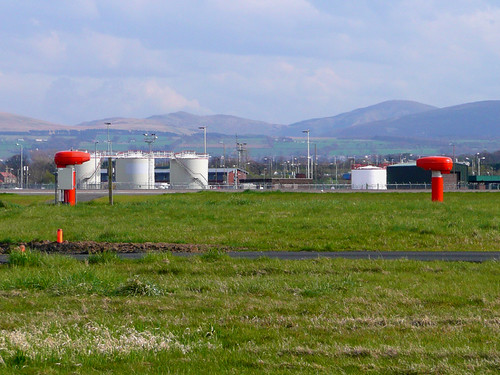
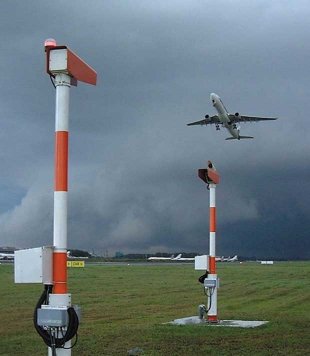
Today most airports use Instrumented Runway Visual Range or IRVR, which is measured by devices called transmissometers which are installed at one side of a runway relatively close to its edge. Normally three are provided, one at each end of the runway and one at the mid-point.
A transmissometer is an instrument for measuring the extinction coefficient of the atmosphere, and for the determination of visual range. It operates by sending a narrow, collimated beam of energy (usually a laser) through the propagation medium. A narrow field of view receiver at the designated measurement distance determines how much energy is arriving at the detector, and determines the path transmission and/or extinction coefficient. Atmospheric extenction is wavelength dependent phenomenon, but the most common wavelength in use for transmissometers is 550 nm, which is right in the middle of the visible waveband, and allows a good approximation of visual range.
Transmissometers are sometimes referred to as telephotometers, transmittance meters, or hazemeters.
..............
Runway Visual Range (RVR) is a term used in aviation meteorology to define the distance over which a pilot of an aircraft on the centreline of the runway can see the runway surface markings delineating the runway or identifying its centre line. RVR is normally expressed in feet or metres.
RVR is used as one of the main criteria for minima on instrument approaches, as in most cases a pilot must obtain visual reference of the runway to land an aircraft. The maximum RVR reading is 2,000 metres or 6,500 feet, above which it is not significant and thus does not need to be reported. RVRs are provided in METARs and are transmitted by air traffic controllers to aircraft making approaches to allow pilots to assess whether it is prudent and legal to make an approach.
Originally RVR was measured by a person, either by viewing the runway lights from the top of a vehicle parked on the runway threshold, or by viewing special angled runway lights from a tower at one side of the runway. The number of lights visible could then be converted to a distance to give the RVR. This is known as the human observer method and can still be used as a fall-back.
Today most airports use Instrumented Runway Visual Range or IRVR, which is measured by devices called transmissometers which are installed at one side of a runway relatively close to its edge. Normally three are provided, one at each end of the runway and one at the mid-point.
A transmissometer is an instrument for measuring the extinction coefficient of the atmosphere, and for the determination of visual range. It operates by sending a narrow, collimated beam of energy (usually a laser) through the propagation medium. A narrow field of view receiver at the designated measurement distance determines how much energy is arriving at the detector, and determines the path transmission and/or extinction coefficient. Atmospheric extenction is wavelength dependent phenomenon, but the most common wavelength in use for transmissometers is 550 nm, which is right in the middle of the visible waveband, and allows a good approximation of visual range.
Transmissometers are sometimes referred to as telephotometers, transmittance meters, or hazemeters.


