


A320 slats/flaps jammed


Joined: Jul 2007
Posts: 350
Likes: 0
From: ***
I don't know, I am guessing wildly:
Maybe because managed would keep the speed command for the autothrust at the respective greendot, S, F on your speed tape, but actually you are flying a speed below that (Vref + xx, acc. QRH)...
Nic
Maybe because managed would keep the speed command for the autothrust at the respective greendot, S, F on your speed tape, but actually you are flying a speed below that (Vref + xx, acc. QRH)...
Nic
Joined: Jun 2005
Posts: 174
Likes: 0
From: Citizen of the World
Look up your ATHR logic. In Managed speed the ATHR will give a thrust setting for the flap lever position. With Slats/Flaps locked will you get the normal config when you move the lever? Better to be in Selected speed as you now control what speed the ATHR will command - less likelihood of the ATHR giving an inappropriate speed for your actual slats/flaps configuration. The Go Around can be interesting in such situations.
Thread Starter
Joined: Dec 2006
Posts: 86
Likes: 0
From: madrid
sorry but the question is : managed speed after all flaps/slats extended. the Vapp selected we use is the one we calculated and entered in MCDU. if we go managed, same target speed but in managed + possibly the GS mini function (why not here)
for the GO around, it is quite clear. the selected speed reverts to managed and fly the vapp calculated by you and inserted in the MCDU
still need a suggestion then !
for the GO around, it is quite clear. the selected speed reverts to managed and fly the vapp calculated by you and inserted in the MCDU
still need a suggestion then !
Joined: Feb 2010
Posts: 38
Likes: 0
From: munich
'flaps/slats jammed' GA procedure
can anybody help with avioneta's comment?
I too would like to know:
1. managed speed after all flaps/slats extended. the Vapp selected we use is the one we calculated and entered in MCDU. if we go managed, same target speed but in managed + possibly the GS mini function.
Do we remain in SEL, or do we go Managed?
2. Do we do Go around with speed SEL?
G.Around with the same speed as Vapp?
What is exact procedure for Go Around in this case if somebody could help please.??
3. As I understand When flaps/slats are deployed the red barber pole = VFE/VMO. I don't understand what is the difference between VFE and Max Speed (for flaps/slats jammed). Which one does the red barber pole indicate?
4. VFE is shown on PFD according to lever position? Overspeed is according to actual flap/slat position? Where is Overspeed shown on PFD? What is difference between VFE and Overspeed in this case?
Bit of confusion with differences between VFE, Max Speed and Overspeed
Many thanks for your help guys!
C4
I too would like to know:
1. managed speed after all flaps/slats extended. the Vapp selected we use is the one we calculated and entered in MCDU. if we go managed, same target speed but in managed + possibly the GS mini function.
Do we remain in SEL, or do we go Managed?
2. Do we do Go around with speed SEL?
G.Around with the same speed as Vapp?
What is exact procedure for Go Around in this case if somebody could help please.??
3. As I understand When flaps/slats are deployed the red barber pole = VFE/VMO. I don't understand what is the difference between VFE and Max Speed (for flaps/slats jammed). Which one does the red barber pole indicate?
4. VFE is shown on PFD according to lever position? Overspeed is according to actual flap/slat position? Where is Overspeed shown on PFD? What is difference between VFE and Overspeed in this case?
Bit of confusion with differences between VFE, Max Speed and Overspeed
Many thanks for your help guys!
C4
Last edited by channel4; 30th June 2011 at 17:43.


Moderator

Joined: Apr 2004
Posts: 794
Likes: 0
From: Rome
1. managed speed after all flaps/slats extended. the Vapp selected we use is the one we calculated and entered in MCDU. if we go managed, same target speed but in managed + possibly the GS mini function.
Do we remain in SEL, or do we go Managed?
Do we remain in SEL, or do we go Managed?
2. Do we do Go around with speed SEL?
G.Around with the same speed as Vapp?
What is exact procedure for Go Around in this case if somebody could help please.??
G.Around with the same speed as Vapp?
What is exact procedure for Go Around in this case if somebody could help please.??
3. As I understand When flaps/slats are deployed the red barber pole = VFE/VMO. I don't understand what is the difference between VFE and Max Speed (for flaps/slats jammed). Which one does the red barber pole indicate?
4. VFE is shown on PFD according to lever position? Overspeed is according to actual flap/slat position? Where is Overspeed shown on PFD? What is difference between VFE and Overspeed in this case?
Cheers.
Last edited by I-2021; 1st July 2011 at 14:01. Reason: typo
Joined: Mar 2005
Posts: 1,338
Likes: 1
From: Uh... Where was I?
If you study the procedure and you have a flaps and/or slats jam one day in approach you may carry out all the procedures and land without having to hold for thouble shooting. If you don't, you have to discontinue approach and hold.
- When you have the ECAM caution, pull speed (so your speed doesn't get too low for the actual flap/slat config). But don't rush in doing this. Keep in mind that VLS remains meaningful all the way.
- Then look at the ECAM and if it is a locked or the recycle doesn't work, ask the PNF to clear the page. (you have a MAX SPEED line but you want to slow down, not to accelerate)
- Then select VFE next -5 kt. If it is not displayed you know it by heart, or you can find it in the placard.
- Then review STS page: you have to select GPWS FLAP mode OFF or FLAP 3, accordingly, and note the delta VREF.
- When speed is VFE nex- 5 kt, select next configuration
- repeat until you have CONF 3, then select VAPP (or manage, if you like, but you need to insert VAPP in the PERF page. I prefer not having any GS mini interfering, specially in short runways. Selected speed is recommended in the FCOM, anyway.
- then calculate VMAX (different than the PFD barber pole in some cases). You can note it or set it (-10 kt) as a SPD CSTR in the GA.
- plan the Go around (diversion or circuit). For circuit, always keep the landing configuration. For diversion, clean up, except for flaps>1 jam, where you also keep config.
- finally, calculate landing distance (normally not limiting in the "typical" runways)
Go around if you don't have acomplished all these before 1000 ft, but don't go around without calculating VMAX.
you can always trust VLS and the aural overspeed warning. VMAX (VFE) can be wrong (slower than real)
Disconnect AP above 500 ft.
in case of go around, do it smoothly and don't change configuration. With no slats or no flaps you can have stall warning if you are too brisk.
- When you have the ECAM caution, pull speed (so your speed doesn't get too low for the actual flap/slat config). But don't rush in doing this. Keep in mind that VLS remains meaningful all the way.
- Then look at the ECAM and if it is a locked or the recycle doesn't work, ask the PNF to clear the page. (you have a MAX SPEED line but you want to slow down, not to accelerate)
- Then select VFE next -5 kt. If it is not displayed you know it by heart, or you can find it in the placard.
- Then review STS page: you have to select GPWS FLAP mode OFF or FLAP 3, accordingly, and note the delta VREF.
- When speed is VFE nex- 5 kt, select next configuration
- repeat until you have CONF 3, then select VAPP (or manage, if you like, but you need to insert VAPP in the PERF page. I prefer not having any GS mini interfering, specially in short runways. Selected speed is recommended in the FCOM, anyway.
- then calculate VMAX (different than the PFD barber pole in some cases). You can note it or set it (-10 kt) as a SPD CSTR in the GA.
- plan the Go around (diversion or circuit). For circuit, always keep the landing configuration. For diversion, clean up, except for flaps>1 jam, where you also keep config.
- finally, calculate landing distance (normally not limiting in the "typical" runways)
Go around if you don't have acomplished all these before 1000 ft, but don't go around without calculating VMAX.
you can always trust VLS and the aural overspeed warning. VMAX (VFE) can be wrong (slower than real)
Disconnect AP above 500 ft.
in case of go around, do it smoothly and don't change configuration. With no slats or no flaps you can have stall warning if you are too brisk.
Moderator
Joined: Apr 2004
Posts: 794
Likes: 0
From: Rome
Microburst2002,
Real life is not a sim scenario. That kind of failure is one where people tend to make a lot of mess in the sim, in real life it can only be worst. Therefore if you are not burning and you have some fuel left I would strongly recommend that you take all the time that you may need to complete the procedures before actually starting the approach. Being head down reading the checklist and all the notes in a way that the PF understands what he has to do, while monitoring the approach and talking to the ATC, and finally discovering that you would be more comfortable with that runway that is just 20 nm away, all of that is not really nice to be seen from an observer point of view.
Just my 2 cents.
If you study the procedure and you have a flaps and/or slats jam one day in approach you may carry out all the procedures and land without having to hold for thouble shooting. If you don't, you have to discontinue approach and hold.
Just my 2 cents.
Joined: Mar 2005
Posts: 1,338
Likes: 1
From: Uh... Where was I?
You are right
I apply the 1000 rule. If by then you haven't done everything (including GA considerations and landing distance) then go around.
I have practiced it a few times in the sim and I had it in real life long time ago.
Knowing that you can rely on VLS makes it very simple. Just fly VFE next -5 and move the lever until 3, then VAPP, then GPWS, then calculate VMAX-10 for GA accel.
If the failure occurs early (at conf 1 selection) there is plenty of time. If it occurs later, there is less time, but also the problem is milder.
but i agree with you. If there is plenty of fuel, I don't have the drill so '"fresh", it is IMC, etc... there is no reason not to take some time and make sure everything is OK and double checked before shooting the approach.
I apply the 1000 rule. If by then you haven't done everything (including GA considerations and landing distance) then go around.
I have practiced it a few times in the sim and I had it in real life long time ago.
Knowing that you can rely on VLS makes it very simple. Just fly VFE next -5 and move the lever until 3, then VAPP, then GPWS, then calculate VMAX-10 for GA accel.
If the failure occurs early (at conf 1 selection) there is plenty of time. If it occurs later, there is less time, but also the problem is milder.
but i agree with you. If there is plenty of fuel, I don't have the drill so '"fresh", it is IMC, etc... there is no reason not to take some time and make sure everything is OK and double checked before shooting the approach.
Joined: Jun 2011
Posts: 35
Likes: 0
From: On Contract at 14° 35' N, 121º 00 E'
1. GS speed Mini is not an issue due to the relatively high approach speeds generated by configuration abnormals.
2. Selected Speed will not automatically revert to managed speed on Go Around.
3. Go Around Speeds are published in the QRH for the various abnormal configurations and should be prebriefed for a possible Go Around and flown in Selected mode (dialed up during Go Around).

2. Selected Speed will not automatically revert to managed speed on Go Around.
3. Go Around Speeds are published in the QRH for the various abnormal configurations and should be prebriefed for a possible Go Around and flown in Selected mode (dialed up during Go Around).
Joined: Mar 2005
Posts: 1,338
Likes: 1
From: Uh... Where was I?
If GO AROUND mode is activated upon advancing the thrust levers to TOGA (which occurs in most models even in case of a full AP/FD OFF, save those without the retrofit) then speed becomes managed.
If I have problems with an elevator, or ailerons, I would gladly use GS mini and increased speeds. In a no flap no slat scenario, however, I would stick to a selected ECAM VAPP (conf full perf page VLS plus ECAM delta vref). Airbus recommends selected speed (see QRH procedure). Of course, if I see VLS above my target speed (heavier thand loadsheet) I will respect VLS anyway.
Actually the whole thing is very easy. When the lock occurs, set progressively VFE next -5 kt and set next config, then select VLS, then calculate VMAX-10 for the GA, then verify landing distance is not a problem. done.
In a flaps jammed between 2 and 3 I could insert VAPP and manage speed during approach to get benefit from GS mini. Landing distance is not an issue.
If I have problems with an elevator, or ailerons, I would gladly use GS mini and increased speeds. In a no flap no slat scenario, however, I would stick to a selected ECAM VAPP (conf full perf page VLS plus ECAM delta vref). Airbus recommends selected speed (see QRH procedure). Of course, if I see VLS above my target speed (heavier thand loadsheet) I will respect VLS anyway.
Actually the whole thing is very easy. When the lock occurs, set progressively VFE next -5 kt and set next config, then select VLS, then calculate VMAX-10 for the GA, then verify landing distance is not a problem. done.
In a flaps jammed between 2 and 3 I could insert VAPP and manage speed during approach to get benefit from GS mini. Landing distance is not an issue.
Moderator
Joined: Apr 2004
Posts: 794
Likes: 0
From: Rome
I say again .. where in FCOM does it say this?
Another good reason for using Selected speed is .. on a go-around the a/c will not accelerate automatically at Aa but will remain at the pilot-selected speed.
Cheers.
Joined: Jun 1997
Posts: 846
Likes: 0
From: 5530N
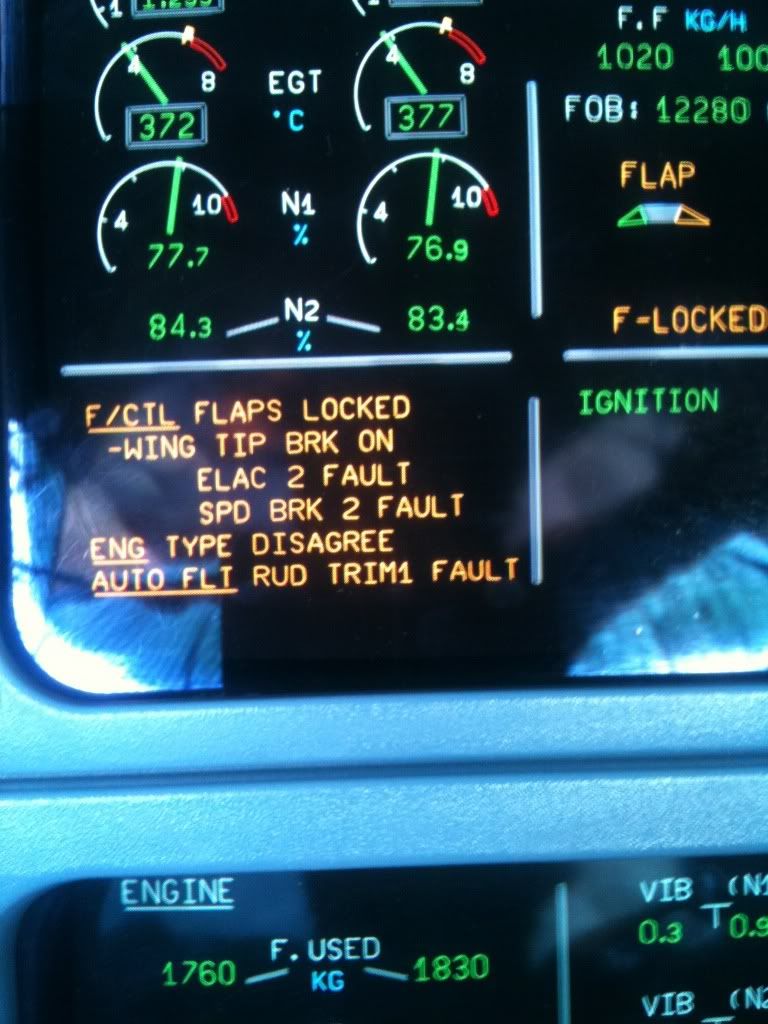
"ENG TYPE DISAGREE"? I'd really like to ask how an A/C with that kind of status msg wound up in flt? Or was it a sim?
Joined: Mar 2005
Posts: 1,338
Likes: 1
From: Uh... Where was I?
The more i think about it, the simpler it gets.
consider a total flaps and slats fault (flap lever control sensor unit fault, for instance).
You can reduce speed right away to VLS and set the lever to conf 2 and 3 at VFE next -5 kt. This will be symbolic, since nothing happens. In the mean time, PNF can calculate landing distance. VMAX is unlimited, because you are clean.
so in the end it is very straight forward: fly VLS and land the airplane.
In any other case you have better conditions, and you can also fly any speed above VLS. sometimes flap lever movement will be symbolic, sometimes it will not, but in the end it all comes to "fly VLS and land".
consider a total flaps and slats fault (flap lever control sensor unit fault, for instance).
You can reduce speed right away to VLS and set the lever to conf 2 and 3 at VFE next -5 kt. This will be symbolic, since nothing happens. In the mean time, PNF can calculate landing distance. VMAX is unlimited, because you are clean.
so in the end it is very straight forward: fly VLS and land the airplane.
In any other case you have better conditions, and you can also fly any speed above VLS. sometimes flap lever movement will be symbolic, sometimes it will not, but in the end it all comes to "fly VLS and land".