


V Tail

Guest
Posts: n/a
Subsonic
I think there is uncoupling and true structural aerodynamic independence. At low Mach, the speed at which air becomes compressible, as I recall is ~ 269 knots. Below that value, air is considered inviscid, and is free to interfere with solids located close by (twin tails). I was taught that interference (airframe) is similar to Ground effect, only at altitude. Shock waves are less mysterious (to me) and since they are frequently visible succumb more easily to explanation.

Joined: Dec 2008
Posts: 45
Likes: 0
From: Not even close
Very interesting thread this is.
But back to the Bonanza - wasn't the V-tail merely a sales promotion thing to make the aircraft stand out (kinda like for the Arrow that used a T-tail for a couple of years)?
Another reason for using a V or a double fin design rather than a conventional type would be size (height).
But back to the Bonanza - wasn't the V-tail merely a sales promotion thing to make the aircraft stand out (kinda like for the Arrow that used a T-tail for a couple of years)?
Another reason for using a V or a double fin design rather than a conventional type would be size (height).


Joined: Nov 2000
Aviation Qualifications: ATPL
Posts: 1,518
Likes: 229
From: UK
The Fouga Magister was derived from a glider post WW2 (part of the Marshal plan I believe, to develop a jet trainer.) The glider had a conventional tail, however, Fouga decided to mount a single jet engine on top of the fuselage; the tail was in the efflux! The simple solution was to move the tail surfaces into a V shape - et voila. Having done that subsequent iterations found twin engines buried in the wing roots, but the tail remained.

Joined: Feb 2005
Posts: 4,581
Likes: 0
From: flyover country USA
Bonanza rudder authority
With a cross-wind from the left, it ran out of " rudder" during take-off, so much that one could depart off the runway!

Joined: Aug 2006
Posts: 169
Likes: 19
From: Nairn, Highland
There was a successful glider, the Schemp Hirth SHK in the 1970s with a V-tail (a few are still around today). One of the greatest problems with the SHK was explaining to others how the tail worked.
Stick back - both tails up. Rudder left - both tails left. Rudder left, stick back simultaneously - the surfaces move, well....in a most confusing manner. The explanation was best ended at this point: "The glider will probably spin"
Stick back - both tails up. Rudder left - both tails left. Rudder left, stick back simultaneously - the surfaces move, well....in a most confusing manner. The explanation was best ended at this point: "The glider will probably spin"

Joined: Jan 2006
Posts: 2,480
Likes: 2
From: In a far better place
A lot of high-powered taildraggers have this issue - and the remedy is opening the throttle a bit slower! Of course, if you've never flown a taildragger...
 we were exempt from high x-winds in Alaska and Canada. But wait!!!
 we floaters were totally exempt from cross winds. Now as for the Bonanza... the beautifuel tall natural blond babe in the right seat blew the x-wind off the planet, while her boy friend blew wind out of his xxxx!
 Hey... maybe that's what accounted for the great shorth field performance in those gusty x-wind conditions.
Joined: Jan 2005
Posts: 2,315
Likes: 10
From: France
Couldn't resist posting this one...
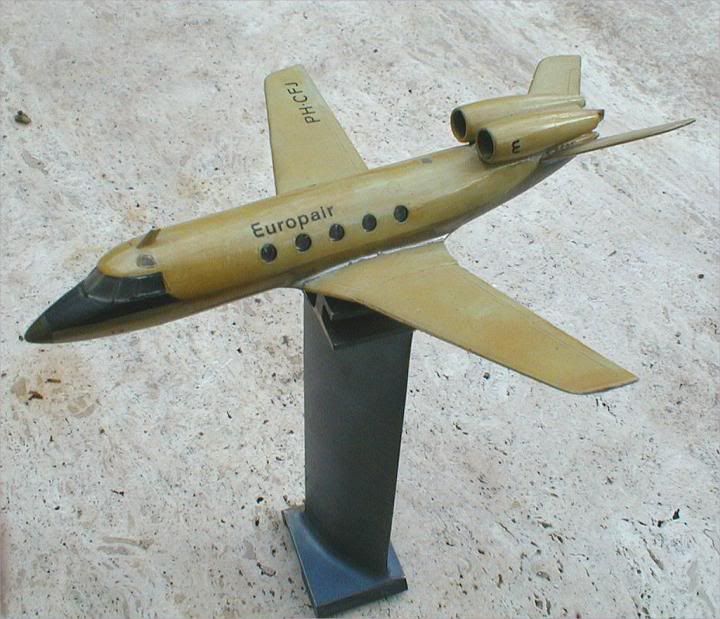
1968....
Design exercise at university, basic spec was for a business jet.
So I went all-out for a general-purpose alternative to the LearJet and Mystère 20 of the day.
Less wing sweep, rough field u/c, engines out of the way of FOD (inspired by the A-10), and a V-tail as a consequence.
Nicked the eyelet windows from the SabreLiner, and big airbrakes from the F-104 (but inspired by the beaver tail of the F-28, more instant power during a GA).
Had some trouble defending my choices.... I graduated OK, but somehow my design never flew....
Pity, I still like the look.
CJ
1968....
Design exercise at university, basic spec was for a business jet.
So I went all-out for a general-purpose alternative to the LearJet and Mystère 20 of the day.
Less wing sweep, rough field u/c, engines out of the way of FOD (inspired by the A-10), and a V-tail as a consequence.
Nicked the eyelet windows from the SabreLiner, and big airbrakes from the F-104 (but inspired by the beaver tail of the F-28, more instant power during a GA).
Had some trouble defending my choices.... I graduated OK, but somehow my design never flew....
Pity, I still like the look.
CJ
Fleet Manager


Joined: Aug 2006
Aviation Qualifications: CPL
Posts: 7,089
Likes: 2,952
From: Ontario, Canada
Hmmm,
I don't want to sound unkind, but, an engine sheds a turbine wheel, and takes out both the other engine, and the flight controls for the tail as well...
Yaw the plane, and the separated air off the engine spoils the airflow over half the tail...
I'm happy you graduated, I hope you're still innovating, the world needs thinkers!
Cheers, Pilot DAR
I don't want to sound unkind, but, an engine sheds a turbine wheel, and takes out both the other engine, and the flight controls for the tail as well...
Yaw the plane, and the separated air off the engine spoils the airflow over half the tail...
I'm happy you graduated, I hope you're still innovating, the world needs thinkers!
Cheers, Pilot DAR
Joined: Feb 2005
Posts: 4,581
Likes: 0
From: flyover country USA
Pilot DAR speaks the truth:
However, in this respect the plane could still be certified - but only because turbine wheels are certified to be "prime reliable" and thus should never fail.
Except maybe once in a while...
And then of course there's N60NA. Not a turbine wheel, but #3 eng. fan blades flew everywhere, including the #1 gearbox and the #2 inlet.
don't want to sound unkind, but, an engine sheds a turbine wheel, and takes out both the other engine, and the flight controls for the tail as well...
Except maybe once in a while...
And then of course there's N60NA. Not a turbine wheel, but #3 eng. fan blades flew everywhere, including the #1 gearbox and the #2 inlet.
Last edited by barit1; 14th March 2009 at 03:38.
Joined: Jan 2005
Posts: 2,315
Likes: 10
From: France
Pilot DAR is right of course on both counts.
However, un uncontained turbine failure would affect any other aircraft with rear-mounted engines in a similar manner, and has done so in the past.
I suspect the Warthog has some added armour in the nacelles to minimise the risk.
As to partial blanking of the tail in yaw, I agree!
May well have been one of the criticisms of the design during the presentation, but I no longer remember... it's over forty years ago after all.
On the A-10 is was solved differently.
CJ
However, un uncontained turbine failure would affect any other aircraft with rear-mounted engines in a similar manner, and has done so in the past.
I suspect the Warthog has some added armour in the nacelles to minimise the risk.
As to partial blanking of the tail in yaw, I agree!
May well have been one of the criticisms of the design during the presentation, but I no longer remember... it's over forty years ago after all.
On the A-10 is was solved differently.
CJ
