


727 vomit comet - how do you fly it?

Thread Starter

Joined: Dec 2004
Posts: 206
Likes: 2
From: Brisbane
727 vomit comet - how do you fly it?
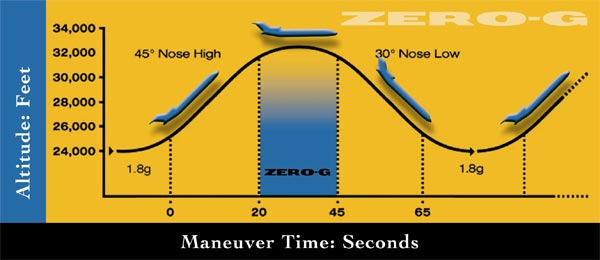
Stephen Hawking's recent jolly got me thinking - yes, we all know that it flies a parabolic hump but how does one do that? It is probably easy enough to say "pressure on bum - stick forward; pressure off bum, stick back" but I assume this is not accurate enough to prevent the floating pax being bumped around against the cabin floor & roof. Could one perhaps tape a pingpong ball on a string to the overhead console & work the stick to keep the ball floating?(!!!) Also what about the pull out? - it must get to some rather severe attitudes and gees at the end of the ride - I guess they had poor old Hawking well protected during that phase of the ride?

Joined: Jan 2005
Posts: 319
Likes: 0
From: north
http://www.astronomicaltours.net/ZeroG/airplane.htm
The major modification enabling the Boeing 727 to conduct Weightless Flight involves an upgrade to the aircraft’s hydraulic system. The modification allows for continuous hydraulic pressure during the performance of parabolas. The modification, along with the addition of accelerometers in the cockpit, were tested and approved by the FAA under a Supplemental Type Certificate (STC).
M
The major modification enabling the Boeing 727 to conduct Weightless Flight involves an upgrade to the aircraft’s hydraulic system. The modification allows for continuous hydraulic pressure during the performance of parabolas. The modification, along with the addition of accelerometers in the cockpit, were tested and approved by the FAA under a Supplemental Type Certificate (STC).
M
Joined: Feb 2005
Posts: 4,581
Likes: 0
From: flyover country USA
My questions are more along the maintenance line:
Since the structural load cycles between 0.0 and 1.8G several times per flight, is each parabola counted as a flight cycle?
Does engine oil pressure drop due to pump cavitation, and are the bearings tolerant of brief loss of cooling flow of oil; or is there a positive feed mod?

Since the structural load cycles between 0.0 and 1.8G several times per flight, is each parabola counted as a flight cycle?
Does engine oil pressure drop due to pump cavitation, and are the bearings tolerant of brief loss of cooling flow of oil; or is there a positive feed mod?

Joined: Dec 2006
Posts: 185
Likes: 0
From: N33 24.7 E36 30.8 E 36 30.8
HI
i've been flying the 727 for almost three years now and every minute of it was pure joy.......well almost all.
The old girl doing parabolas with astronauts aboard..amazing what a good platform will do
i've been flying the 727 for almost three years now and every minute of it was pure joy.......well almost all.
The old girl doing parabolas with astronauts aboard..amazing what a good platform will do
Joined: Jun 2001
Posts: 4,835
Likes: 85
From: Boldly going where no split infinitive has gone before..
I used to enjoy doing Zero G arcs in Aerobatic aircraft.
I always found the hard part wasn't maintaining zero G vertically, but laterally. Zeor G=Zero induced drag, so the aircraft has a tendency to accelerate.
I'd be interested to know what thrust setting they need to maintain a zero acceleration during the arcs in the 727.
I always found the hard part wasn't maintaining zero G vertically, but laterally. Zeor G=Zero induced drag, so the aircraft has a tendency to accelerate.
I'd be interested to know what thrust setting they need to maintain a zero acceleration during the arcs in the 727.
Joined: Sep 2001
Aviation Qualifications: CPL
Posts: 2,787
Likes: 208
From: Toronto
I suspect the engines would be at constant power to save fiddling, but you will get linear acceleration +- all through the maneuver.
The downline builds airspeed while the pullup and upline dissipate it.
Likely not that much linear accel during the 0G segment.
Now for a bit of entertainment -- what is the 0G stall speed?
The downline builds airspeed while the pullup and upline dissipate it.
Likely not that much linear accel during the 0G segment.
Now for a bit of entertainment -- what is the 0G stall speed?
Per Ardua ad Astraeus
Joined: Mar 2000
Posts: 18,575
Likes: 4
From: UK
Correct - an aircraft wing cannot stall in a 0g manouevre like that. A well-known 'get-out-of-jail' ticket for those who have overcooked it a bit in combat. . It gives you time for the thrust to increase your speed a bit.
However, in the 1.8 g pull-out...............................
. It gives you time for the thrust to increase your speed a bit.However, in the 1.8 g pull-out...............................
Joined: Feb 2005
Posts: 4,581
Likes: 0
From: flyover country USA
I'd be interested to know what thrust setting they need to maintain a zero acceleration during the arcs in the 727.
Given that as altitude increases, speed bleeds off, then thrust must decrease too as does drag. Similarly, after rounding over the top, as airspeed increases, so must thrust.
But lower air density over the top means that thrust is dropping without any throttle movement. Whether the density falloff coincides with the speed/drag/thrust requirement I'm not sure, but as a first approximation I'd say little throttle motion is needed.
Further enlightenment welcome!
