
Go Back  PPRuNe Forums > Aircrew Forums > Rotorheads
Reload this Page >

Heli Down In Huntington Beach 11th October 2025

Wikiposts
Search

Notices
Rotorheads A haven for helicopter professionals to discuss the things that affect them

Heli Down In Huntington Beach 11th October 2025

Thread Tools
 
Search this Thread
 
Old 13th October 2025 | 06:35
  #101 (permalink)  
Guest
Community Builder
Community Influencer
15 Anniversary
 
Joined: Oct 2006
Aviation Qualifications: Spotter
Posts: 471
Likes: 356
From: Scotland
Originally Posted by skadi
Well done! 👍
He was reacting really quick with no hesitation. Despite the still running engines. Not like the two young guys who were just recording with their mobiles

skadi
There is another video - I am going to guess the lads sister is at the top of the steps and goes to get help from the man (dad)

https://www.yahoo.com/news/articles/...190754517.html

Deep Throat is offline  
Reply
Old 13th October 2025 | 11:08
  #102 (permalink)  
Fleet Manager
Community Builder
50 Countries Visited
15 Anniversary
 
Joined: Aug 2006
Aviation Qualifications: CPL
Posts: 7,081
Likes: 2,938
From: Ontario, Canada
When coming in to land you can see the tail rotor below the gearbox has significant pitch. The blade is advancing towards the nose and pushing the tail right, nose left. This is being commanded by the pilot.
As they lose airspeed and the vertical fin stops working, the pilot realises they have insufficient ant-torque and tries to abort.
This idea fits which what I opine... During a fast flyby, the tail rotor is not working hard (if at all), so a not connected pitch link would not be noticed. Slowing for the approach is the point at which the loss of tail rotor effect could be noticed. The tail rotor blades appear to have very different pitches in a couple of the video frames. The blade with the large pitch angle would be the connected blade, with the pilot applying large pedal displacement, which the blade which appears to have no pitch could be trailing in flat pitch. The tail rotor gearbox and hub probably would not tolerate this asymmetrical loading well, so a failing tailrotor blade seems plausible.

I've only flown the 222 once, and it was a very long time ago, so my recollection is poor. But I did do extensive testing many years ago on a 206, and 206L for the airspeed at which the fin no longer has a directional stabilizing effect. For both types it was around 21-22 MIAS. Prior to that airspeed, a very slight yaw, which might even go un noticed. At that speed, as though the fin just suddenly stalled, the swing began pretty quickly.
Pilot DAR is offline  
Reply
Old 13th October 2025 | 12:28
  #103 (permalink)  
15 Anniversary
 
Joined: Oct 2006
Aviation Qualifications: A&P
Posts: 1,346
Likes: 270
From: USA
Originally Posted by Pilot DAR
Which is what appears to me also. If one blade did that, the sudden hardover of that blade has the potential to buckle the blade, which would account for the departed piece caught in the photo.
Except what would drive the one blade full travel after the pitch link failure? I would think it would neutralize itself in the air stream. What I find interesting is the pic of the TR GB still intact after both blades failed at a similar length. Only after did the gearbox fail at what appears to be the output quill mount flange.
wrench1 is offline  
Reply
Old 13th October 2025 | 12:44
  #104 (permalink)  
50 Countries Visited
25 Anniversary
 
Joined: Oct 1999
Aviation Qualifications: ATPL
Posts: 7,371
Likes: 926
From: Den Haag
Originally Posted by eswillie
I've seen quite a few posts in the thread stating that there was no apparent tail strike previous to the start of rotation. I'm betting I can't find it again, but I did watch one video taken from nearly directly below and slightly to the right of the Triple Deuce as it approached the landing area, In that short clip, the rear of the tail boom and the tail rotor can be seen to contact some of the top outer branches or fronds of the palm, after which the rotation to the right begins nearly immediately. As someone who sat half a dozen feet in front of spinning main and tail rotors for a decade of my life, I'm always conscious of the threat of contact, often when there have been only inches to spare. From any of the other videos I watched, I did not see that contact, but I was thankful for the one person who caught it, and I would hope that it gets into the record during the investigation.
I really have no idea what you are talking about - there are a bunch of videos where it is entirely clear that the TR is nowhere near any part of any tree.
212man is offline  
Reply
Old 13th October 2025 | 12:53
  #105 (permalink)  
50 Countries Visited
25 Anniversary
 
Joined: Oct 1999
Aviation Qualifications: ATPL
Posts: 7,371
Likes: 926
From: Den Haag
Originally Posted by Harrynz
I would argue that if the pitch link failed, the blade would remain in flat pitch. The blades use trailing link control with counter weights to help move the blade off zero pitch.
The good blade would still be under the pilots control but the tail rotor disk would now only provide half or even less less of its anti-torque ability.

I believe can see the pitch link unconnected in few frames in the the final flyby video before they land. When coming in to land you can see the tail rotor below the gearbox has significant pitch. The blade is advancing towards the nose and pushing the tail right, nose left. This is being commanded by the pilot.
As they lose airspeed and the vertical fin stops working, the pilot realises they have insufficient ant-torque and tries to abort.
What ever else might be true, it is clear that the onset of yaw was caused by a change in the TR rotor speed, not a pre-existing lack of TR thrust. The blades are turning one way, then reverse direction (the actual direction is irrelevant as it will/.may be skewed by frames rate) which I would interpret that as a sudden loss of TR drive. This might be due to an external influence from a TR pitch issue causing an large imbalance that results in the TGB becoming disconnected, then detached. Assuming the observations of there being an issue at all with the TR pitch link are correct. Otherwise it may be as simple TR drive failure, for any of the many reasons they occur.
212man is offline  
Reply
Old 13th October 2025 | 13:14
  #106 (permalink)  
Fleet Manager
Community Builder
50 Countries Visited
15 Anniversary
 
Joined: Aug 2006
Aviation Qualifications: CPL
Posts: 7,081
Likes: 2,938
From: Ontario, Canada
Except what would drive the one blade full travel after the pitch link failure? I would think it would neutralize itself in the air stream.
I opine that if a pitch link failed, that blade went streamlined, it was the connected blade which went full travel when the pilot applied lots of pedal at the instant that the yaw began...
Pilot DAR is offline  
Reply
Old 13th October 2025 | 13:37
  #107 (permalink)  
15 Anniversary
 
Joined: Jul 2006
Aviation Qualifications: ATPL
Posts: 1,357
Likes: 125
From: Up yer nose, again.

Explains what happened, but not why.
Peter Fanelli is offline  
Reply
Old 13th October 2025 | 14:12
  #108 (permalink)  
20 Anniversary
 
Joined: Aug 2002
Posts: 898
Likes: 73
From: UK
The video does ‘appear’ to display a loose pitch link, but I have difficulty believing that the tip path plane of each blade would not be wildly different even before there was any increased any anti-torque requested of it, and there would surely have been vibration through the pedals?
GS-Alpha is offline  
Reply
Old 13th October 2025 | 14:35
  #109 (permalink)  
Community Builder
Community Influencer
25 Anniversary
 
Joined: Nov 1999
Aviation Qualifications: ATPL
Posts: 3,139
Likes: 740
From: UK
Who said there wasn't any vibration through the pedals - How would we know ?

I think there probably would have been, and the pilot was probably thinking 'WHAT THE F.........???' when it let go completely.

Scary.
Uplinker is online now  
Reply
Old 13th October 2025 | 14:37
  #110 (permalink)  
50 Countries Visited
25 Anniversary
 
Joined: Oct 1999
Aviation Qualifications: ATPL
Posts: 7,371
Likes: 926
From: Den Haag
Originally Posted by Peter Fanelli
https://www.youtube.com/watch?v=5ft2...yWYaLid1VDPJkg

Explains what happened, but not why.
I’m guessing the white mist/smoke is hydraulic fluid? I’m assuming the TR pitch increase is the pilot’s response to the uncommanded yaw.
212man is offline  
Reply
Old 13th October 2025 | 14:45
  #111 (permalink)  
20 Anniversary
 
Joined: Aug 2002
Posts: 898
Likes: 73
From: UK
I’m saying I think that vibration would have been there considerably before he actually aborted the landing. The videos don’t appear to show the tip plane difference I’d expect, but as has already been mentioned, video can be very misleading.
GS-Alpha is offline  
Reply
Old 13th October 2025 | 14:46
  #112 (permalink)  
Community Builder
Community Influencer
 
Joined: Jun 2016
Aviation Qualifications: CPL
Posts: 1,318
Likes: 386
From: Brantisvogan
Originally Posted by 212man
I’m guessing the white mist/smoke is hydraulic fluid? I’m assuming the TR pitch increase is the pilot’s response to the uncommanded yaw.
There was some white dust that was caused by the blade fragments impacting the main rotor.
Bell_ringer is online now  
Reply
Old 13th October 2025 | 14:55
  #113 (permalink)  
50 Countries Visited
25 Anniversary
 
Joined: Oct 1999
Aviation Qualifications: ATPL
Posts: 7,371
Likes: 926
From: Den Haag
Originally Posted by Bell_ringer
There was some white dust that was caused by the blade fragments impacting the main rotor.
I meant that coming out the back end, which he keeps commenting on as oil or smoke.
212man is offline  
Reply
Old 13th October 2025 | 15:19
  #114 (permalink)  
Community Builder
Community Influencer
 
Joined: Jun 2016
Aviation Qualifications: CPL
Posts: 1,318
Likes: 386
From: Brantisvogan
Originally Posted by 212man
I meant that coming out the back end, which he keeps commenting on as oil or smoke.
It could only be hydraulic fluid or oil released as part of the gearbox failure. No doubt there was some hot components, heating any leaking liquids. It is all post failure so would consider it secondary symptoms.

Has there be any word on the condition and recovery of the victims?

With the shutdown the websites aren't getting any updates, so info is scant.

Last edited by Bell_ringer; 13th October 2025 at 15:34.
Bell_ringer is online now  
Reply
Old 13th October 2025 | 15:21
  #115 (permalink)  
15 Anniversary
 
Joined: Oct 2006
Aviation Qualifications: A&P
Posts: 1,346
Likes: 270
From: USA
Originally Posted by Pilot DAR
I opine that if a pitch link failed, that blade went streamlined, it was the connected blade which went full travel when the pilot applied lots of pedal at the instant that the yaw began...
So you think when the connected blade went full stroke that is what caused the blade to fail? Then what caused the unconnected blade to fail in the same location at outboard edge of the finger doubler? Its hard to tell from the pics but it looks more like that both blades hit the tailboom which caused the failure at the same location. And only after both blades failed did the TR output quill assembly depart instead of at the 1st blade failure. Quite possible there could have initially been a TR output drive failure of some sort that started the blade failures??

And I think once he lost the TR quill the CG shifted and probably limited his cyclic authority compounding his recovery attempt.

And to note, there is no hydraulics in the tailboom so any fluid smoke would be oil from the TR GBox.
wrench1 is offline  
Reply
Old 13th October 2025 | 15:42
  #116 (permalink)  
50 Countries Visited
25 Anniversary
 
Joined: Oct 1999
Aviation Qualifications: ATPL
Posts: 7,371
Likes: 926
From: Den Haag
And to note, there is no hydraulics in the tailboom so any fluid smoke would be oil from the TR GBox.
​​​​​​​Interesting. Where is the servo located?
212man is offline  
Reply
Old 13th October 2025 | 15:57
  #117 (permalink)  
Fleet Manager
Community Builder
50 Countries Visited
15 Anniversary
 
Joined: Aug 2006
Aviation Qualifications: CPL
Posts: 7,081
Likes: 2,938
From: Ontario, Canada
So you think when the connected blade went full stroke that is what caused the blade to fail?
Probably yes, too much aerodynamic load, combined with vibration, which was not symmetrical. That also begins to overload the TR gearbox attachment and mechanisms.

Then what caused the unconnected blade to fail in the same location at outboard edge of the finger doubler? Its hard to tell from the pics but it looks more like that both blades hit the tailboom which caused the failure at the same location.
I understand that the 222 TR is a teeter hub just like the 206's. I have found that sometimes when you have a fatiguing force, the 180 degree opposed component suffers similar loads, just because the first one (blade) is. The end of the finger doubler is the first weak point outboard of the hub.

And only after both blades failed did the TR output quill assembly depart instead of at the 1st blade failure. Quite possible there could have initially been a TR output drive failure of some sort that started the blade failures??
'Could be, once the tail rotor gearbox and drive line components are being subjected to those high vibrations/loads, more is going to let go. Once one tail rotor blade departed, there is no way that anything at the TR gearbox could ever be near balance limits ever again, even the second blade also departing. Shaking itself to death is just a matter of time at that point...
Pilot DAR is offline  
Reply
Old 13th October 2025 | 17:07
  #118 (permalink)  
15 Anniversary
 
Joined: Oct 2006
Aviation Qualifications: A&P
Posts: 1,346
Likes: 270
From: USA
Originally Posted by Pilot DAR
Probably yes, too much aerodynamic load, combined with vibration, which was not symmetrical. That also begins to overload the TR gearbox attachment and mechanisms.
Interesting. But that has not been my experience picking up the pieces after a failure. If one blade fails individually the out of balance will usually fail the t/boom structure and the gearbox and remaining blade depart. In this case both blades failed almost simultaneously which left the GB in place....

I understand that the 222 TR is a teeter hub just like the 206's.
Yes. But that is the only thing similar. The 222 also has a TR swashplate with "Chinese weights" to keep the blades inline. While some have noted a possible PC link loose those items are not very substantial or heavy. However, if the TR control input bellcrank or control rod failed and the item seen in the pics spinning around is part of the sw/plate then I can see a lot of localized damage occurring in the area where both blades failed. It may also account for why only the TR output quill departed leaving the main TR GB still installed.


wrench1 is offline  
Reply
Old 13th October 2025 | 17:10
  #119 (permalink)  
15 Anniversary
 
Joined: Oct 2006
Aviation Qualifications: A&P
Posts: 1,346
Likes: 270
From: USA
Originally Posted by 212man
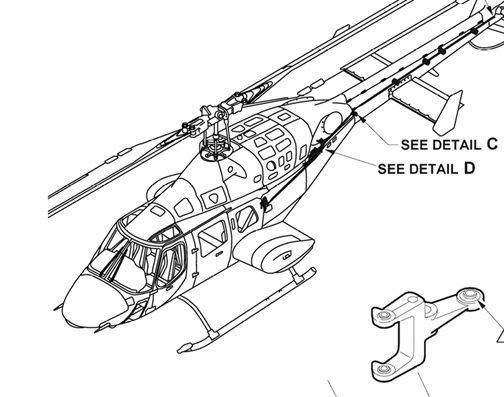
Interesting. Where is the servo located?
Its below and aft of the baggage compartment accessible from the incline belly. Its the larger black item near the Detail D arrow below.

wrench1 is offline  
Reply
Old 13th October 2025 | 17:30
  #120 (permalink)  
 
Joined: Jan 2023
Posts: 2
Likes: 0
From: Ireland
Does there appear to be very faint black smoke from the engine compartment aft section, perhaps a broken drive shaft flailing?
Stilltrying is offline  
Reply


Contact Us - Archive - Advertising - Cookie Policy - Privacy Statement - Terms of Service

Copyright © 2026 MH Sub I, LLC dba Internet Brands. All rights reserved. Use of this site indicates your consent to the Terms of Use.