


Why does Vy decrease with altitude in the H125/AS350B3 helicopter

Thread Starter

Joined: Sep 2007
Posts: 368
Likes: 21
From: I am not sure where we are, but at least it is getting dark
Why does Vy decrease with altitude in the H125/AS350B3 helicopter
Vy (best rate of climb, and autorotation speed) in the H125 / AS350B3/e is 65KIAS at sea level, decreasing by 1kt for every 1,000ft per the flight manual. All similar types of helicopters that I am aware of, only specify a fixed value for Vy.
Why is that?
I am finding plenty of explanations why this is the case in fixed wing aircraft, but they don't seem to make sense (to me) when talking about a helicopter.
Why is that?
I am finding plenty of explanations why this is the case in fixed wing aircraft, but they don't seem to make sense (to me) when talking about a helicopter.


Joined: Oct 1999
Aviation Qualifications: ATPL
Posts: 7,371
Likes: 926
From: Den Haag
Vy (best rate of climb, and autorotation speed) in the H125 / AS350B3/e is 65KIAS at sea level, decreasing by 1kt for every 1,000ft per the flight manual. All similar types of helicopters that I am aware of, only specify a fixed value for Vy.
Why is that?
I am finding plenty of explanations why this is the case in fixed wing aircraft, but they don't seem to make sense (to me) when talking about a helicopter.
Why is that?
I am finding plenty of explanations why this is the case in fixed wing aircraft, but they don't seem to make sense (to me) when talking about a helicopter.


Joined: Dec 2006
Posts: 431
Likes: 41
From: yes
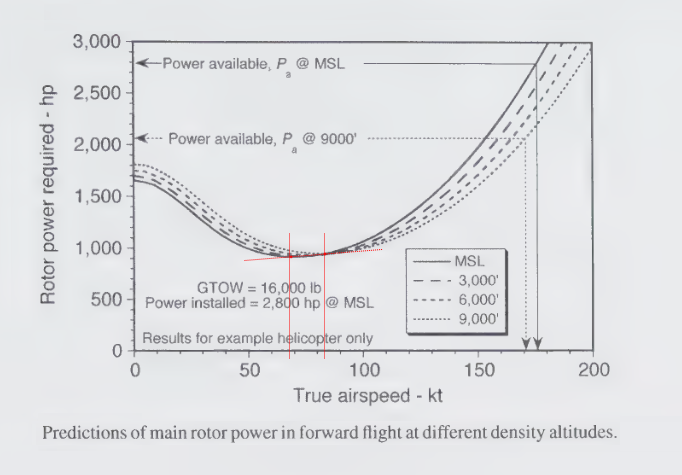
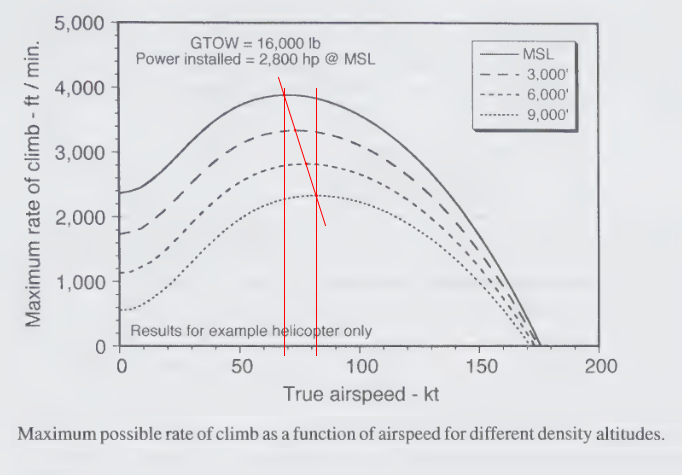
The IAS/TAS relationship is only part of the reason. Lower air density at higher altitudes results in a smaller power required for level flight, and best rate of climb is predicated on maximum excess power available, which occurs at the speed for minimum power in level flight (see images attached from “Principles of Helicopter Aerodynamics", J.G.Leishman):
Thread Starter
Joined: Sep 2007
Posts: 368
Likes: 21
From: I am not sure where we are, but at least it is getting dark
Thank you. What I was missing is that Vy is a function of TAS instead of IAS.
Now, according to the sample charts for the sample helicopter, Vy (TAS) increases with altitude, for example from 59KTAS at MSL to 82KTAS at 9,000ft AMSL, looking at the red lines. By rule of thumb, TAS for the same IAS should increase only by roughly 18% between MSL and 9,000ft - 59KIAS at 9,000ft should result in roughly 69KTAS at that altitude.
In other words, in the sample machine, your Vy would increase from 59KIAS at MSL, to roughly 70KIAS at 9000ft to achieve the 82KTAS.
In the AS350 models, Vy (IAS) decreases instead, from 65KIAS at MSL to 56KIAS at 9,000ft.
56KIAS at 9,000ft should give around 66KTAS, so this would tell me that Vy (TAS) barely changes in the AS350 at higher altitude, and the increase in true airspeed for a given IAS, is basically what is responsible for the decrease in Vy (IAS). If I extrapolate further, Vy per the manual is 45kts at 20,000ft, that's somewhere around 62 or 63KTAS.
In other models, perhaps the increase in Vy (TAS) and the increase in TAS are more or less the same, and they get away with specifying one Vy (IAS) for all altitudes?
Now, according to the sample charts for the sample helicopter, Vy (TAS) increases with altitude, for example from 59KTAS at MSL to 82KTAS at 9,000ft AMSL, looking at the red lines. By rule of thumb, TAS for the same IAS should increase only by roughly 18% between MSL and 9,000ft - 59KIAS at 9,000ft should result in roughly 69KTAS at that altitude.
In other words, in the sample machine, your Vy would increase from 59KIAS at MSL, to roughly 70KIAS at 9000ft to achieve the 82KTAS.
In the AS350 models, Vy (IAS) decreases instead, from 65KIAS at MSL to 56KIAS at 9,000ft.
56KIAS at 9,000ft should give around 66KTAS, so this would tell me that Vy (TAS) barely changes in the AS350 at higher altitude, and the increase in true airspeed for a given IAS, is basically what is responsible for the decrease in Vy (IAS). If I extrapolate further, Vy per the manual is 45kts at 20,000ft, that's somewhere around 62 or 63KTAS.
In other models, perhaps the increase in Vy (TAS) and the increase in TAS are more or less the same, and they get away with specifying one Vy (IAS) for all altitudes?
Joined: Nov 2000
Posts: 4,330
Likes: 74
From: White Waltham, Prestwick & Calgary
Mostly from Ray Prouty
VY occurs when the power required curve is at its lowest point, when most excess power is available, or where the gap between the two curves is the largest. As you increase altitude, the power required curve moves up and to the right, firstly because TAS increases relative to IAS, but also (as power is drag x TAS), the power required increases as well. VY must also increase because the graph moves. Having said that, as air density decreases, IAS reduces against TAS quicker than TAS increases, so the indicated speed for VY decreases slightly (VY is based on IAS). It also increases with weight, because you need more TRT, so more collective means more induced power, more tail rotor thrust, increasing profile power. In short, when altitude increases, TAS increases but VY as a function of IAS decreases.
As TAS, VY increases, hence the confusion on some charts.
VY occurs when the power required curve is at its lowest point, when most excess power is available, or where the gap between the two curves is the largest. As you increase altitude, the power required curve moves up and to the right, firstly because TAS increases relative to IAS, but also (as power is drag x TAS), the power required increases as well. VY must also increase because the graph moves. Having said that, as air density decreases, IAS reduces against TAS quicker than TAS increases, so the indicated speed for VY decreases slightly (VY is based on IAS). It also increases with weight, because you need more TRT, so more collective means more induced power, more tail rotor thrust, increasing profile power. In short, when altitude increases, TAS increases but VY as a function of IAS decreases.
As TAS, VY increases, hence the confusion on some charts.


Joined: May 2002
Aviation Qualifications: ATP+Mil
Posts: 18,633
Likes: 1,072
From: Downeast
How about a couple of curve balls for consideration for what has been an excellent discussion with excellent posts.
As some of us have flown in areas of super cold air...Alaska, Canada, Norway, Antartica for examples.....what effect does super cold air have on this due to its effect upon Barometric Altimeters for example.
The FAA and other authorities have offered guidance and correction tables for those effects.
My question is more about how we use the data shown in the performance charts when we encounter abnormal air temperatures....or is that information baked into the cake in the Charts?
The follow-up question is how much effect does a Knot or two deviation from the computed Vy cause in ROC.
My experience in one particular aircraft model demonstrated to every Pilot during Conversion training showed that to be critical during OEI operations where Vbroc airspeed was the target speed.
I see Vy and Vbroc being the same as both are for rate of climb and not for angle of climb.
Then there is the matter of Instrument error when it comes to achieving that magic number computed on the Performance Chart.
Theory is fine but practical application takes over from that point.
As some of us have flown in areas of super cold air...Alaska, Canada, Norway, Antartica for examples.....what effect does super cold air have on this due to its effect upon Barometric Altimeters for example.
The FAA and other authorities have offered guidance and correction tables for those effects.
My question is more about how we use the data shown in the performance charts when we encounter abnormal air temperatures....or is that information baked into the cake in the Charts?
The follow-up question is how much effect does a Knot or two deviation from the computed Vy cause in ROC.
My experience in one particular aircraft model demonstrated to every Pilot during Conversion training showed that to be critical during OEI operations where Vbroc airspeed was the target speed.
I see Vy and Vbroc being the same as both are for rate of climb and not for angle of climb.
Then there is the matter of Instrument error when it comes to achieving that magic number computed on the Performance Chart.
Theory is fine but practical application takes over from that point.

Joined: Jan 2009
Aviation Qualifications: ATP+Mil
Posts: 344
Likes: 105
From: Sweden
I expect modern FFS to be quite accurate with these things.
Long time ago I was training in a sim, for a hot, high and heavy mission (sandy playground) we where doing.
I was the PM, we lost an engine just after takeoff at and quite warm. The setting for the training mission off course was to be able for sustained flight. We where loosing altitude, I suggested and retracted the gears, it made things better but not much.
But my PF was doing Vy from memory (AS532 with steam gauges). But when we applied the standard -1kt/1000’ we actually was able to climb with ~200fpm.
I later was able to replicate it in a OEI drift down test in the real A/C. The calculation and the resulting altitude after drift down matched. Not applying the -1kt/1000’ and increasing to Vy without altitude correction ment descent even with only a few knots off.
I guess the 355 might have been as weak as the Bo 105 in OEI on the upper weight limit. Two knots off - height loss.


