


LA Fires

Thread Starter

Joined: Sep 2005
Posts: 768
Likes: 45
From: Montreal
LA Fires
I’ve done bucketing and snorkeling, and a little NVG, but not both at the same time. My sense was you lost a lot of the peripheral you need for confined vertical reference with at least the older NVG. Anybody there that can update me on night firefighting?
And where are you finding your water there?
And where are you finding your water there?

Joined: Jan 2006
Posts: 11
Likes: 0
From: around
Looks like they're getting water from the various reservoirs. Currently Stone Canyon Reservoir. Yesterday they were hitting the Encino Reservoir. I've also seen them going out to the ocean.
https://globe.adsbexchange.com/?icao=a4f98b
https://globe.adsbexchange.com/?icao=a4f98b


Joined: Oct 1999
Aviation Qualifications: ATPL
Posts: 7,371
Likes: 926
From: Den Haag
I’ve done bucketing and snorkeling, and a little NVG, but not both at the same time. My sense was you lost a lot of the peripheral you need for confined vertical reference with at least the older NVG. Anybody there that can update me on night firefighting?
And where are you finding your water there?
And where are you finding your water there?


Joined: May 2002
Aviation Qualifications: ATP+Mil
Posts: 18,633
Likes: 1,072
From: Downeast
You reckon there is a shortage of ground surface lighting?
Lots of smoke about for sure and dark bits outside where the actual fire is burning....and around Los Angeles some lumpy bits to run into.
One thing for sure the Boys and Girls out there flying at night fighting the fires are sure earning their money and our respect.
I did it in the day time and felt grossly underpaid and disrespected.
Lots of smoke about for sure and dark bits outside where the actual fire is burning....and around Los Angeles some lumpy bits to run into.
One thing for sure the Boys and Girls out there flying at night fighting the fires are sure earning their money and our respect.
I did it in the day time and felt grossly underpaid and disrespected.

Joined: Mar 2007
Posts: 72
Likes: 5
From: Approaching the MAP
I've done it for several years and as long as the company SOPs and crew training are adapted to nvg fire fighting, it can be done safely.
The largest detriment of nvg flying is reduced depth perception, reduced sense of rate of closure, and reduced ability to judge height above terrain. So crew training has to address these areas of higher risk. We use additional CRM callouts that include VSI and radalt along with standard cockpit calls to help paint a mental model of surrounding terrain and position of aircraft in relation thereof. At night we increase our standard drop height a bit to allow for a higher margin of safety. We don't do vertical reference on goggles so our procedures in the water source as well as on the drop over the fire had to be adapted to account for not utilizing VR. The drops were easy to adapt to - fly it like an airtanker and keep your speed around 60 KIAS and adjust the start of the drop due to a different sight picture. In the water source it is constant CRM and use of searchlights to help hold position.
The fire puts out a lot of light and helps illuminate the surrounding terrain so that we use unaided sighting techniques as much as reliance on goggles.
The largest detriment of nvg flying is reduced depth perception, reduced sense of rate of closure, and reduced ability to judge height above terrain. So crew training has to address these areas of higher risk. We use additional CRM callouts that include VSI and radalt along with standard cockpit calls to help paint a mental model of surrounding terrain and position of aircraft in relation thereof. At night we increase our standard drop height a bit to allow for a higher margin of safety. We don't do vertical reference on goggles so our procedures in the water source as well as on the drop over the fire had to be adapted to account for not utilizing VR. The drops were easy to adapt to - fly it like an airtanker and keep your speed around 60 KIAS and adjust the start of the drop due to a different sight picture. In the water source it is constant CRM and use of searchlights to help hold position.
The fire puts out a lot of light and helps illuminate the surrounding terrain so that we use unaided sighting techniques as much as reliance on goggles.
Joined: Dec 2024
Posts: 11
Likes: 1
From: Montreal
I was also told that in some case dropping water under ngv is easier than in day time as with ngv you can see through the fire smokes.
Joined: Dec 2000
Posts: 299
Likes: 9
From: uk
Thermal cameras might be able to see through smoke but never heard of NVG being able to do that.
Joined: Sep 2003
Posts: 2,081
Likes: 189
From: Redding CA, or on a fire somewhere
The thermal cameras are on the Bell 429's that are on contract with Cal-Fire as "Helco" platforms. Basically they fly above and direct the air assets. Coulson also has an S-76 that they use as a "lead Helicopter" to direct their Chinooks on drops. They also have thermal imaging cameras linked to mapping systems. Both these aircraft do the same as the old USFS Cobras that were retired a couple years back.

Joined: Oct 2009
Posts: 47
Likes: 24
From: New York
The thermal cameras are on the Bell 429's that are on contract with Cal-Fire as "Helco" platforms. Basically they fly above and direct the air assets. Coulson also has an S-76 that they use as a "lead Helicopter" to direct their Chinooks on drops. They also have thermal imaging cameras linked to mapping systems. Both these aircraft do the same as the old USFS Cobras that were retired a couple years back.
Joined: Sep 2003
Posts: 2,081
Likes: 189
From: Redding CA, or on a fire somewhere
Also one of the Coulson S-76 pilots used to work for me flying our S-76's before leaving to go work for them.
See this articel here...scroll down almost to the end:
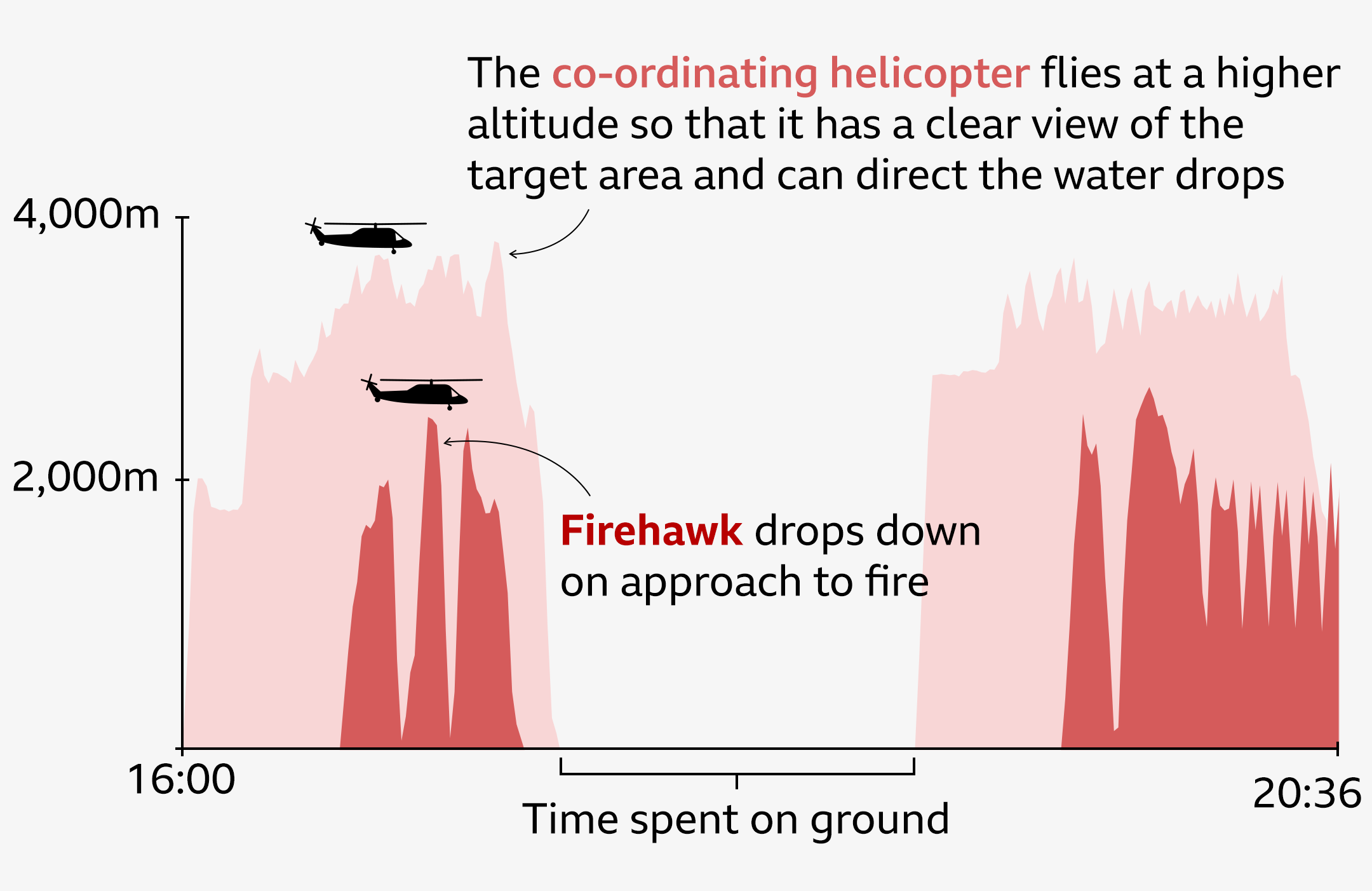
https://www.bbc.co.uk/news/resources...a-d79c0ff994c3
That’s where Cal Fire captains like Williamson come in.
They hover a thousand feet above the fray in helicopters like the Bell 429. Cal Fire is using versions equipped with multiple AM and FM radios and night vision capabilities.
Digital screens in the cockpit allow the crew see all the other helicopters participating in the firefight. Bright lights illuminate their way at night. The craft is light and nimble, and powered by twin engines.
From up high, they can co-ordinate multiple aircraft to drop their water on the same target, extinguishing the flames for the ground team below.
The Cal Fire team has a particular affection for their Bell 429.
“This is the one I've been on since the beginning,” said Williamson. “It’s awesome. It’s a pretty rad helicopter.”
They hover a thousand feet above the fray in helicopters like the Bell 429. Cal Fire is using versions equipped with multiple AM and FM radios and night vision capabilities.
Digital screens in the cockpit allow the crew see all the other helicopters participating in the firefight. Bright lights illuminate their way at night. The craft is light and nimble, and powered by twin engines.
From up high, they can co-ordinate multiple aircraft to drop their water on the same target, extinguishing the flames for the ground team below.
The Cal Fire team has a particular affection for their Bell 429.
“This is the one I've been on since the beginning,” said Williamson. “It’s awesome. It’s a pretty rad helicopter.”

Last edited by Gordy; 19th January 2025 at 18:35. Reason: added stuff
Joined: Oct 2009
Posts: 47
Likes: 24
From: New York
Nope, Cal-Fire has two of them on contract, one operated by Capitol Helicopters, I gave one of their pilots his 135 ride earlier this year. It is based at McClellan Field, (main aviation base of Cal-Fire). He used to work for me at Redding Air Service on our fire contracts before moving to Capitol.
Also one of the Coulson S-76 pilots used to work for me flying our S-76's before leaving to go work for them.
See this articel here...scroll down almost to the end:
https://www.bbc.co.uk/news/resources...a-d79c0ff994c3
Also one of the Coulson S-76 pilots used to work for me flying our S-76's before leaving to go work for them.
See this articel here...scroll down almost to the end:
https://www.bbc.co.uk/news/resources...a-d79c0ff994c3
We also rarely hover over the fire during HLCO missions as the article states, we fly orbits to extend our time on scene.
Joined: Mar 2007
Posts: 72
Likes: 5
From: Approaching the MAP
@verticalspin is correct. I worked alongside one of the Capitol 429s for several months at night this past season and they don't have cameras. The BBC article is written by someone who's never been near a fire and full of inaccuracies.
NVGs help in seeing through smoke up to a certain point. Just like shallow fog, they can get you in trouble and will slowly shut down the thicker the smoke gets. This is why adopting a scanning technique that includes looking under the goggles will help identify areas of heavy smoke.
NVGs help in seeing through smoke up to a certain point. Just like shallow fog, they can get you in trouble and will slowly shut down the thicker the smoke gets. This is why adopting a scanning technique that includes looking under the goggles will help identify areas of heavy smoke.
Joined: Sep 2003
Posts: 2,081
Likes: 189
From: Redding CA, or on a fire somewhere
I was on fires with both the Capitol and PJ 429s. They use NVGs for night HLCO missions but do not have thermal imaging systems. Those cameras are only installed on the two Helicopter Express 407s that are being used by the USFS.
We also rarely hover over the fire during HLCO missions as the article states, we fly orbits to extend our time on scene.
We also rarely hover over the fire during HLCO missions as the article states, we fly orbits to extend our time on scene.
Joined: Oct 2009
Posts: 47
Likes: 24
From: New York
I never said you didn't, Gordy. Just pointing out some flaws of a poorly written/researched article. Their little graphic with the altitude in meters is amusing too. I'm sure the author was being told altitudes in feet and forgot to convert it. Last time I checked the Palisades weren't anywhere close to 2000m. Anything above 10k feet for more than 30 min the USFS requires oxygen for HLCO operations, I'm sure CalFire would have similar restrictions.
Joined: Sep 2003
Posts: 2,081
Likes: 189
From: Redding CA, or on a fire somewhere
I never said you didn't, Gordy. Just pointing out some flaws of a poorly written/researched article. Their little graphic with the altitude in meters is amusing too. I'm sure the author was being told altitudes in feet and forgot to convert it. Last time I checked the Palisades weren't anywhere close to 2000m. Anything above 10k feet for more than 30 min the USFS requires oxygen for HLCO operations, I'm sure CalFire would have similar restrictions.

Joined: Sep 2004
Aviation Qualifications: ATPL(H)
Posts: 2,371
Likes: 877
From: Canada
Night Attack
Just for context
These videos from 2 years ago does speak a bit of night Helicopter Fire Attack.
I think there was a more detailed video at the time from Coulson with much better descriptions of how it is all supposed to work but I can’t locate it on YouTube as entering a search of night helicopter fire fighting leads to endless reports on the present ongoing emergency.
Just for context
These videos from 2 years ago does speak a bit of night Helicopter Fire Attack.
I think there was a more detailed video at the time from Coulson with much better descriptions of how it is all supposed to work but I can’t locate it on YouTube as entering a search of night helicopter fire fighting leads to endless reports on the present ongoing emergency.

Joined: Mar 2011
Posts: 518
Likes: 50
From: London/Atlanta
Not sure how current this is but some good filming.
https://www.instagram.com/reel/DEoxW...R1cXo2MzQ1bA==
https://www.instagram.com/reel/DEoxW...R1cXo2MzQ1bA==
