


CG Effect on Range/Airspeed

Avoid imitations


Joined: Nov 2000
Aviation Qualifications: ATPL
Posts: 15,110
Likes: 1,083
From: Wandering the FIR and cyberspace often at highly unsociable times
I've looked in my three "Prouty" helicopter aerodynamics manuals.
He does mention C of G a few times, but nowhere does he answer the OP's question directly. My own take is that it is probably more about the aerodynamics of the fuselage as presented to the oncoming airflow, i.e. mainly parasite drag related and the least "draggy" aircraft nose up/down attitude will vary from helicopter type to type.
He does mention C of G a few times, but nowhere does he answer the OP's question directly. My own take is that it is probably more about the aerodynamics of the fuselage as presented to the oncoming airflow, i.e. mainly parasite drag related and the least "draggy" aircraft nose up/down attitude will vary from helicopter type to type.


Joined: Jan 2009
Aviation Qualifications: ATP+Mil
Posts: 344
Likes: 105
From: Sweden
I've looked in my three "Prouty" helicopter aerodynamics manuals.
He does mention C of G a few times, but nowhere does he answer the OP's question directly. My own take is that it is probably more about the aerodynamics of the fuselage as presented to the oncoming airflow, i.e. mainly parasite drag related and the least "draggy" aircraft nose up/down attitude will vary from helicopter type to type.
He does mention C of G a few times, but nowhere does he answer the OP's question directly. My own take is that it is probably more about the aerodynamics of the fuselage as presented to the oncoming airflow, i.e. mainly parasite drag related and the least "draggy" aircraft nose up/down attitude will vary from helicopter type to type.
Aft CG set the attitude less nose down to begin with and reduce the negative lift(downforce) comming from the stab.
Most helos should gain from this by reduced induced drag on the stabilizator and as the negative lift reduces the need for vertical positive lift from the main rotor reduces it can be tilted more forward thus giving more forward thrust from the same power.
Joined: Nov 2006
Posts: 1,951
Likes: 90
From: After all, what’s more important than proving to someone on the internet that they’re wrong? - Manson
There can be consequences - back in the day with the introduction of the MD500D version the MR TT Straps had a propensity to crack.
It was found in one environment that due to the FWD C of G being the more prevalent flight regime the straps did not crack as much or as often.
The fix by MD (Hughes at the time) was to remove some of the the horizontal stabiiser "nose up" trim and change the flapping angles between the mast and the head as evidenced by resultant cyclic displacement.
Granted AFT C of G changes the body angle on the cab which reduces drag in some cases but the poor old rotor has to deal with increased bending angles and flapping angles which can have knock on effects.
i.e. the Bell 212 can be flown fast but you better have deep pockets as they beat themselves to bits and eat flight control components.
It was found in one environment that due to the FWD C of G being the more prevalent flight regime the straps did not crack as much or as often.
The fix by MD (Hughes at the time) was to remove some of the the horizontal stabiiser "nose up" trim and change the flapping angles between the mast and the head as evidenced by resultant cyclic displacement.
Granted AFT C of G changes the body angle on the cab which reduces drag in some cases but the poor old rotor has to deal with increased bending angles and flapping angles which can have knock on effects.
i.e. the Bell 212 can be flown fast but you better have deep pockets as they beat themselves to bits and eat flight control components.

Joined: Dec 2006
Posts: 431
Likes: 41
From: yes
Prouty, R., Helicopter Performance Stability, and Control, 1986.
On page 306, Prouty estimates the total equivalent flat plate area of an example UH-60 sized rotorcraft to be 19.3 ft-sq (zero angle of attack). The contribution of the horizontal stabilator to the total drag is estimated to be 0.2 ft-sq. or roughly 1% of the total area at 115 kts. So the contribution of the horizontal stabilizer is really insignificant.
I thought page 296 might be of interest:
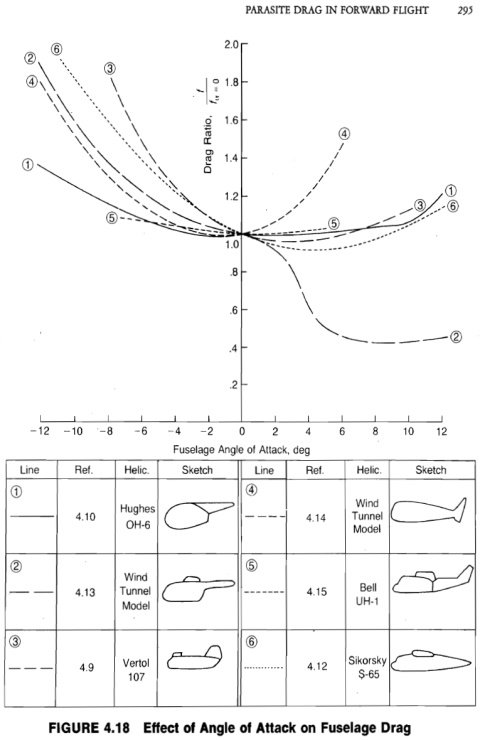
On page 306, Prouty estimates the total equivalent flat plate area of an example UH-60 sized rotorcraft to be 19.3 ft-sq (zero angle of attack). The contribution of the horizontal stabilator to the total drag is estimated to be 0.2 ft-sq. or roughly 1% of the total area at 115 kts. So the contribution of the horizontal stabilizer is really insignificant.
I thought page 296 might be of interest:
Joined: Jan 2009
Aviation Qualifications: ATP+Mil
Posts: 344
Likes: 105
From: Sweden
Prouty, R., Helicopter Performance Stability, and Control, 1986.
On page 306, Prouty estimates the total equivalent flat plate area of an example UH-60 sized rotorcraft to be 19.3 ft-sq (zero angle of attack). The contribution of the horizontal stabilator to the total drag is estimated to be 0.2 ft-sq. or roughly 1% of the total area at 115 kts. So the contribution of the horizontal stabilizer is really insignificant.
On page 306, Prouty estimates the total equivalent flat plate area of an example UH-60 sized rotorcraft to be 19.3 ft-sq (zero angle of attack). The contribution of the horizontal stabilator to the total drag is estimated to be 0.2 ft-sq. or roughly 1% of the total area at 115 kts. So the contribution of the horizontal stabilizer is really insignificant.
I did a calculation of the difference in main rotor lift needed on a 10.6T NH90. Between max forward CG and max aft CG there is a reduced need for lift from the main rotor of about 327kg due to the reduced need for “negative” lift from the stabilizer.
At 3000’ +15C and at MCP the TAS increase is about 4kt between 10.5t and 10t gross weight, so for 327kg we gain about 2.6kt from the reduced load on the main rotor only.
There is no data to find the extra drag that max forward CG cost due to the induced drag from the stabilizer, but probably more than zero as lift seldom comes for free


