


Split tip rotors

Thread Starter


Joined: Feb 2006
Aviation Qualifications: LAME
Posts: 36,137
Likes: 5,738
From: Falling off the end of the thread
Split tip rotors
Now there is something different..
https://www.flightglobal.com/helicop...138504.article
https://www.flightglobal.com/helicop...138504.article
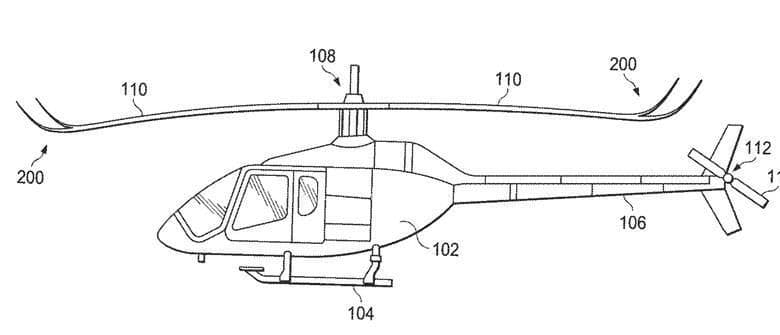
Meanwhile, Bell also appears to be seeking to bring to rotorcraft the performance gains fixed-wing aircraft have obtained from the use of split-tip winglets, such as those produced by Aviation Partners for the Boeing 737NG.
The patent application for the split-tip rotor blade notes that in wind-tunnel testing of the design, lift rose by about 13.5% and drag reduced by about 17%. “Accordingly the lift/drag ratio was increased by about 36.91%”. This, Bell says, “can result in fuel savings of about 15-17%”.
Bell was granted a US patent for the design on 21 April. Although the airframer gives no detail of specific applications for the split-tip rotors, a drawing within the patent documents shows an aircraft bearing a strong similarlity to its 505 light-single.
The patent application for the split-tip rotor blade notes that in wind-tunnel testing of the design, lift rose by about 13.5% and drag reduced by about 17%. “Accordingly the lift/drag ratio was increased by about 36.91%”. This, Bell says, “can result in fuel savings of about 15-17%”.
Bell was granted a US patent for the design on 21 April. Although the airframer gives no detail of specific applications for the split-tip rotors, a drawing within the patent documents shows an aircraft bearing a strong similarlity to its 505 light-single.


Joined: Nov 2010
Posts: 727
Likes: 47
From: Earth
The primary claims of the patent are really stating the use of split winglets in general. Dihedral as shown on a helicopter rotor blade does not really make much sense at all, but since all the aerodynamic modeling described in the patent was for improved L/D with dihedral fixed wing applications, I guess thats the way they tried to made the extra claim 11 for a helicopter application.
https://patents.google.com/patent/US10625847B2/en
In reality, this is sort of taking the BERP concept to the extreme, where it used a well-integrated notch shape to create a smaller vortex that interfaced with the main one, this concept achieves a similar effect with 2 discrete tips.
Accordingly, it can be advantageously utilized with fixed wing aircraft, helicopters, propeller blades, fans, wind power turbine blades, cooling fan blades, aerodynamic spoilers, and other devices utilizing airfoils.
In reality, this is sort of taking the BERP concept to the extreme, where it used a well-integrated notch shape to create a smaller vortex that interfaced with the main one, this concept achieves a similar effect with 2 discrete tips.
Joined: Sep 2002
Aviation Qualifications: CPL
Posts: 4,721
Likes: 636
From: Great South East, tired and retired
In the hover, I can see it would have an advantage. Be interesting to see how it is in forward flight, with the blades passing the fore/aft position.


Joined: Aug 2000
Aviation Qualifications: ATP+Mil
Posts: 1,629
Likes: 206
From: SW England
Having once, rather unscientifically, split a set of Wessex blade tip-caps on a tree which snuck in too close towards us while we were dropping troops on a hillside in NI, I can vouch for the fact that they don't always result in an improvement in performance.
Last edited by Thud_and_Blunder; 28th May 2020 at 11:46.
Joined: Oct 2006
Aviation Qualifications: A&P
Posts: 1,346
Likes: 270
From: USA
Would be interesting to see the track and balance procedures on those type of blades. Hopefully we wouldn't have to go back to Zeiss each blade or start using BBs to product balance again.

Joined: Jun 2020
Posts: 1
Likes: 0
From: Devon
Save fuel in flight........use more getting the RTB sorted though. Cool concept i always understood the anhedral was the way forward with the paddle tip to elongate the chord. Either way its going to interesting to hear the noise they make.
Joined: Jul 2007
Posts: 7
Likes: 0
From: Australia
Brilliant T&B. Gave me a laugh at 0200 with the baby.
Joined: May 2011
Posts: 1,358
Likes: 3
From: NEW YORK
All the most recent wingtip modifications on civil jets extend both above as well as below, so I'd have thought that helicopter blades would be similarly fitted.

Joined: Jun 2016
Aviation Qualifications: CPL
Posts: 1,318
Likes: 387
From: Brantisvogan
may have something to do with the desire to keep the tailboom in one piece.
Joined: May 2011
Posts: 1,358
Likes: 3
From: NEW YORK
Suggests though that the idea of an electrically powered tail rotor would fit with this split rotor blade idea. It obviates the need for a TR drive shaft, so the geometry can be a lot more flexible,

Joined: Jul 2013
Aviation Qualifications: Non-Aircrew
Posts: 5,672
Likes: 3,317
From: Everett, WA
Noise wise, my first guess is that it would be quieter and at a higher frequency. A large amount of helicopter noise is from the blade hitting the vortex from preceding rotor - less then intensity of that vortex and you should reduce the noise. But there will be more (smaller) vorticies so the frequency would increase.
Joined: Oct 2005
Posts: 2,131
Likes: 56
From: Anglia


