


R-22 ROTOR SEPARATION? Florida Photo

Thread Starter
Joined: Mar 2010
Posts: 220
Likes: 0
From: Florida
R-22 ROTOR SEPARATION? Florida Photo
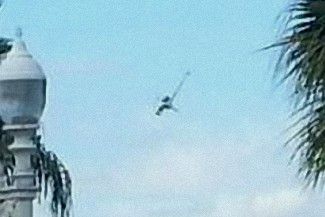
Man killed in helicopter crash was experienced pilot | TBO.com
The pilot whose helicopter crashed into Tampa Bay on Friday afternoon near Apollo Beach was an experienced pilot who was certified on multiple aircraft, including large commercial passenger jets, according to a statement released by his family.
John Lawrence Ward, whose friends called him Larry, held both U.S. and International airline transport licenses and was a licensed helicopter instructor, according to the statement.
“He had just celebrated his 60th birthday on Thanksgiving,” according to the statement. “Larry loved flying.”
The statement said Ward’s wife, Karen and friends were shocked by the tragedy as Larry was known as a meticulous pilot.
“Information available suggests that this may have resulted from mechanical failure,” according to the statement.
The Wards have been residents of Davis Islands in Tampa for more than 20 years. “Karen appreciates the concern expressed by family, friends and neighbors regarding Larry's death,” according to the family’s statement.
Ward took off Friday afternoon from Tampa Bay Aviation for a flight in an R-22 helicopter. The weather was good and Ward, a 1974 graduate of the U.S. Naval Academy with more than 20 years experience as a pilot with American Airlines, was flying about 75 yards above Tampa Bay.
Around 3 p.m., the helicopter crashed into the bay when a rotor apparently malfunctioned and separated from the helicopter, according to witnesses.
The helicopter sank into the shallow waters of the bay a few hundred yards offshore and quickly sank.
Crews immediately started searching for Ward. They found the helicopter using underwater sensors but were not able to find Ward’s body or salvage the helicopter by nightfall. The search resumed this morning and divers with the Hillsborough County Sheriff’s Office soon found Ward’s body at the site of the crash.
The National Transportation Safety Board and the Federal Aviation Administration will conduct the investigation into the cause of the accident.
John Lawrence Ward, whose friends called him Larry, held both U.S. and International airline transport licenses and was a licensed helicopter instructor, according to the statement.
“He had just celebrated his 60th birthday on Thanksgiving,” according to the statement. “Larry loved flying.”
The statement said Ward’s wife, Karen and friends were shocked by the tragedy as Larry was known as a meticulous pilot.
“Information available suggests that this may have resulted from mechanical failure,” according to the statement.
The Wards have been residents of Davis Islands in Tampa for more than 20 years. “Karen appreciates the concern expressed by family, friends and neighbors regarding Larry's death,” according to the family’s statement.
Ward took off Friday afternoon from Tampa Bay Aviation for a flight in an R-22 helicopter. The weather was good and Ward, a 1974 graduate of the U.S. Naval Academy with more than 20 years experience as a pilot with American Airlines, was flying about 75 yards above Tampa Bay.
Around 3 p.m., the helicopter crashed into the bay when a rotor apparently malfunctioned and separated from the helicopter, according to witnesses.
The helicopter sank into the shallow waters of the bay a few hundred yards offshore and quickly sank.
Crews immediately started searching for Ward. They found the helicopter using underwater sensors but were not able to find Ward’s body or salvage the helicopter by nightfall. The search resumed this morning and divers with the Hillsborough County Sheriff’s Office soon found Ward’s body at the site of the crash.
The National Transportation Safety Board and the Federal Aviation Administration will conduct the investigation into the cause of the accident.
Last edited by fly911; 12th November 2013 at 08:18.


Joined: Feb 2005
Posts: 1,957
Likes: 0
From: Australia
site opened for me OK too. but sure as hell gives ones the heebees straight up.
"a licensed helicopter instructor"
AS, Usually the only way they can separate and not at the same time damage tail boom is by mast bumping, from low G flight such as a pushover from the top of a cyclic climb.
Hard to imagine that from a flight instructor, very hard.
Unless there was a preexisting damage, the investigation would quickly establish that though.
The only other way is that the mast became separated in the xmon (nut comes off bottom of mast) and that has happened a couple of times but mods should have fixed that on all aircraft by now I would guess. That could happen and leave the mast fairing in place.
I saved image and blew it up to reveal what looks like mast fairing still in place. I don't see any flocks of birds in the photo.
Sympathies to all concerned.
"a licensed helicopter instructor"
AS, Usually the only way they can separate and not at the same time damage tail boom is by mast bumping, from low G flight such as a pushover from the top of a cyclic climb.
Hard to imagine that from a flight instructor, very hard.
Unless there was a preexisting damage, the investigation would quickly establish that though.
The only other way is that the mast became separated in the xmon (nut comes off bottom of mast) and that has happened a couple of times but mods should have fixed that on all aircraft by now I would guess. That could happen and leave the mast fairing in place.
I saved image and blew it up to reveal what looks like mast fairing still in place. I don't see any flocks of birds in the photo.
Sympathies to all concerned.
Last edited by topendtorque; 2nd December 2012 at 17:23.
Joined: Aug 2010
Posts: 13
Likes: 0
From: New Zealand
NTSB Special Investigation Report
This is not an uncommon scenario with the R22. NTSB report SIR-96/03 makes very interesting reading into the "phenomena" of R22 accidents in apparent straight and level flight.

Joined: Dec 2001
Posts: 943
Likes: 0
From: Gold Coast, Queensland
Looking at videos of the R22 cattle mustering in Oz, I'm amazed there are not more of these types of accidents. I know some years back that not all the flight hours were recorded to "save money". The good old tough Bell 47 could get away with that but it appears the R22 can't. So sad for all involved.

Joined: Oct 2004
Posts: 132
Likes: 6
From: N/A
Nigel, surely you're not so naïve as to think that those days are gone?
As for this accident, I'd be very interested to hear what happened if it's not a result of a low g maneuver, very sad for everyone involved.
As for this accident, I'd be very interested to hear what happened if it's not a result of a low g maneuver, very sad for everyone involved.
Thread Starter
Joined: Mar 2010
Posts: 220
Likes: 0
From: Florida
Minimum solo weight?
I believe that there is a minimum solo weight on the R-44 that could effect stability. I'm not sure about the R-22. A very experienced pilot. Sad to see this happen.
Joined: Jun 2005
Posts: 126
Likes: 0
From: South Florida
Low G
Doesnt look characteristic of low G / Mast Bumping as the tail looks completely intact.
I wonder if it threw a blade - I saw a 22 roll over from the hover a few years ago inverting the aircraft with one blade completely intact about 600 ft from the wreckage.
I wonder if it threw a blade - I saw a 22 roll over from the hover a few years ago inverting the aircraft with one blade completely intact about 600 ft from the wreckage.

Joined: Nov 2002
Posts: 282
Likes: 0
From: Ross-on-Wye
Mast separation/bumping
Until recently I would have been surprised that an experienced FI could make the mistake of a swift cyclic reversal following rapid flap-back in turbulence. That was until I found myself co-piloting with an experienced SH 300C owner. Following a good general handling session, I sat back as my pilot lifted off with excessive aft cyclic. As the T/R approached the surface, without thinking I reacted immediately by ramming the cyclic forward. The day was saved but thinking back I could see that had I been R22 airborne, such action would probably have resulted in a severe 'mast bump' to say the least and more likely caused a M/R - mast separation. Sobering thinking time! DRK
Joined: Dec 2008
Posts: 2,191
Likes: 26
From: Top of the World
 Crapinson Flimsicopter
Namaste flight beyond sight
Sadly that was no crass remark. As I have known well 2 Pilot's killed by the Robi & 1 almost. A close friend who is very senior Engineer & Pilot refuses to fly them point blank, reason he gave is; I have Family, a Daughter & I am not going to fly such a known widow maker as he had rebuilt too many & is disappointed in the flimsy construction & too many blade delaminations.


Happy Landings always
VF
Sadly that was no crass remark. As I have known well 2 Pilot's killed by the Robi & 1 almost. A close friend who is very senior Engineer & Pilot refuses to fly them point blank, reason he gave is; I have Family, a Daughter & I am not going to fly such a known widow maker as he had rebuilt too many & is disappointed in the flimsy construction & too many blade delaminations.
Happy Landings always
VF
Joined: Aug 2011
Posts: 222
Likes: 0
From: Ventura Ca U.S.A.
 In late 1987 I was flying an R-22 600 agl 80 kts when it rolled to the right 90 deg uncommanded.
 It was a shocker I added a little aft cyclic and the almost low G became a banking turn to the right, I thought it was a mountan rotor from the hills near by, After reading the special report I turned white. WTF over,
 never will I think twice of what it might of been
Joined: Nov 2009
Posts: 23
Likes: 2
From: Fort parry wells island beach
I would vote against a single-blade-throwing scenario, as the aircraft is peculiarly intact in the photo. With the massive imbalance and rotation from one blade departing , i would expect to see a buckled or fractured tail boom, as well as the whole upper portion of the fuselage being ripped open from the transmission ripping itself out.. (think back to that squirrel crash in nz last xmas)
While i cant speak from experience myself i also would have thought mast bumping would come with tail and fuselage damage... as well as it being less likely from a more experienced pilot. Although only speculation; it might be a worthwhile guess that the aircraft had a previous mast bumping incident that went unreported, and may have damaged the mast internally.. for it to later fail in the cruise on this flight.. (in a positive G state.. pulling the rotor section away from the fuselage without impacting it)..
Very sad indeed.
While i cant speak from experience myself i also would have thought mast bumping would come with tail and fuselage damage... as well as it being less likely from a more experienced pilot. Although only speculation; it might be a worthwhile guess that the aircraft had a previous mast bumping incident that went unreported, and may have damaged the mast internally.. for it to later fail in the cruise on this flight.. (in a positive G state.. pulling the rotor section away from the fuselage without impacting it)..
Very sad indeed.
Joined: Jul 2008
Posts: 372
Likes: 0
From: Australia
Blade failure?
I'm almost with you Mhale71. I have been directly involved in one crash of an R44 and in that case when one blade failed catastrophically the other blade suddenly carries all the load and rises. In the case I dealt with, the failed blade did not separate entirely so the spar which was still attached flailed the tail boom and the boom failed. There was significant evidence of disbonding (delamination?) within the blade structure (confirmed by the NTSB) and the IIC concluded that this was the most probable cause of the crash.
I do not see any evidence of any remnants of either blade in the photo and I do not see any distortion of the boom. So, unless there was a simultaneous separation of both blades, I think the failure is further down the mast or in the attachment of the rotor head to the mast. Anecdotal reports indicate that cockpit strikes may also occur after failure of one blade. I do not see that in the picture.
Regards
Blakmax
I do not see any evidence of any remnants of either blade in the photo and I do not see any distortion of the boom. So, unless there was a simultaneous separation of both blades, I think the failure is further down the mast or in the attachment of the rotor head to the mast. Anecdotal reports indicate that cockpit strikes may also occur after failure of one blade. I do not see that in the picture.
Regards
Blakmax