


Helicopter down this evening in Norway: July 2011

Thread Starter

Joined: Jan 2003
Posts: 365
Likes: 15
From: CYPG
Helicopter down this evening in Norway: July 2011

 sad
sad Joined: Sep 2003
Posts: 1,034
Likes: 1
From: 59°45'36N 10°27'59E
www.vg.no just released image from crash site.
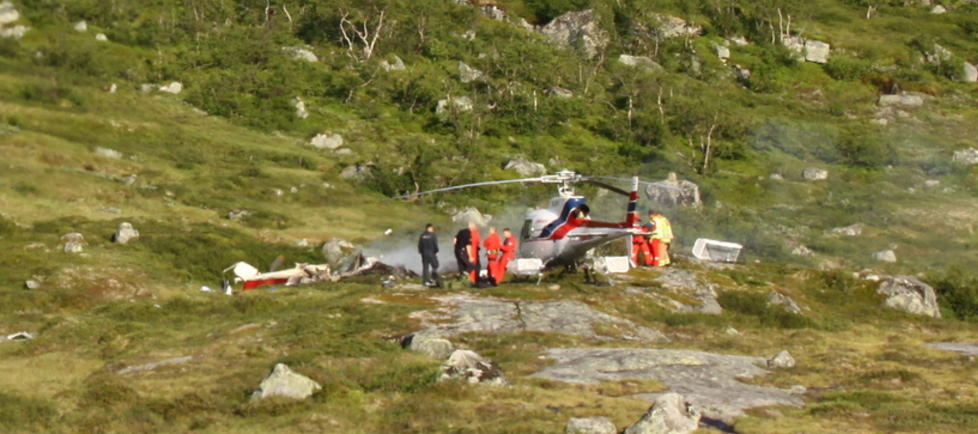
According to media 3 people confirmed dead, 2 has status as missing. Police said this morning that idendification of the passengers will be challenging.
According to media 3 people confirmed dead, 2 has status as missing. Police said this morning that idendification of the passengers will be challenging.
Joined: Sep 2003
Posts: 1,034
Likes: 1
From: 59°45'36N 10°27'59E
Joined: Sep 2003
Posts: 1,034
Likes: 1
From: 59°45'36N 10°27'59E
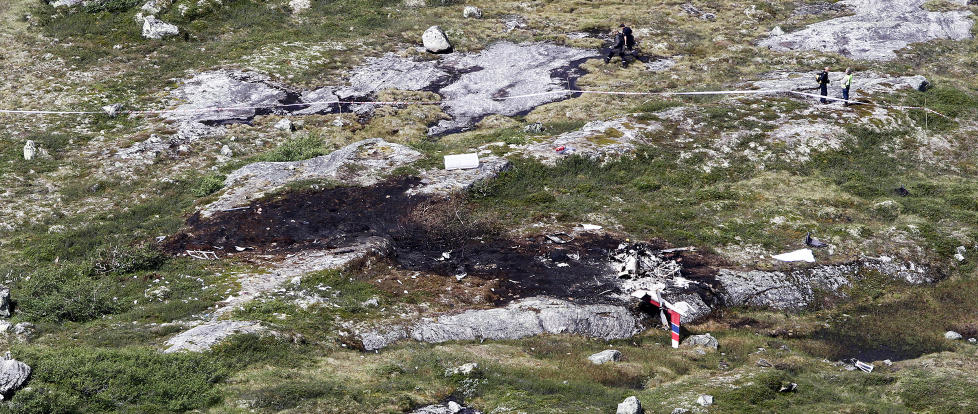
AIBN confirms a/c struck terrain with high forward speed, nose pointing slightly downwards.
Aftenposten.no - Nose struck first
Aftenposten.no - Nose struck first
Joined: Sep 2003
Posts: 1,034
Likes: 1
From: 59°45'36N 10°27'59E
Joined: Jan 2005
Posts: 111
Likes: 5
From: KoN
Report published on the accident to this AS350 in July 2011
The report was published today and the english summary goes like this:
As the helicopter started the descent for an approach in mountainous terrain, witnesses observed it turning tightly to the right. During the turn, control of the helicopter appeared to be lost, with a high bank angle and a steep descent. At the end, it seemed as if control was about to be regained, but the helicopter hit the ground hard about 500 metres short of the planned landing site and immediately caught fire. All five persons on board were fatally injured. The helicopter was a total loss.
The investigation has not revealed any technical defects or irregularities that could have influenced the course of events. The Accident Investigation Board Norway considers it likely that abrupt manoeuvring initiated a sequence where control of the helicopter was partly lost for a period, and that the height was insufficient for the commander to recover in time. The AIBN believes that the hydraulic system may have reached its limitation during the manoeuvring, resulting in the phenomenon servo transparency, (also called jack stall) occurring.
Three safety recommendations are issued in the report, dealing with limitations during manoeuvring with passengers on board, warning of servo transparency hazards and the need for flight recorders.
An english translation of the full report is availble here: AIBN 2012/13 eng
As the helicopter started the descent for an approach in mountainous terrain, witnesses observed it turning tightly to the right. During the turn, control of the helicopter appeared to be lost, with a high bank angle and a steep descent. At the end, it seemed as if control was about to be regained, but the helicopter hit the ground hard about 500 metres short of the planned landing site and immediately caught fire. All five persons on board were fatally injured. The helicopter was a total loss.
The investigation has not revealed any technical defects or irregularities that could have influenced the course of events. The Accident Investigation Board Norway considers it likely that abrupt manoeuvring initiated a sequence where control of the helicopter was partly lost for a period, and that the height was insufficient for the commander to recover in time. The AIBN believes that the hydraulic system may have reached its limitation during the manoeuvring, resulting in the phenomenon servo transparency, (also called jack stall) occurring.
Three safety recommendations are issued in the report, dealing with limitations during manoeuvring with passengers on board, warning of servo transparency hazards and the need for flight recorders.
An english translation of the full report is availble here: AIBN 2012/13 eng

Joined: Jun 2008
Posts: 1,413
Likes: 0
From: England & Scotland
Try here http://www.aaib.gov.uk/cms_resources...HL%2002-09.pdf from page 90.
Joined: Jul 2008
Posts: 185
Likes: 0
From: In the Alps
Servo Transparency
In short, aggressive maneuvers and/or excessive G load can result in control forces which overpower the hydraulic system, leading to stiff controls and an uncommanded roll and pitch up.
You can easily avoid it by not doing any crazy stunts.
You can easily avoid it by not doing any crazy stunts.
Joined: Jan 2005
Posts: 111
Likes: 5
From: KoN
Chapter 1.18 (page 30-45) in the AIBN report also has a quite detailed description of what it is and what it might feel like. It looks in particular at ST in right turns, similar to the AAIB report on the Scottish accident referenced above. The AIBN description and calculations appears to have been developed with/accepted by Eurocopter.
Joined: Apr 2006
Posts: 448
Likes: 4
From: In the mountains
It's a crap your pants feeling... I've had it in a BA while doing a hard right hand turn when all of a sudden the controls locked up. Luckily I had space to fight through the recovery. Also had it in a B3 with a faulty servo while coming in to land...with only a 20-30° bank at about 40 kts... Luckily it was only a partial effect but being that close to the ground wasn't comfortable
Like Jymil says..... avoid the excessively hard menouvres and it will avoid you...
Like Jymil says..... avoid the excessively hard menouvres and it will avoid you...
Joined: Jan 2012
Posts: 440
Likes: 0
From: Royal Leamington Spa
Thanks for the feedback.
The report citing Eurocopter states:
Will the a/c always pitch up with down collective?
Is the Squirrel more sensitive to jack stall/servo transparency than other types? Does it manifest the same way in other types?
leading to stiff controls and an uncommanded roll and pitch up.
the phenomenon will induce an uncommanded right cyclic force and an associated down collective reaction.
Is the Squirrel more sensitive to jack stall/servo transparency than other types? Does it manifest the same way in other types?
Avoid imitations


Joined: Nov 2000
Aviation Qualifications: ATPL
Posts: 15,110
Likes: 1,083
From: Wandering the FIR and cyberspace often at highly unsociable times
Rather puzzling that it occurred in the descent though. Collective pitch would normally be reduced to descend, taking the aircraft further from the limit of the hydraulic system.
Also, from the photos posted here, the tail rotor blades appear to be almost undamaged.
Also, from the photos posted here, the tail rotor blades appear to be almost undamaged.