


Flightsim-pilot questions (Merged)

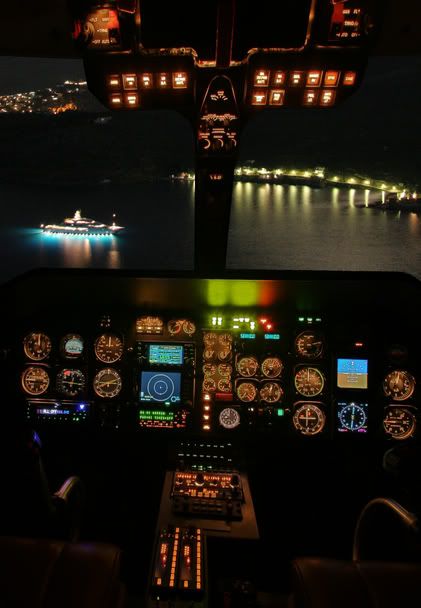
 Request - Pic of panel b206 at night
Thread Starter
Joined: Jun 2006
Posts: 43
Likes: 0
From: Paducah, Kentucky
That is a gorgeous picture. And helps to give me some ideas of the lighting.
I would love to sim the AS365, and perhaps will do one next. First I have to get one done to fund further development. Right now, I'm looking into doing custom instruments for people.
Patrick
I would love to sim the AS365, and perhaps will do one next. First I have to get one done to fund further development. Right now, I'm looking into doing custom instruments for people.
Patrick


Thread Starter
Joined: Jun 2006
Posts: 43
Likes: 0
From: Paducah, Kentucky
Hmmm this is a 407, but also gives me ideas.
Someone asked why I can't use something for FS. Well, the lighting used in default aircraft is very primative, and is already available in the gauges I have created, but I am using programming tecniques to go beyond their capabilities to add reality.
I guess in the end, it depends on the instruments you have installed, and if they are designed with lighting at all.
Patrick
Someone asked why I can't use something for FS. Well, the lighting used in default aircraft is very primative, and is already available in the gauges I have created, but I am using programming tecniques to go beyond their capabilities to add reality.
I guess in the end, it depends on the instruments you have installed, and if they are designed with lighting at all.
Patrick


Thread Starter
Joined: Jun 2006
Posts: 43
Likes: 0
From: Paducah, Kentucky
Thanks.
Those do help considerably. It appears that internal light instruments have a light in them near the top that illuminates that instrument.
For the attitude indicator that has no internal light, post lights were added to put crossing mini spots on it.
Thanks again,
Patrick
Those do help considerably. It appears that internal light instruments have a light in them near the top that illuminates that instrument.
For the attitude indicator that has no internal light, post lights were added to put crossing mini spots on it.
Thanks again,
Patrick
Thread Starter
Joined: Jun 2006
Posts: 43
Likes: 0
From: Paducah, Kentucky
 Electric gyro questions
I have a few questions for someone patient enough to put up with them.
All of the following questions assume an attitude indicator in a helicopter (B206), that is driven by an electric gyro.
1) First, is there always a "pull to cage" knob? I have seen some photos without one I think. I am guessing that if there is not it is because the gyro is incapable of tumbling, and hence does not need it. I would also expect that it would be rare to see one in a helicopter as it rarely would exceed certain bank and pitch limits. If you do cage one, do you need to do this in level flight?
2) If you were to not turn on the gyro during start, but waited till you were in an established constant turn at say 10 degree right bank, and then flipped on the gyro and allowed it to spin up before leveling out, would it then assume that was level, and hence now indicate a bank in the opposite direction?
3) When it is not functional, is there a warning flag? Does the flag say "OFF"? Does it go away right away on power on, or wait until the gyro spins up? When the gyro fails, how long would it take you to notice it spinning down (if the flag were not telling you immediately)?
4) Thanks.
Patrick

All of the following questions assume an attitude indicator in a helicopter (B206), that is driven by an electric gyro.
1) First, is there always a "pull to cage" knob? I have seen some photos without one I think. I am guessing that if there is not it is because the gyro is incapable of tumbling, and hence does not need it. I would also expect that it would be rare to see one in a helicopter as it rarely would exceed certain bank and pitch limits. If you do cage one, do you need to do this in level flight?
2) If you were to not turn on the gyro during start, but waited till you were in an established constant turn at say 10 degree right bank, and then flipped on the gyro and allowed it to spin up before leveling out, would it then assume that was level, and hence now indicate a bank in the opposite direction?
3) When it is not functional, is there a warning flag? Does the flag say "OFF"? Does it go away right away on power on, or wait until the gyro spins up? When the gyro fails, how long would it take you to notice it spinning down (if the flag were not telling you immediately)?
4) Thanks.
Patrick
Joined: Jan 2005
Posts: 13
Likes: 0
From: Denmark
After you spin up the gyro on the ground, you will ned to cage it with the knob! To set it level!
Depending on the gyro system, if you cage it in a turn, it will show a wrong indication when you level out!
You can have different warning flags, but an off flag (orange) could show in top right hand corner!
Some attitude indicators spin at aprox, 18000 to 22000 Rpm, hence it will take a little while for it to slow down! But the flag will show right away!
http://www.faa.gov/library/manuals/a...ying_handbook/
Depending on the gyro system, if you cage it in a turn, it will show a wrong indication when you level out!
You can have different warning flags, but an off flag (orange) could show in top right hand corner!
Some attitude indicators spin at aprox, 18000 to 22000 Rpm, hence it will take a little while for it to slow down! But the flag will show right away!
http://www.faa.gov/library/manuals/a...ying_handbook/
Joined: Jul 2002
Posts: 103
Likes: 0
From: Lost in thought
This is probably more detailed than you were looking for .... but here goes....
All mechanical gyros drift over time and require some form of correction. Vertical gyros used for attitude indicators have a biasing mechanism that over time keeps the gyro "dirty side down". That biasing mechanism is based on the assumption that over the long term, the aircraft is straight and level. A lot of times these are mercury switches that apply an small electromagnetic force until the mercury switch centers (gravity down)
So if you were to fly any aircraft in a constant co-ordinated turn long enough, the gyro would eventually re-align and show level flight while in the turn.
So when you start up a gyro, you have to have some form of mechanism to get it where you want quickly, otherwise you'd have to wait for this biasing mechanism to work itself out before you could take off. For mechanical attitude indicators, the common means is to cage (mechanically force) the indicator to straight and level. Other remote gyros had a "fast erect" switch (Viagra for gyros) that dramatically reduced the time required for the biasing mechanism to drive the gyro to the desired position.
Later AHRS (Attitude heading reference systems) perform automatic alignments on power up, so you don't even have to cage or "fast erect." Instead, if the AHRS sees a relatively stable input from its gravity sensors after power up, it automatically performs the equivalent of a "fast erect". Usually when you are talking AHRS though, the sensors are either FOG or MEMs type and you don't really have anything moving anymore. It's all done in math.
That all said, I suppose there might be some mechanical gyros that automatically cage when power is removed. None of the mechanical units I'm aware of, though, seem to have this feature.
Hope that helps you out.
All mechanical gyros drift over time and require some form of correction. Vertical gyros used for attitude indicators have a biasing mechanism that over time keeps the gyro "dirty side down". That biasing mechanism is based on the assumption that over the long term, the aircraft is straight and level. A lot of times these are mercury switches that apply an small electromagnetic force until the mercury switch centers (gravity down)
So if you were to fly any aircraft in a constant co-ordinated turn long enough, the gyro would eventually re-align and show level flight while in the turn.
So when you start up a gyro, you have to have some form of mechanism to get it where you want quickly, otherwise you'd have to wait for this biasing mechanism to work itself out before you could take off. For mechanical attitude indicators, the common means is to cage (mechanically force) the indicator to straight and level. Other remote gyros had a "fast erect" switch (Viagra for gyros) that dramatically reduced the time required for the biasing mechanism to drive the gyro to the desired position.
Later AHRS (Attitude heading reference systems) perform automatic alignments on power up, so you don't even have to cage or "fast erect." Instead, if the AHRS sees a relatively stable input from its gravity sensors after power up, it automatically performs the equivalent of a "fast erect". Usually when you are talking AHRS though, the sensors are either FOG or MEMs type and you don't really have anything moving anymore. It's all done in math.
That all said, I suppose there might be some mechanical gyros that automatically cage when power is removed. None of the mechanical units I'm aware of, though, seem to have this feature.
Hope that helps you out.

Joined: Nov 2001
Posts: 571
Likes: 0
From: Alderney or Lancashire UK
Avnx has done a very thorough job of it. The only thing I can add is that some older gyros use jets of air to bias them. There is a fan on the rotor which is ducted through holes to give air jets. There are pendulums with shutters which partially cover the holes, and when the gyro is erect, all is in equilibrium. The air jets cancel each other out. If the gyro is not erect the pendulums move, the shutters cover some, and uncover the opposing jets, which applies force to the rotor until the equilibrium is re-established. Caging it forces the gyro erect by brute force. I have seen some of this type of instrument with no cage knob but they are pretty old. They are certainly capable of 'tumbling' and you just have to wait until they sort themselves out if they do!!


Joined: Oct 1999
Aviation Qualifications: ATPL
Posts: 7,373
Likes: 931
From: Den Haag
They are very bright cockpit flood lights, used at night or in poor lighting to bring your eyes' sensitivity to near daylight levels when flying in the viscinity of electrical storms. This prevents you from becoming blinded by nearby lightning flashes, which would be the case if you had allowed your eyes to becoming 'night acclimatised'.
Personally, if the lightning is that close I have my eyes shut anyway......
Personally, if the lightning is that close I have my eyes shut anyway......
Thread Starter
Joined: Jun 2006
Posts: 43
Likes: 0
From: Paducah, Kentucky
Originally Posted by 212man
They are very bright cockpit flood lights, used at night or in poor lighting to bring your eyes' sensitivity to near daylight levels when flying in the viscinity of electrical storms. This prevents you from becoming blinded by nearby lightning flashes, which would be the case if you had allowed your eyes to becoming 'night acclimatised'.
Personally, if the lightning is that close I have my eyes shut anyway......
Personally, if the lightning is that close I have my eyes shut anyway......
Ok, makes perfect sense. Thanks. Also explains why I couldn't find a thing on them searching google with "aircraft exterior lights".
Patrick


Joined: May 2002
Aviation Qualifications: ATP+Mil
Posts: 18,633
Likes: 1,072
From: Downeast
212man is being polite....they are commonly known as "anti-dazzle" lights (UK lingo)....and all the time I thought they were just there to blank out the two big white serving plate orbs shining back at me on the windscreen.