


BK117


Joined: Jun 2004
Posts: 646
Likes: 18
From: Europe

Joined: Jul 2002
Posts: 221
Likes: 18
From: Somewhere, Over the Rainbow
Reading through the B2 RFM, under limitations (sn 7253-sub or post SB 60-113 which I believe is the 125% gearbox) there is a note:
NOTE The engine is protected against over-TOT and over-torque by a STOP.
I can’t find any other reference to this, don’t believe it’s the collective pitch stop - does this imply that at TOT limits the engine will stop producing additional power (TOT limiting)? If so, does this mean in an OEI situation you can only expect TOT limits for power and nothing more should the situation be dire?
NOTE The engine is protected against over-TOT and over-torque by a STOP.
I can’t find any other reference to this, don’t believe it’s the collective pitch stop - does this imply that at TOT limits the engine will stop producing additional power (TOT limiting)? If so, does this mean in an OEI situation you can only expect TOT limits for power and nothing more should the situation be dire?

Joined: Oct 2006
Aviation Qualifications: A&P
Posts: 1,346
Likes: 270
From: USA
Reading through the B2 RFM, under limitations (sn 7253-sub or post SB 60-113 which I believe is the 125% gearbox) there is a note:
NOTE The engine is protected against over-TOT and over-torque by a STOP.
I can’t find any other reference to this, don’t believe it’s the collective pitch stop - does this imply that at TOT limits the engine will stop producing additional power (TOT limiting)? If so, does this mean in an OEI situation you can only expect TOT limits for power and nothing more should the situation be dire?
NOTE The engine is protected against over-TOT and over-torque by a STOP.
I can’t find any other reference to this, don’t believe it’s the collective pitch stop - does this imply that at TOT limits the engine will stop producing additional power (TOT limiting)? If so, does this mean in an OEI situation you can only expect TOT limits for power and nothing more should the situation be dire?
Joined: Jul 2002
Posts: 221
Likes: 18
From: Somewhere, Over the Rainbow
The only engine limiting I recall was via the FCU topping stop. And yes, once that stop was contacted the rotor would droop as the engine(s) were "topped out" power wise. I believe the engine maintained the same the same speed/temp limits but the SB you mentioned allowed 125% max torque vs the previous 100% TQ.
I wish it was more clearly articulated that if things go bad you more than likely will not have the 125% OEI torque available if you’re up at even a bit of altitude and that the engine will protect itself all the way to a smoking hole in the ground. Blackhawks have temp limiting (electronically controlled) and it’s warned all over the flight manual as well as clearly predicted with a torque available chart.
Joined: Oct 2006
Aviation Qualifications: A&P
Posts: 1,346
Likes: 270
From: USA


Joined: Oct 1999
Aviation Qualifications: ATPL
Posts: 7,371
Likes: 926
From: Den Haag
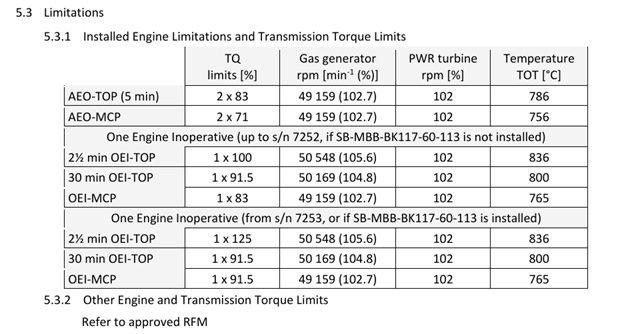
The FCU topping stop limits fuel flow which in turn limits the TOT. So no TOT trigger. The stop setting also requires adjustment after certain maintenance tasks to ensure engine produces max design power. Below is a screenshot of the EASA TCDS which shows the TOT limits with the engine side remaining the same regardless of the SB 113 status.
NOTE The engine is protected against over-TOT and over-torque by a STOP
Joined: Oct 2006
Aviation Qualifications: A&P
Posts: 1,346
Likes: 270
From: USA
I can recall doing topping checks in a 212 once, where I could not hit the Ng stop before reaching ITT limits. I stopped trying at 10,000 ft!
Joined: Oct 1999
Aviation Qualifications: ATPL
Posts: 7,371
Likes: 926
From: Den Haag
I always preferred performing the topping checks on the ground whenever possible, however, not all aircraft would permit that method. In flight topping could become interesting especially when at the moment you record the rotor RPM droop the engine not under test experiences a governor failure and everything gets a bit exciting.
There was an incident at Aberdeen Airport, but I can't find the report because the internet is saturated by more recent accidents of the 332/225 now. Engine replaced with bolts not tightened at the high speed shaft MGB connection (multiple shifts). During ground runs, the connection welded itself from overheating from friction, so was not evident. Commander elected to do the topping check in the visual circuit, with a 700 ft cloud base. Commander elected to manipulate the speed select levers while also the handling pilot. High speed shaft failed with the other engine at idle, on the downwind leg. Commander managed to get it onto a cross runway.
Sorry for thread drift.....
Joined: Jul 2002
Posts: 221
Likes: 18
From: Somewhere, Over the Rainbow
Last edited by TwinHueyMan; 2nd December 2025 at 15:26.
Joined: Oct 2006
Aviation Qualifications: A&P
Posts: 1,346
Likes: 270
From: USA
Joined: Oct 1999
Aviation Qualifications: ATPL
Posts: 7,371
Likes: 926
From: Den Haag
A separate overspeed system was installed due to the disc failures. You’ll find a number of turbines with hydro-mechanical fuel control systems were designed to use a topping or trim procedure to adjust max engine power like the 101. Plus on this side of the spectrum, most models were transmission limited and you would smoke a transmission or twist a mast before your engine gave it up based on the components I've changed after a "dire" situation or two. But as I recall, most Sikorsky models were engine limited and would expense the engines to keep the blades turning which I always thought was a better priority in the big picture.
Yes, part-power stop and one could sign off the check using that stop as the charts were calibrated for its use as it provided a more stabilized environment vs hanging at the outer limits of the power envelop. There was also a "slave" stop for the PT6s that allowed the check to be done on the ground, however, most used the built in part power stop in flight unless it was super cold outside.
Yes, part-power stop and one could sign off the check using that stop as the charts were calibrated for its use as it provided a more stabilized environment vs hanging at the outer limits of the power envelop. There was also a "slave" stop for the PT6s that allowed the check to be done on the ground, however, most used the built in part power stop in flight unless it was super cold outside.
