


Airbus Procedures and callouts

Only half a speed-brake

Joined: Apr 2003
Posts: 4,459
Likes: 136
From: Commuting not home
AviatoR21
I call 3-7 thousand blue because it is expected of me. In the previous company, for 8 years straight, we said FL370. Neither of the two bosses felt the need to have a SOP on this, BTW.
I call 3-7 thousand blue because it is expected of me. In the previous company, for 8 years straight, we said FL370. Neither of the two bosses felt the need to have a SOP on this, BTW.


Joined: Jul 2006
Posts: 1,100
Likes: 111
From: Somewhere over the rainbow
akindofmagic
I saw a couple of guys mentioning that; I guess it's a company or European standard rule? Cause in the Airbus FCOM says to set Standard '' At Transition altitude'' Not before. And '' To set QNH'' When approaching the transition level in the descent.
FCOM-PRO-NOR-SOP- Descent Adjustment.
I saw a couple of guys mentioning that; I guess it's a company or European standard rule? Cause in the Airbus FCOM says to set Standard '' At Transition altitude'' Not before. And '' To set QNH'' When approaching the transition level in the descent.
FCOM-PRO-NOR-SOP- Descent Adjustment.
Joined: Jun 2006
Posts: 200
Likes: 53
From: FLXXX
Before Takeoff Checklist - Flap Setting
Does your operator call Config 1? Or Config 1+F?
I believe as per FCTM you call what the aircraft displays which is 1+F, there is no such thing as Config 1 for takeoff yet I see some pilots respond incorrectly.
Does your operator call Config 1? Or Config 1+F?
I believe as per FCTM you call what the aircraft displays which is 1+F, there is no such thing as Config 1 for takeoff yet I see some pilots respond incorrectly.

Joined: Apr 2013
Aviation Qualifications: CPL
Posts: 368
Likes: 88
From: Neither here or there
True story.
I was jump seating (safety pilot). Obnoxious old fool with traditional Southern American Machismo running through his veins (the trainer) in the left and a new cadet in the right seat. We're starting descent when cadet accidentally trips the autopilot (I still think it was the trainer - known for this sort of thing). Cadet re-engages and announces "AUTOPILOT 2". Trainer berates him "WHERE AUTOPILOT TWO???, IT SAYS AYY PEE TWO!". Cadet, with a lump in his throat, repeats.
Ten seconds later, the Thrust Idle FMA is displayed, cadet calls out ""TEE HAYCH ARR, AYE DEE EL EE". The look on the trainers face after that.
I was jump seating (safety pilot). Obnoxious old fool with traditional Southern American Machismo running through his veins (the trainer) in the left and a new cadet in the right seat. We're starting descent when cadet accidentally trips the autopilot (I still think it was the trainer - known for this sort of thing). Cadet re-engages and announces "AUTOPILOT 2". Trainer berates him "WHERE AUTOPILOT TWO???, IT SAYS AYY PEE TWO!". Cadet, with a lump in his throat, repeats.
Ten seconds later, the Thrust Idle FMA is displayed, cadet calls out ""TEE HAYCH ARR, AYE DEE EL EE". The look on the trainers face after that.
Last edited by CW247; 18th January 2020 at 10:15.
 for a long time.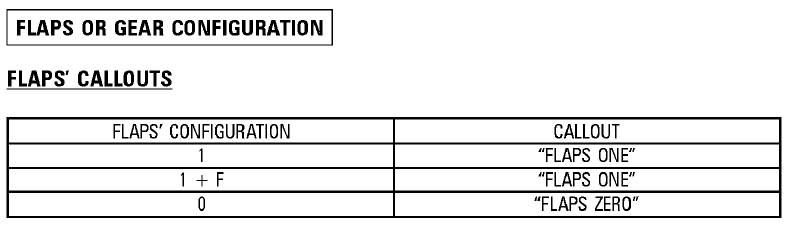


Joined: Nov 1999
Aviation Qualifications: ATPL
Posts: 3,144
Likes: 741
From: UK
[Originally Posted by Check Airman [img]images/buttons/viewpost.gif[/img]
I'm fairly new to the type, but wish Airbus would drop the FMA callouts. I don't see how it accomplishes much.[/QUOTE]
The point is, what is displayed on the FMA is what the computers are actually doing - an output. What is on the FCP is what they have been asked to do - an input. The two are not necessarily the same. Calling and confirming the FMA is a way of ensuring the aircraft will do what you have asked and also of keeping the other pilot in the loop and catching errors and incapacitation.
I'm fairly new to the type, but wish Airbus would drop the FMA callouts. I don't see how it accomplishes much.[/QUOTE]
The point is, what is displayed on the FMA is what the computers are actually doing - an output. What is on the FCP is what they have been asked to do - an input. The two are not necessarily the same. Calling and confirming the FMA is a way of ensuring the aircraft will do what you have asked and also of keeping the other pilot in the loop and catching errors and incapacitation.
Joined: Mar 2006
Posts: 2,633
Likes: 136
From: USA
Uplinker, I agree with everything you've said. My only point is that it's not necessary to say it out loud, to understand what's about to happen. We can use our inside voices.
As I said to the previous poster, my airline (and if I'm not mistaken, at least the five largest operators in the US) does not make FMA calls. Several hundred Airbus airplanes flying around every day with no FMA calls.In fairness, we do a lot of things that are not Airbus SOP (don't get me started on our checklists). At the end of the day, I'm going to follow my SOP. If that means calling out the FMA, so be it. Right now, we're not required to make any FMA calls, so we don't.
Joined: Mar 2001
Posts: 4,562
Likes: 33
From: I wouldn't know.
I believe all those arguments have been done previously in this thread. But yes, i do agree that FMA callouts are not an absolute necessity and can become automated and simply parroted in some cases. Which is actually quite unsafe if you think about it.
The main point is to know and understand them, check expected behaviour against real FMAs and voice anything that does not fit. And that is something i would expect every professional pilot to do.
The main point is to know and understand them, check expected behaviour against real FMAs and voice anything that does not fit. And that is something i would expect every professional pilot to do.

