


Flaps-down G limits?

Thread Starter
Joined: Jun 2002
Aviation Qualifications: PPL
Posts: 7,177
Likes: 297
From: Nanaimo (CAC8)
Flaps-down G limits?
I could have posted this on the Questions forum, but I figured that there are enough knowledgeable people on this forum and that the answer would be of interest to PPLs.
Why is the flaps-down G limit for most (all?) aircraft restricted to +2.0 to 0.0 G? I am particularly interested in the reason for prohibiting negative G.
These limits apply to all the light aircraft that I have flown and I see that it also applies to transports - the 737 for example. I have done some Internet research, but haven’t found any conclusive information.
Another related question concerns the ASI white arc. Is the flap limiting speed (Vf?) applicable to all flap deflections? I have always assumed it is.
Why is the flaps-down G limit for most (all?) aircraft restricted to +2.0 to 0.0 G? I am particularly interested in the reason for prohibiting negative G.
These limits apply to all the light aircraft that I have flown and I see that it also applies to transports - the 737 for example. I have done some Internet research, but haven’t found any conclusive information.
Another related question concerns the ASI white arc. Is the flap limiting speed (Vf?) applicable to all flap deflections? I have always assumed it is.

Avoid imitations


Joined: Nov 2000
Aviation Qualifications: ATPL
Posts: 15,115
Likes: 1,091
From: Wandering the FIR and cyberspace often at highly unsociable times
If the flaps are up, they can flex across their chord, along with the wings and their associated hinge points because they all lie in the same orientation. If they are down, when the wings flex, the hinge points will move with the wing but the flaps won't bend because they are not in the same orientation. This will put a big load on the hinge points.
Try simulating this using a sheet of paper. It all flexes very easily. If you crease a third of it, lengthways to make a "flap" and then "lower" the flap and try flexing it again, the paper will crumple along the bend.
P.S. EMUAS Rule OK!
Try simulating this using a sheet of paper. It all flexes very easily. If you crease a third of it, lengthways to make a "flap" and then "lower" the flap and try flexing it again, the paper will crumple along the bend.
P.S. EMUAS Rule OK!

Fleet Manager


Joined: Aug 2006
Aviation Qualifications: CPL
Posts: 7,090
Likes: 2,952
From: Ontario, Canada
The plus 2, minus zero G limits for flaps extended are based upon the certification requirement. I'm sure that a wise aeronautical engineer back in the day realizes that there is no plausible reason to deliberately enter negative G with the flaps extended, nor be pulling more than 2G. That said, the airframe will withstand more, it is just not needed for certification.

Joined: Oct 2004
Aviation Qualifications: CPL
Posts: 421
Likes: 40
From: California
Moderator


Joined: Feb 2000
Aviation Qualifications: CPL
Posts: 14,480
Likes: 178
From: UK
The plus 2, minus zero G limits for flaps extended are based upon the certification requirement. I'm sure that a wise aeronautical engineer back in the day realizes that there is no plausible reason to deliberately enter negative G with the flaps extended, nor be pulling more than 2G. That said, the airframe will withstand more, it is just not needed for certification.
G
Joined: Jun 2008
Posts: 519
Likes: 16
From: Luton
Originally Posted by India Four Two View Post
Another related question concerns the ASI white arc. Is the flap limiting speed (Vf?) applicable to all flap deflections? I have always assumed it is.
Vfe is the limit with (full) flaps extended. Many aircraft allow partial flaps at higher speeds. Those limits will be on a panel placard.
Another related question concerns the ASI white arc. Is the flap limiting speed (Vf?) applicable to all flap deflections? I have always assumed it is.
Vfe is the limit with (full) flaps extended. Many aircraft allow partial flaps at higher speeds. Those limits will be on a panel placard.
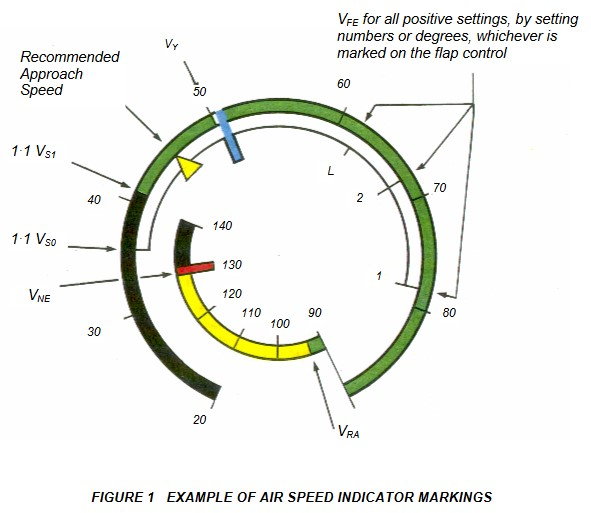
EASA Certification Specifications provide for multiple markings on the white arc to show Vfe for different flap settings.
Last edited by Jim59; 27th June 2020 at 11:03.

Joined: Dec 2006
Posts: 2,486
Likes: 8
From: The No Transgression Zone
I haven't seen the term spanwise load distribution in a while...some old stuff I wrote about spanwise load distribution hopefully nothing is wrong and maybe a little helpful
Effect of Span-Loading on Aircraft Performance
Effect of Span-Loading on Aircraft Performance
Joined: May 2005
Posts: 1,198
Likes: 32
From: France
[QUOTE]With the large nose down pitching moments from the flaps the tail balancing loads are increased. Can be a critical design case for the tail structure.[/QUOTE]
If you’ve ever flown an Aztec or a Cessna 152, you’ll be surprised that they both pitch up quite strongly when the flaps are initially extended.
If you’ve ever flown an Aztec or a Cessna 152, you’ll be surprised that they both pitch up quite strongly when the flaps are initially extended.
Joined: Mar 2009
Posts: 395
Likes: 63
From: UK
wave turbulence. Often needed to get rid of flaps fast - those cantilevered flap hinges produced large twisting loads.
Joined: Dec 2006
Posts: 2,486
Likes: 8
From: The No Transgression Zone
I also get those flaps retracted at the speed of light as soon as I recognize it.
Thread Starter
Joined: Jun 2002
Aviation Qualifications: PPL
Posts: 7,177
Likes: 297
From: Nanaimo (CAC8)
Lots of interesting input. This was obviously a question that was lurking and just waiting to be asked!
Thanks Pilot DAR (and GTE for the follow up). There is an analogous situation with demonstrated crosswind velocity in gliders. The regulations require demonstration of satisfactory landing characteristics up to 0.2 Vso. Given the generally low stall-speeds of gliders and the unwillingness of manufactures to spend more money than is necessary during certification, we end up with ludicrously low demonstrated crosswind values in the POHs. For example, the Flight Manual of the DG1000S that I fly has this in the Limitations section:
However, later on in the Normal Procedures section, we have this informative but at the same time useless wording:
PDR1 wrote:
The C182 that I used to fly required a strong push and lots of nose-down trimming when going from zero to 40º flap. Are you saying that if I didn't push, it would have eventually stabilized in a nose-down attitude? I can't do a test, because it was written off last year.
I'm sure that a wise aeronautical engineer back in the day realizes that there is no plausible reason to deliberately enter negative G with the flaps extended, nor be pulling more than 2G. That said, the airframe will withstand more, it is just not needed for certification.
2.12 Crosswinds
The demonstrated crosswind velocity is 15 km/h (8 kts.) according to the airworthiness requirements.
The demonstrated crosswind velocity is 15 km/h (8 kts.) according to the airworthiness requirements.
4.5.1 Launch
... Take-off with strong crosswind is possible.
... Take-off with strong crosswind is possible.
Not really a surprise, just the transient vs the steady-state case. Flaps mostly (nearly always) produce a steady-state nose-down trim change, ...
Fleet Manager
Joined: Aug 2006
Aviation Qualifications: CPL
Posts: 7,090
Likes: 2,952
From: Ontario, Canada
Are you saying that if I didn't push, it would have eventually stabilized in a nose-down attitude?
Though some Cessna POH's state that it is possible to actually flare and land without an elevator input, I've only once done this, while flying with a skilled safety pilot, who was about to take over and land, as I did not have my hands on the control wheel at all. Getting to the top of the flare with no elevator control is relatively easy, flaring not so easy....
Thread Starter
Joined: Jun 2002
Aviation Qualifications: PPL
Posts: 7,177
Likes: 297
From: Nanaimo (CAC8)
Well, well, after 53 years of flying, I did something new and learned something new today! I was flying a Bellanca Scout towplane and I looked at the stick-free behaviour when lowering full-flap. The Scout only has 27º flaps, not the C182's 40º barn-door flaps, but adequate for this experiment.
I was in the first stage of descent after glider release - flaps up, 2100 RPM, trimmed for 80 mph. With hands off the stick, I then quickly applied full flap. The nose pitched up to 15-20º above the horizon and the IAS reduced to a minimum of 55 mph. The Scout then entered a phugoid with about a 15 second period. During the first cycle, the maximum IAS was 85 mph (Vfe is 100 mph). Subsequent cycles were significantly damped compared to the first one, but the phugoid was still present after six cycles, with the IAS oscillating around a nominal 65 mph.
After stabilizing the IAS, I then tried the obvious thing - raising the flaps. A very similar experience, but in reverse. The nose pitched down and the IAS reached 90 mph, before oscillating with 15 second phugoids and eventually beginning to stabilize around 80 mph.
I'm going to try that again, but with a flight recorder. I'm also going to look at the difference in trim position between the stick-free flaps-down speed and after retrimming when putting the flaps down.
I was in the first stage of descent after glider release - flaps up, 2100 RPM, trimmed for 80 mph. With hands off the stick, I then quickly applied full flap. The nose pitched up to 15-20º above the horizon and the IAS reduced to a minimum of 55 mph. The Scout then entered a phugoid with about a 15 second period. During the first cycle, the maximum IAS was 85 mph (Vfe is 100 mph). Subsequent cycles were significantly damped compared to the first one, but the phugoid was still present after six cycles, with the IAS oscillating around a nominal 65 mph.
After stabilizing the IAS, I then tried the obvious thing - raising the flaps. A very similar experience, but in reverse. The nose pitched down and the IAS reached 90 mph, before oscillating with 15 second phugoids and eventually beginning to stabilize around 80 mph.
I'm going to try that again, but with a flight recorder. I'm also going to look at the difference in trim position between the stick-free flaps-down speed and after retrimming when putting the flaps down.
Last edited by India Four Two; 3rd July 2020 at 02:31.