


4 Engine Tiltrotor Drone

Thread Starter
Ecce Homo! Loquitur...

Joined: Jul 2000
Aviation Qualifications: Spotter
Posts: 24,543
Likes: 7,271
From: Peripatetic
4 Engine Tiltrotor Drone
Four engined tiltrotor drone - interesting alternative design......
Last edited by Senior Pilot; 18th November 2024 at 21:07. Reason: Add video


Joined: Jul 2013
Aviation Qualifications: Non-Aircrew
Posts: 5,677
Likes: 3,322
From: Everett, WA
I suspect that wing hinge will not scale up well - lots of stresses going through a small point. OK when the forces are measured in lbs./newtons, far different matter when they are measured in tons.
Thread Starter
Ecce Homo! Loquitur...
Joined: Jul 2000
Aviation Qualifications: Spotter
Posts: 24,543
Likes: 7,271
From: Peripatetic
The point would be the crossover point in weight.
Design would give a useful ceiling/speed/weight advantage over classic rotary design.
Useful for maritime use?
Design would give a useful ceiling/speed/weight advantage over classic rotary design.
Useful for maritime use?
Joined: Oct 2019
Aviation Qualifications: Non-Aircrew
Posts: 1,697
Likes: 1,073
From: USA
For versatility I prefer the helicopters with the pusher propeller to improve speed and range.
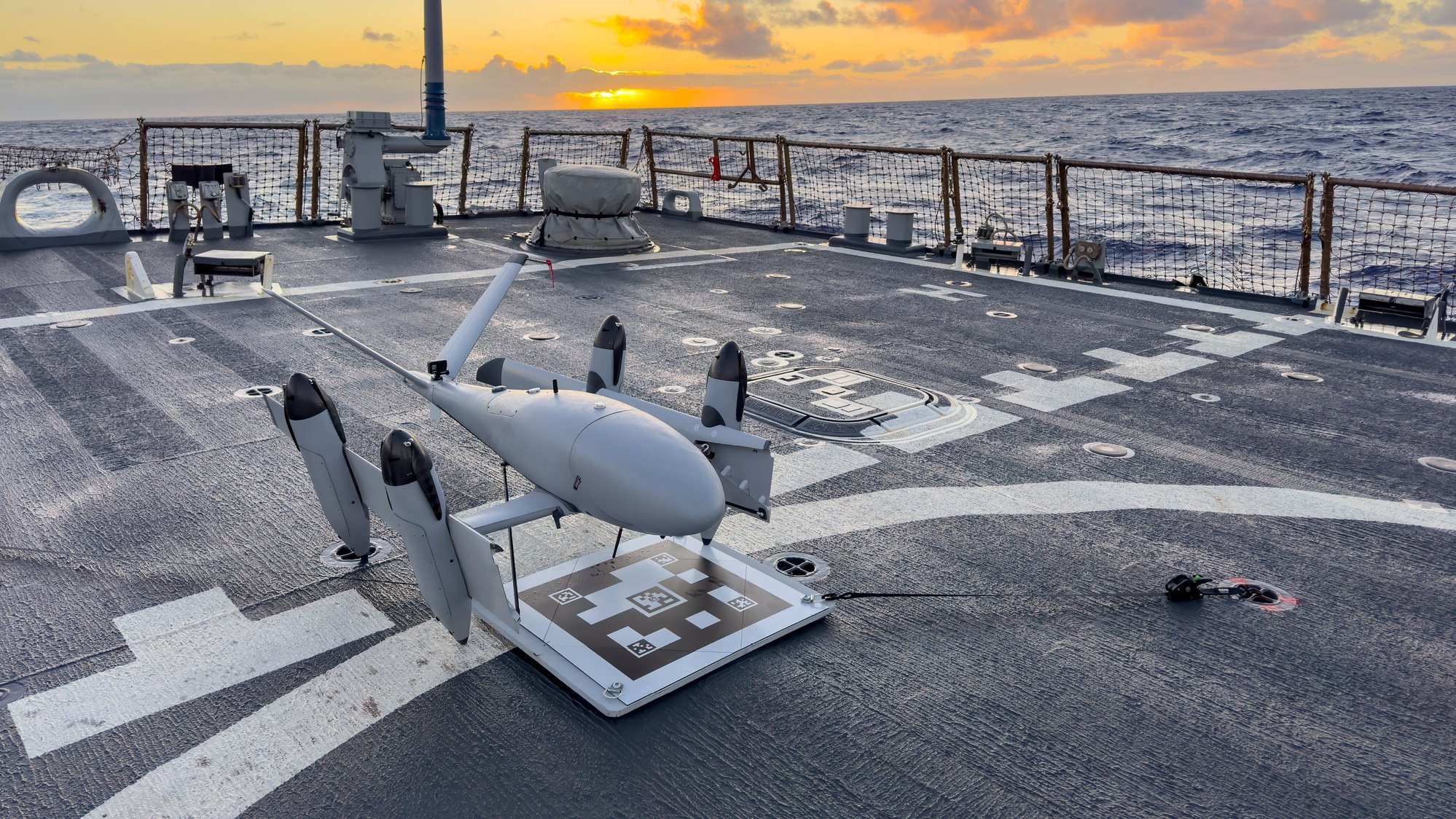
It appears to be a PteroDynamics Swing Wing Drone concept
It could improve speed, altitude, and range over a helicopter but at a cost in the weight of the hinge and complexity. In comparison the the V-22, for example, having a power-train carry-through to mitigate an engine failure seems ridiculously expensive and will be needed for the turbine engines that a larger scale aircraft will require as the electric motors don't have the battery capacity to support their use.
For small/drone/RPV use, I don't see the folding of wings to vertical landing as a critical value. There are already control programs to allow fairly easy transition to tail-first landings in the vertical position.
A video from early development; haven't watched it, but it was part of a good enough effort to get funding to eventually make a US Navy demo:
It appears to be a PteroDynamics Swing Wing Drone concept
It could improve speed, altitude, and range over a helicopter but at a cost in the weight of the hinge and complexity. In comparison the the V-22, for example, having a power-train carry-through to mitigate an engine failure seems ridiculously expensive and will be needed for the turbine engines that a larger scale aircraft will require as the electric motors don't have the battery capacity to support their use.
For small/drone/RPV use, I don't see the folding of wings to vertical landing as a critical value. There are already control programs to allow fairly easy transition to tail-first landings in the vertical position.
A video from early development; haven't watched it, but it was part of a good enough effort to get funding to eventually make a US Navy demo:

Thread Starter
Ecce Homo! Loquitur...
Joined: Jul 2000
Aviation Qualifications: Spotter
Posts: 24,543
Likes: 7,271
From: Peripatetic
Interesting video.
https://www.edrmagazine.eu/transwing...ght-in-britain
https://www.ainonline.com/aviation-n...-vtol-aircraft
https://www.edrmagazine.eu/transwing...ght-in-britain
In detailed design currently is the X-P5, which is due to emerge into more public view in the second quarter of 2025. This model will be larger, weighing in at 150 kg with a payload capacity of 27 kg and a hybrid internal combustion engine configuration. With similar speed performance to the X-P4, the 6 metres wingspan X-P5 will offer a range of 600 nm and an endurance in the region of 10 hours.
At the conceptual design stage is the X-P7, an altogether different animal with a wingspan of 10 metres, an MTOW of 1,400 kg and a useful payload of 280 kg, though design studies suggest that carrying payloads of up to 300 kg is potentially achievable. With a cruise speed of 120 kt, a dash speed capability of 180 and a range of 1,000 nm at MTOW, the X-P7 has been designed with maritime operations in mind, with a wide range of applications possible: expeditionary logistics, land strike, ISR, maritime strike – truly a flexible asset to enhance military – and security – operations, particularly with an endurance of nine hours at MTOW and a practical cruise ceiling around 18,000 ft.
Traditionally, critical items delivered by air for resupply are conducted using manned aviation assets. On the basis of ‘Think Big, Start Small and Scale at Pace”, the payloads selected for the Transwing X-P4 and X-P5 variants have been driven by studies into critical resupply to ships. A study of 3,500 sorties using helicopters found that 46% had a payload under 1 kg and over 90% were under 25 kg. The ability of Transwing to carry payloads that land and launch on moving vessels and vehicles, coupled with a significantly reduced real estate footprint underscores its adaptability for at sea and land applications, where autonomous operation and payload delivery are becoming increasingly critical requirements.
At the conceptual design stage is the X-P7, an altogether different animal with a wingspan of 10 metres, an MTOW of 1,400 kg and a useful payload of 280 kg, though design studies suggest that carrying payloads of up to 300 kg is potentially achievable. With a cruise speed of 120 kt, a dash speed capability of 180 and a range of 1,000 nm at MTOW, the X-P7 has been designed with maritime operations in mind, with a wide range of applications possible: expeditionary logistics, land strike, ISR, maritime strike – truly a flexible asset to enhance military – and security – operations, particularly with an endurance of nine hours at MTOW and a practical cruise ceiling around 18,000 ft.
Traditionally, critical items delivered by air for resupply are conducted using manned aviation assets. On the basis of ‘Think Big, Start Small and Scale at Pace”, the payloads selected for the Transwing X-P4 and X-P5 variants have been driven by studies into critical resupply to ships. A study of 3,500 sorties using helicopters found that 46% had a payload under 1 kg and over 90% were under 25 kg. The ability of Transwing to carry payloads that land and launch on moving vessels and vehicles, coupled with a significantly reduced real estate footprint underscores its adaptability for at sea and land applications, where autonomous operation and payload delivery are becoming increasingly critical requirements.


Joined: Apr 2002
Aviation Qualifications: PPL
Posts: 1,264
Likes: 57
From: Surrey, UK ;
My concern with every style of "drone" I have seen so far is what happens if one of the motors fails ? Without complex and expensive power cross connections, I'd worry that they became uncontrollable.
Thread Starter
Ecce Homo! Loquitur...
Joined: Jul 2000
Aviation Qualifications: Spotter
Posts: 24,543
Likes: 7,271
From: Peripatetic
My concern with every style of "drone" I have seen so far is what happens if one of the motors fails?
One of the advantages given in the video in MechEngr’s post is the quick transition either way - around 10 seconds, and controllability during the transition.
Joined: Oct 2019
Aviation Qualifications: Non-Aircrew
Posts: 1,697
Likes: 1,073
From: USA
When it is in hover the CG is located very close to the forward 2 motors; losing either of those during take-of/landing will make for a bad day. The remaining motors do not form a triangle with the CG inside of it.
Joined: Dec 2001
Aviation Qualifications: ATPL
Posts: 3,760
Likes: 424
From: GA, USA

Joined: Jul 2006
Posts: 2,192
Likes: 240
From: The back of beyond
My concern with every style of "drone" I have seen so far is what happens if one of the motors fails ? Without complex and expensive power cross connections, I'd worry that they became uncontrollable.
Last edited by melmothtw; 19th November 2024 at 19:01.
Joined: Nov 2010
Posts: 880
Likes: 225
From: Australia
Last edited by helispotter; 19th November 2024 at 21:37.
Joined: Nov 2010
Posts: 880
Likes: 225
From: Australia
This raises an interesting question over what safety philosophy is required. If such craft remain uncrewed, even when scaled up as far as is feasible, concern is no longer for safety of anyone on board, rather the safety of people on the ground or a ship and to a lesser extent the loss of the asset itself. For resupply missions, SOPs could require personnel on ground to remain well clear until a load release or a safe shutdown "on deck"? You would want to avoid introducing complex and heavy mechanical cross connections as the viability of the concept would soon be lost.
Joined: Oct 2019
Aviation Qualifications: Non-Aircrew
Posts: 1,697
Likes: 1,073
From: USA
The overall CG shifts back, but the CG of the majority of the mass that is in the fuselage in the form of batteries and payload doesn't move. It remains at roughly 25% chord and that is the load being carried at the swing/tilt hinge. The moment applied by the motors at relative to that 25% chord has to be zero to keep the aircraft in balance.
During hover the rear position motors are each carrying only their own weight and whatever a roughly quarter span of the wing weighs. If a forward position motor is lost, the other motors have no thrust solution and the aircraft will no longer balance. The overall CG is back a small amount but it looks to me that it lies outside the thrust triangle
Maybe I missed the easy to perform demo of an engine/motor out condition?
As long as they stick to electric motors and small aircraft they can get away with it. But moving to turboprops or turbojets to get far larger aircraft will not see a good solution to this problem.
During hover the rear position motors are each carrying only their own weight and whatever a roughly quarter span of the wing weighs. If a forward position motor is lost, the other motors have no thrust solution and the aircraft will no longer balance. The overall CG is back a small amount but it looks to me that it lies outside the thrust triangle
Maybe I missed the easy to perform demo of an engine/motor out condition?
As long as they stick to electric motors and small aircraft they can get away with it. But moving to turboprops or turbojets to get far larger aircraft will not see a good solution to this problem.
