


Future Carrier (Including Costs)


Joined: Apr 2009
Posts: 2,049
Likes: 535
From: Wherever it is this month
One possible NATO scenario puts a UK carrier based ASW task group (with NATO frigates and SSKs) in the Eastern Atlantic and/or GIUK gap to conduct task group ASW (Merlins with dipping sonar, frigates (and destroyers) with towed array (and hull mounted) sonar and submarines as part of the task group. Meanwhile the F-35B can counter Bears, Backfires, and so on.
The UK has committed a carrier capability to NATO, and this seems similar to the Cold War and the roles of CVS/Sea Harrier/Sea King.
The UK has committed a carrier capability to NATO, and this seems similar to the Cold War and the roles of CVS/Sea Harrier/Sea King.
You need speed, good range and endurance, large numbers of air-to-air weapons, early warning and ideally tanker support to make a good fist of the air defence role. None of those are strong suits of the QEC air wing. In the NATO context, it has to be said that the USN air wings are much better-suited to it.
I'm ready for the 'party line' response to that, too: that the UK carrier group's availability lets the US do something else with one of theirs. But one of the aims of NATO is famously to 'keep the Americans in' and offering them an off-ramp seems an odd way of going about that. Besides, you only have to follow the news to wonder whether the 'something else' would always be aligned to British interests.
It's not a compelling narrative, IMHO. If there is a SDSR next year (which looks all the more likely now that we'll have a new government as the 5-year point since SDSR15 approaches) then there will be some interesting debate about how to beef up QEC group capabilities so that it can do more under Article V than simply relieve the US of an Atlantic commitment. Where would the cuts fall to make that happen? Or might it be decided that QEC will stay ocean-bound in any Article V plans, leading to announcement of the first UK A-model acquisitions? An interesting year beckons, for sure.
Last edited by Easy Street; 2nd November 2019 at 01:11.

Ecce Homo! Loquitur...

Joined: Jul 2000
Aviation Qualifications: Spotter
Posts: 24,550
Likes: 7,281
From: Peripatetic
The Role of the Invincible class in the Cold War was as part of the outer screen for a CBG with the Shar able to launch and “hack the shad” as Bear-Ds Tracking the fleet slipped in and out of long range radar cover outside CAP range. Not a role the F-35B will be suitable or able to perform from the centre of its own CBG, and far less capable at the CAP role than the F-14/F-18s if the era.
The threat itself also having been retired and replaced by satellite surveillance. Regardless I cannot see the RN being willing to use the QE as a sacrificial goat to protect a USN carrier.
The threat itself also having been retired and replaced by satellite surveillance. Regardless I cannot see the RN being willing to use the QE as a sacrificial goat to protect a USN carrier.
Thread Starter

Joined: Feb 2002
Posts: 2,968
Likes: 102
From: Devon
The primary role of the Invincible class was to operate nine or so ASW Sea Kings for task group ASW in the Atlantic and GIUK gap. The Sea Harrier came later (and the anti Bear role existed because the Bear provided long range targeting for Soviet submarine launched missiles) - and the AEW Sea King after that. I have no idea what the party line is today - but I assume were are still in the business of maritime task groups, and crisis response shipping -and they are major exercises planned such as DEFENDER 2020.
The carrier will not always have to have as many jets aboard as possible. This was one of the reasons for acquiring the B, as the C version would mean constant deck landing training. For some reason people overlook this, like they ignore the manpower needed for cats and traps..
This looks like a tooled up jet to me:
The carrier will not always have to have as many jets aboard as possible. This was one of the reasons for acquiring the B, as the C version would mean constant deck landing training. For some reason people overlook this, like they ignore the manpower needed for cats and traps..
This looks like a tooled up jet to me:
Last edited by WE Branch Fanatic; 2nd November 2019 at 16:51.
Joined: Jan 2004
Posts: 2,682
Likes: 63
From: Far West Wessex
The F135 STOVL propulsion system weighs almost 4,000 lb more than the CTOL version. I would guess that this number includes only the bits for which P&W as prime is responsible, which would not include doors and actuators.
The difference in OEW is less, as Engines correctly points out, but that is due to the omission of the gun and its feed system and an aggressively lightened airframe.
As for the F-35C: It was the last version to close and the wing area and OEW continued to grow through 2006. 35 per cent bigger wing than a Super Hornet, because it lacks an effective high-lift system. I don't think it's a great example of a CV penalty at work.
On the Rafale commonality: I don't have any parts-count numbers, but I do know that Dassault employed and improved CATIA with the aim of getting the best balance between eliminating "scar weight" on the CTOL and maintaining commonality. Some of this involved the idea of "cousin parts" - differing in weight and strength but fitting together in the same way - and the idea of concentrating the difference in the smallest possible number of parts. This was a JSF goal but I think a lot of it went out of the window in the Great Weight Panic.
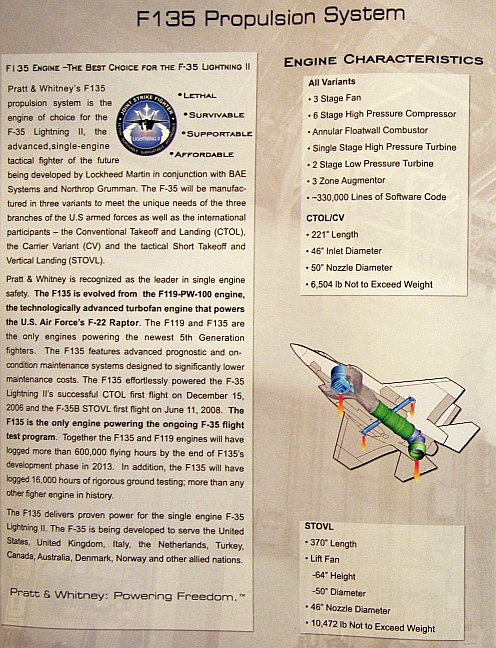
The difference in OEW is less, as Engines correctly points out, but that is due to the omission of the gun and its feed system and an aggressively lightened airframe.
As for the F-35C: It was the last version to close and the wing area and OEW continued to grow through 2006. 35 per cent bigger wing than a Super Hornet, because it lacks an effective high-lift system. I don't think it's a great example of a CV penalty at work.
On the Rafale commonality: I don't have any parts-count numbers, but I do know that Dassault employed and improved CATIA with the aim of getting the best balance between eliminating "scar weight" on the CTOL and maintaining commonality. Some of this involved the idea of "cousin parts" - differing in weight and strength but fitting together in the same way - and the idea of concentrating the difference in the smallest possible number of parts. This was a JSF goal but I think a lot of it went out of the window in the Great Weight Panic.
Joined: Dec 2006
Posts: 786
Likes: 2
From: UK
LO,
Sorry, I think I could helpfully respond here:
The empty weights I quoted were actual 'as weighed' from the 2016 OT&E report. Once again, for clarity, all three variants (that's A, B and C) have 'aggressively lightened airframes'.
Yes, the B and C don't have an internal gun, but the point I was trying to get over (and clearly not doing very well ) is that the B and C both have substantial 'penalty weights' for ship operation. (I suppose I could make the argument that the A model carries a penalty weight for having to have a gun - I believe that it was the only variant for which an internal gun was specified in the System Requirement Document). The B and C also lack the heavy boom refuelling receptacle that the USAF demanded for the A. Apples and oranges and all that....
LO is correct that the C was the last variant to be designed, but I'm not sure that this is relevant to the weight issues. For clarity, the original 'batting order' for the programme was A, then B, then C. Once the weight problem was realised around 2004, the weight reduction effort was focussed first on the B, as that was the variant most severely affected. From then on, the batting order ran B, A, then C. Almost all of the weight saving measures developed for the B were moved over to both the A and the C. What is true is that the C was able to exploit most of the B's weight saving changes earlier in its design cycle than the A, so there was less rework than on the A. One big measure it couldn't adopt, though, were the reduced size tail fins - the C had to keep its big fins for the low speed approach.
Yes, the F-35C does lack the F/A-18's slotted flaps, but that was driven by LO issues and known at the outset when the wing was sized. I have to gently disagree and say that, for my money at least, the F-35C's design is a perfectly valid example of a 'CV penalty'. I had some involvement in some of the CV specific design work and I can confirm that deck ops exacted a significant penalty in weight. The main thing I took away was that the DOD's selection of carrier approach speed (Vpa) as a Key Performance Parameter (KPP) was absolutely on the nail - it was the parameter that drove much of the C's design.
LM used CATIA, not always as well as other companies I worked with, but they got better as time went on. Yes, they wanted to limit the number of differences between variants, but during the weight reduction effort they had to make more compromises than they originally wanted. In some cases, it was found that 'commonality' was imposing severe weight penalties, and variant specific changes were essential. As to 'cousin parts', LM used the idea frequently, and had been for some time - McDonnell Douglas were certainly using them in the 1970s and 80s. As I've posted a number of times, LM made a poor job of the airframe design and, unforgivably for any combat aircraft but especially for a power lift aircraft, failed to keep control of airframe weight. In my view (and just opinion) it cost the programme at least two years and a ton of money.
I hope these posts help people understand that getting the F-35 programme across the line has been a massively difficult undertaking. Yes, one can pillory LM for not doing better. One can also recognise that they (and NG and BAES) have made some towering technical achievements along the way to get the programme to where it is now. And those achievements rest on sheer hard work and brilliance from thousands of dedicated people.
Best regards as ever to my friends at LM and BAES,
Engines
PS: and now I really will go quiet for a bit.
Sorry, I think I could helpfully respond here:
The empty weights I quoted were actual 'as weighed' from the 2016 OT&E report. Once again, for clarity, all three variants (that's A, B and C) have 'aggressively lightened airframes'.
Yes, the B and C don't have an internal gun, but the point I was trying to get over (and clearly not doing very well ) is that the B and C both have substantial 'penalty weights' for ship operation. (I suppose I could make the argument that the A model carries a penalty weight for having to have a gun - I believe that it was the only variant for which an internal gun was specified in the System Requirement Document). The B and C also lack the heavy boom refuelling receptacle that the USAF demanded for the A. Apples and oranges and all that....
LO is correct that the C was the last variant to be designed, but I'm not sure that this is relevant to the weight issues. For clarity, the original 'batting order' for the programme was A, then B, then C. Once the weight problem was realised around 2004, the weight reduction effort was focussed first on the B, as that was the variant most severely affected. From then on, the batting order ran B, A, then C. Almost all of the weight saving measures developed for the B were moved over to both the A and the C. What is true is that the C was able to exploit most of the B's weight saving changes earlier in its design cycle than the A, so there was less rework than on the A. One big measure it couldn't adopt, though, were the reduced size tail fins - the C had to keep its big fins for the low speed approach.
Yes, the F-35C does lack the F/A-18's slotted flaps, but that was driven by LO issues and known at the outset when the wing was sized. I have to gently disagree and say that, for my money at least, the F-35C's design is a perfectly valid example of a 'CV penalty'. I had some involvement in some of the CV specific design work and I can confirm that deck ops exacted a significant penalty in weight. The main thing I took away was that the DOD's selection of carrier approach speed (Vpa) as a Key Performance Parameter (KPP) was absolutely on the nail - it was the parameter that drove much of the C's design.
LM used CATIA, not always as well as other companies I worked with, but they got better as time went on. Yes, they wanted to limit the number of differences between variants, but during the weight reduction effort they had to make more compromises than they originally wanted. In some cases, it was found that 'commonality' was imposing severe weight penalties, and variant specific changes were essential. As to 'cousin parts', LM used the idea frequently, and had been for some time - McDonnell Douglas were certainly using them in the 1970s and 80s. As I've posted a number of times, LM made a poor job of the airframe design and, unforgivably for any combat aircraft but especially for a power lift aircraft, failed to keep control of airframe weight. In my view (and just opinion) it cost the programme at least two years and a ton of money.
I hope these posts help people understand that getting the F-35 programme across the line has been a massively difficult undertaking. Yes, one can pillory LM for not doing better. One can also recognise that they (and NG and BAES) have made some towering technical achievements along the way to get the programme to where it is now. And those achievements rest on sheer hard work and brilliance from thousands of dedicated people.
Best regards as ever to my friends at LM and BAES,
Engines
PS: and now I really will go quiet for a bit.

Joined: Aug 2012
Aviation Qualifications: Spotter
Posts: 343
Likes: 173
From: Scotland
Thread Starter
Joined: Feb 2002
Posts: 2,968
Likes: 102
From: Devon
The second part of Chris Terrill's documentary about HMS Queen Elizabeth and last years WESTLANT 18 deployment is in BBC2 at 2000 GMT tonight. Last week focused a lot on the first F-35B landing and take off, but also mentioned the ASW role of the Merlin HM2.
I believe it is on BBC iPlayer too.
When the replacement for the Invincible class CVS (ASW carrier) was first studied in the nineties, it was apparent that larger carriers were needed. The 20 000 size of the Invincibles was a legacy of their origin as platforms for ASW in the NATO theatre, operating sufficient helicopters for constant dipping (sonar in water). It just so happened they making them just a little larger allowed a Harrier sized aircraft to be operated. This was useful as the Soviet submarines often carried missiles with guidance provided by Bears, so Harrier became Sea Harrier to 'hack the shad'. The addition of an AEW capability post Falklands meant that the jets could be used more effectively than standing constant CAP.
In the nineties, the small size of the CVS limited our ability to carry a meaningful number of jets, both Sea Harrier (primarily air defence) and Harrier GR7/9, plus the ASW and AEW helicopters. Post Cold War, the assumption was made that Cold War type missions such as ASW, fleet defence, protecting sea lines of communication and so on were things of the past, as we opted to fight campaigns in landlocked (or nearly landlocked), so the politicians, and public bought into the carriers = attack only type thinking.
F-35B was the only V/STOL successor to Sea Harrier/Harrier, and was intended to be capable of the full range of missions including Defensive Counter Air and Offensive Counter Air. Even without security and Geopolitical issues with Russia, it should have been clear that after Iraq and Afghanistan, the next conflict would most likely involve an adversary with naval and air capabilities such as submarines or MiGs.
Part of the problem (for the RN) is that no record was kept of why STOVL was the preferred option (cost of equipment, the training burden, manpower, and operating limits for smaller carriers in higher sea states) to inform the politicians, nor were the whole ship aspects of fixed wing flying properly articulated.
I believe it is on BBC iPlayer too.
When the replacement for the Invincible class CVS (ASW carrier) was first studied in the nineties, it was apparent that larger carriers were needed. The 20 000 size of the Invincibles was a legacy of their origin as platforms for ASW in the NATO theatre, operating sufficient helicopters for constant dipping (sonar in water). It just so happened they making them just a little larger allowed a Harrier sized aircraft to be operated. This was useful as the Soviet submarines often carried missiles with guidance provided by Bears, so Harrier became Sea Harrier to 'hack the shad'. The addition of an AEW capability post Falklands meant that the jets could be used more effectively than standing constant CAP.
In the nineties, the small size of the CVS limited our ability to carry a meaningful number of jets, both Sea Harrier (primarily air defence) and Harrier GR7/9, plus the ASW and AEW helicopters. Post Cold War, the assumption was made that Cold War type missions such as ASW, fleet defence, protecting sea lines of communication and so on were things of the past, as we opted to fight campaigns in landlocked (or nearly landlocked), so the politicians, and public bought into the carriers = attack only type thinking.
F-35B was the only V/STOL successor to Sea Harrier/Harrier, and was intended to be capable of the full range of missions including Defensive Counter Air and Offensive Counter Air. Even without security and Geopolitical issues with Russia, it should have been clear that after Iraq and Afghanistan, the next conflict would most likely involve an adversary with naval and air capabilities such as submarines or MiGs.
Part of the problem (for the RN) is that no record was kept of why STOVL was the preferred option (cost of equipment, the training burden, manpower, and operating limits for smaller carriers in higher sea states) to inform the politicians, nor were the whole ship aspects of fixed wing flying properly articulated.

Joined: May 1999
Aviation Qualifications: ATP+Mil
Posts: 27,395
Likes: 857
From: Quite near 'An aerodrome somewhere in England'
The second part of Chris Terrill's documentary about HMS Queen Elizabeth and last years WESTLANT 18 deployment is on BBC2 at 2000 GMT tonight.

Joined: Jan 2004
Posts: 2,682
Likes: 63
From: Far West Wessex
Peace, Engines...
We seem to be mostly in factual agreement. The interesting thing is that discussing "penalties" or "scar weight" in the A/B/C context depends on which version is considered as the baseline - but thinking about it some more, this may be misleading, since none of the versions is the baseline.
The key to understanding the aerodynamic, structural and propulsion elements of the F-35 design is that no aircraft in history, that I can think of, has had such diverse and competing requirements imposed on it, along with a battery of non-negotiable constraints.
t was much more than what the late George Muellner described as "three versions differing only in how they took off and landed". CV requirements meant (eventually) quad tails and either a large wing, or the ability to accommodate two wing sizes. STOVL mandated a single large engine, located close to the CG, along with minimal OEW. Compatibility with different ships imposed limits on span and length. LO demanded large internal volume, translating into a rather broad body and an unusual relationship of net to gross wing area, and was unforgiving regarding changes to the mold line - all versions had to have the same wing sweep.
It would all have been hard enough, even without the USAF's willingness to die on the barricades to protect sustained 9g. For what it's worth, I don't think any of the designs submitted in 1996 would have done any better than the F-35. The engineers did their best, but there was no elegant solution to the problem enshrined in the JORD.
We seem to be mostly in factual agreement. The interesting thing is that discussing "penalties" or "scar weight" in the A/B/C context depends on which version is considered as the baseline - but thinking about it some more, this may be misleading, since none of the versions is the baseline.
The key to understanding the aerodynamic, structural and propulsion elements of the F-35 design is that no aircraft in history, that I can think of, has had such diverse and competing requirements imposed on it, along with a battery of non-negotiable constraints.
t was much more than what the late George Muellner described as "three versions differing only in how they took off and landed". CV requirements meant (eventually) quad tails and either a large wing, or the ability to accommodate two wing sizes. STOVL mandated a single large engine, located close to the CG, along with minimal OEW. Compatibility with different ships imposed limits on span and length. LO demanded large internal volume, translating into a rather broad body and an unusual relationship of net to gross wing area, and was unforgiving regarding changes to the mold line - all versions had to have the same wing sweep.
It would all have been hard enough, even without the USAF's willingness to die on the barricades to protect sustained 9g. For what it's worth, I don't think any of the designs submitted in 1996 would have done any better than the F-35. The engineers did their best, but there was no elegant solution to the problem enshrined in the JORD.


Joined: Jan 2007
Posts: 2,451
Likes: 209
From: Location: Location!

Joined: Mar 2010
Aviation Qualifications: ATCO
Posts: 8,023
Likes: 314
From: Often in Jersey, but mainly in the past.
indeed a good episode, but a rather unpleasant shock during the credits that the lady had died. A quick search on google implies it may have been cancer - what a very sad event.
Joined: Apr 2010
Aviation Qualifications: Military (Retired)
Posts: 958
Likes: 1,239
From: Herefordshire
Joined: Mar 2010
Aviation Qualifications: ATCO
Posts: 8,023
Likes: 314
From: Often in Jersey, but mainly in the past.
Thread Starter
Joined: Feb 2002
Posts: 2,968
Likes: 102
From: Devon
The third episode of the documentary is on tonight at 2000 on BBC 2, including the first SRVL landing.
Carriers are not all about jets. The CVS (Invincible class) was originally designed to operate nine or so ASW Sea Kings to protect task groups and convoys, to which the Sea Harrier was later added to deal with Bears providing long range guidance for submarine launched missiles. Later, post 2000 ir so, squadrons of six Marlins would embark.
Given the greater range and endurance, can they achieve the same level of coverage with six aircraft? Against a limited threat, perhaps three cabs an a towed array frigate (with extra Merlin) is enough? Or at least enough to protect the carrier (only)?
Even with a limited threat, perhaps a couple of SSKs, you would still want to use things such as helicopters with dipping sonar AND frigates with towed array. It is a carrier role - and wonder if any carriers will take part in next year's Exercise Defender 2020?
Back to the jets, this Corbett Paper makes the point that have carriers up to speed with having jets embarked, they need to be embarked regularly.
Joined: Aug 2001
Posts: 865
Likes: 15
From: Greater Aldergrove
Folks,
Loving this thread, as a mere enthusiast. Brought a question to mind, given the joint RN/RAF deployment of F35s planned.
Back in the Falklands, the RAF deployed Harriers onto the RN carriers...presumably this was something that was trained for in advance? Or was it concieved specifically to tackle the Argentines in 1982?
Loving this thread, as a mere enthusiast. Brought a question to mind, given the joint RN/RAF deployment of F35s planned.
Back in the Falklands, the RAF deployed Harriers onto the RN carriers...presumably this was something that was trained for in advance? Or was it concieved specifically to tackle the Argentines in 1982?
Ecce Homo! Loquitur...
Joined: Jul 2000
Aviation Qualifications: Spotter
Posts: 24,550
Likes: 7,281
From: Peripatetic
https://www.thetimes.co.uk/article/b...gned-5l97th9jb
A consortium led by Babcock beat two rival bids to build the cut-price warships, which are 140m long. The Ministry of Defence had set a ceiling of £250 million per ship, which critics initially decried as unrealistic. The new fleet of general purpose “budget” frigates are set to be delivered by 2028, with the first entering the water by 2023.
Questions were raised over the timing of the announcement during the election campaign. Announcements of a political nature are banned under purdah rules.
Boris Johnson has pledged to “bring shipbuilding home” and the deal will help to make the domestic industry viable. The “e” in the Type 31e’s name stands for “export” because the plan is for the ships to be sold overseas.
The firm said that the ships would be assembled at its Rosyth facility and involve supply chains throughout the country, in line with the UK’s shipbuilding strategy.
It is understood that the decision to sign the contract fell to the ministry’s permanent secretary, Sir Stephen Lovegrove, who in his capacity as the accounting officer made the decision to proceed on cost grounds.
Archie Bethel, chief executive of Babcock, said that the Arrowhead 140 design on which the Type 31es would be based was a “modern warship that will meet the maritime threats of today and tomorrow with British ingenuity and engineering at its core”.
Boost for shipyard as deal for five frigates is signed
The government has signed a £1.25 billion deal with a defence giant to build five Type 31e frigates at a Scottish shipyard.A consortium led by Babcock beat two rival bids to build the cut-price warships, which are 140m long. The Ministry of Defence had set a ceiling of £250 million per ship, which critics initially decried as unrealistic. The new fleet of general purpose “budget” frigates are set to be delivered by 2028, with the first entering the water by 2023.
Questions were raised over the timing of the announcement during the election campaign. Announcements of a political nature are banned under purdah rules.
Boris Johnson has pledged to “bring shipbuilding home” and the deal will help to make the domestic industry viable. The “e” in the Type 31e’s name stands for “export” because the plan is for the ships to be sold overseas.
The firm said that the ships would be assembled at its Rosyth facility and involve supply chains throughout the country, in line with the UK’s shipbuilding strategy.
It is understood that the decision to sign the contract fell to the ministry’s permanent secretary, Sir Stephen Lovegrove, who in his capacity as the accounting officer made the decision to proceed on cost grounds.
Archie Bethel, chief executive of Babcock, said that the Arrowhead 140 design on which the Type 31es would be based was a “modern warship that will meet the maritime threats of today and tomorrow with British ingenuity and engineering at its core”.

Joined: Oct 2018
Aviation Qualifications: PPL
Posts: 12,223
Likes: 1,649
From: Ferrara
Well thank God for that. Let's hope they order more than 5 eventually - the RN needs these more than it needs the carriers TBH.
The great risk is that of creeping add-ons but if they can build them fast enough there won't be enough time for people to dream up some nice expensive modifications.
The great risk is that of creeping add-ons but if they can build them fast enough there won't be enough time for people to dream up some nice expensive modifications.
Joined: Oct 2018
Aviation Qualifications: PPL
Posts: 12,223
Likes: 1,649
From: Ferrara
Big splash in this weeks "Economist" with an oped and a 3 -4 page Briefing on Carriers in general and the USN v China in particular. You'll have to pay to buy the magazine and its pay-walled the website
Fairly balanced - points out the horrendous cost and the increase in defensive systems are pushing them further and further offshore and increasing the need for IFR in the USN/China case.
In general they see that (for everyone except the USN)
"The result of all this is that carriers will only be fully effective against military minnows. “Most of the time, nations aren’t in a high-end fight with a peer competitor,” says Mr Kaushal, “but are competing for influence in third states, perhaps a civil war like Syria.” China appreciates that its own carriers would not survive for long in a scrap with America—but they might come in handy for cowing an Asian neighbour into submission or bombarding irksome rebels on some African coast."
Fairly balanced - points out the horrendous cost and the increase in defensive systems are pushing them further and further offshore and increasing the need for IFR in the USN/China case.
In general they see that (for everyone except the USN)
"The result of all this is that carriers will only be fully effective against military minnows. “Most of the time, nations aren’t in a high-end fight with a peer competitor,” says Mr Kaushal, “but are competing for influence in third states, perhaps a civil war like Syria.” China appreciates that its own carriers would not survive for long in a scrap with America—but they might come in handy for cowing an Asian neighbour into submission or bombarding irksome rebels on some African coast."