


Plane with the engine connected to the wheels

Thread Starter
Joined: May 2014
Posts: 175
Likes: 0
From: Alaska
Plane with the engine connected to the wheels
Plane with the engine connected to the wheels. Will it take off?
Do you believe that a plane without propellers or jet engines will be able to take off and fly a short distance (leave the ground for a few meters) if the engine is connected only to the wheels?
Do you believe that a plane without propellers or jet engines will be able to take off and fly a short distance (leave the ground for a few meters) if the engine is connected only to the wheels?

Joined: May 2005
Posts: 1,115
Likes: 4
From: Yorkshire
Do you believe that a plane without propellers or jet engines will be able to take off and fly a short distance (leave the ground for a few meters) if the engine is connected only to the wheels?
It would have to be accelerated to beyond flight speed on the ground, and then it's momentum (negative inertia for the pedants
 ) would carry it into the air for a few moments.
MJ


Joined: Jun 2003
Posts: 348
Likes: 0
From: LSZH, oder in der Nähe
Yes indeed - pretty much the same principle as a chuck glider (and, indeed, the occasion racing car).


To be fair to pedants, a pedant would probably point out that the unit of inertia is mass, (eg kilogram in SI units), whereas the unit of momentum is mass*velocity, so one is extremely unlikely to be the "negative" of the other 
Originally Posted by Mach Jump
it's momentum (negative inertia for the pedants) would carry it into the air for a few moments
) would carry it into the air for a few moments
Thread Starter
Joined: May 2014
Posts: 175
Likes: 0
From: Alaska
Yes but can the plane really accelerate to beyond the flight speed supposing a powerful engine, coupled to the wheels, is available?
It appears that the moment the plane is about to take off the thrust will be zero. As the plane gets more and more speed, running on the runway, the force with which the wheels press on the ground decreases and less and less thrust is available.
It appears that the moment the plane is about to take off the thrust will be zero. As the plane gets more and more speed, running on the runway, the force with which the wheels press on the ground decreases and less and less thrust is available.
Last edited by simplex1; 26th May 2014 at 13:56.
Joined: May 2005
Posts: 1,115
Likes: 4
From: Yorkshire
To be fair to pedants...
Perhaps it's me being the pedant!

As the plane gets more and more speed, running on the runway, the force with which the wheels press on the ground decreases and less and less thrust is available.
MJ
Thread Starter
Joined: May 2014
Posts: 175
Likes: 0
From: Alaska
Yes if one keeps the angle of attack zero or slightly negative and then, after the plane gets enough speed, suddenly changes the angle of attack and make it positive, the plane will fly a bit. However, if the plane has no flaps, no ailerons, no other moving control surface and can not modify its initial shape in any way or suddenly drop ballast, then will it take off?
Moderator


Joined: Feb 2000
Aviation Qualifications: CPL
Posts: 14,480
Likes: 178
From: UK
I've experienced it, so definitely.
The incident in question was a big Chevrolet truck with nitrous injection that had an instrumented pylon on top for testing whole aeroplane wings that could not for various reasons be scaled and put in a wind tunnel.
It wasn't supposed to happen, but on one occasion we did get airborne for 10 metres or so down the runway at Rufforth in Yorkshire during safety testing of a microlight wing.
It was a bit disconcerting. There were five of us in the vehicle at the time, 2 from the CAA observing, driver, operator, and myself in the back seat as test conductor. This is a picture of a similar (but not quite identical) vehicle I found online:-

(The wing could have it's AoA changed from controls within the vehicle.)
G
The incident in question was a big Chevrolet truck with nitrous injection that had an instrumented pylon on top for testing whole aeroplane wings that could not for various reasons be scaled and put in a wind tunnel.
It wasn't supposed to happen, but on one occasion we did get airborne for 10 metres or so down the runway at Rufforth in Yorkshire during safety testing of a microlight wing.
It was a bit disconcerting. There were five of us in the vehicle at the time, 2 from the CAA observing, driver, operator, and myself in the back seat as test conductor. This is a picture of a similar (but not quite identical) vehicle I found online:-
(The wing could have it's AoA changed from controls within the vehicle.)
G
Joined: May 2013
Posts: 1,126
Likes: 2
From: have I forgotten or am I lost?
simplex just what are you on about?
yes a vehicle can accelerate to a speed where it can lift off and trade momentum for thrust to continue flying a little while, yes it can have all its wheels off the ground.
what is so difficult to understand???
the previous posters have given the correct answers. why do you ask them?
yes a vehicle can accelerate to a speed where it can lift off and trade momentum for thrust to continue flying a little while, yes it can have all its wheels off the ground.
what is so difficult to understand???
the previous posters have given the correct answers. why do you ask them?
Joined: May 2005
Posts: 1,115
Likes: 4
From: Yorkshire
However, if the plane has no flaps, no ailerons, no other moving control surface and can not modify its initial shape in any way or suddenly drop ballast, then will it take off?
However, if the positions of the C of G, C of P, and mainwheels were adjusted correctly, you could arrange for the aircraft to pitch it's own nose up when it reached a certain speed, and fly a few metres before it ran out of 'momentum'.
MJ
Moderator
Joined: Feb 2000
Aviation Qualifications: CPL
Posts: 14,480
Likes: 178
From: UK
Either we were at target AoA and accelerating to condition, or we were on speed condition and pitching the wing up onto AoA conditon. I honestly couldn't tell tell you which now.
It seemed, so far as we could tell, to leave the ground with all four wheels at once, pitching very slightly nose-up.
G
Last edited by Genghis the Engineer; 26th May 2014 at 18:04.
 just for a little while.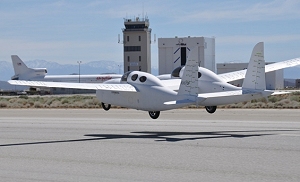


Joined: Feb 2002
Aviation Qualifications: AME
Posts: 4,182
Likes: 1,115
From: UK
Genghis' picture reminded me of my hang-gliding tuition.
Running on a flat field (no slope) legs going like the clappers, wing pitch angle at neutral, once up to 'speed' ease the bar out and up we go, a short hop as airspeed degraded very quickly and we all end up in a big heap in the nettles/cow pats.
Happy days but it proved the point, if not with powered wheels.
Running on a flat field (no slope) legs going like the clappers, wing pitch angle at neutral, once up to 'speed' ease the bar out and up we go, a short hop as airspeed degraded very quickly and we all end up in a big heap in the nettles/cow pats.
Happy days but it proved the point, if not with powered wheels.

Avoid imitations

Joined: Nov 2000
Aviation Qualifications: ATPL
Posts: 15,114
Likes: 1,088
From: Wandering the FIR and cyberspace often at highly unsociable times
It certainly worked for the Harrier - I was once asked by an Senior Army Officer passenger in the T-bird how we got the drive down those narrow legs to the wheels, ho-ho-ho..........
He nodded wisely. "Aha", he said. "So when the pilot is good enough to fly by himself, they'll take off those little stabiliser wheels, just like my daddy will do with my bike!"
_________________
To answer the original question:
Yes it is quite possible. Look up the Mercedes Le Mans racer from a few years back. It took off, did a complete back flip and managed to fly completely out of the race track in the process. The driver was extremely lucky to survive intact.
