'WEBF' said above:
"...Surely the whole point about deck landing aids is that they are built to exist aboard ship and need to be tested aboard ship? After all, deck landing aids exist to help the pilot land his aircraft at sea, aboard a moving ship that has six axes of freedom - the linear motions of heave, sway, and surge, as well as the rotational ones of pitch, yaw, and roll, as well as intended movement through the sea. Then on top that are issues relating to things like vibration from the ship's powerplant and other machinery as well as EMC issues. It has to exist side by side with other equipment - from things like radars and communications systems to flight deck vehicles and RAS equipment.
Everything intended for naval use (from a new 30mm cannon to a new radar) has have trials aboard ship, surely this applies here too? The system needs to be demonstrated aboard a ship (preferably RN) recovering STOVL aircraft that can simulate a 60 knot approach from astern...."
No argument there - however my response to your entreaty earlier was in relation to there being no CVF for the time being. Certainly when the CVF is available I'll gather the landings aids will be installed (wot? no testing?) having been tested by computer simulation to then be tested in the real world. And please let us not forget the Bedford Array testing on one CVS many moons ago now with the VACC Harrier. I did not forget.
If you require real world real CVF testing you will have to wait eh.
______________
Sadly a lot of URL info about SRVLs from the past goes cold. Some old testing graphics / info has been provided in several threads here to my knowledge. Here is a new tidbit about RVL landings (put them on a ship to become SRVL).
STRIKE TEST NEWS Air Test and Evaluation Squadron 23
Newsletter 2012 Issue
“...F-35B (STOVL) FLIGHT SCIENCES AIRCRAFT
For each variant, Flight Sciences aircraft specifically go after flight test data requirements that would not be available in a production configur-ation. Each aircraft has a unique set of instrumentation that has been incorporated throughout the airframe, making them truly one-of-a kind. They were the first to roll off the production line in Fort Worth, and each one is critical to the completion of the flight test program. The Flight Science jets do not have full sensor suites installed and do not run the block software that provides warfighting capabilities for the jet. Recent lines of testing are defined below for each aircraft. The BF-1 team completed loads testing of the new Auxiliary Air Inlet (AAI) door configuration in January 2012 with positive results. BF-1 has continued loads testing with unflared slow landings in STOVL mode....”
http://www.navair.navy.mil/nawcad/in...ownload&id=670 [small pdf]
________________
Even USMC test pilots have been testing SRVLs in the simulator according to this link:
Aviation Week 28 Jul
2008 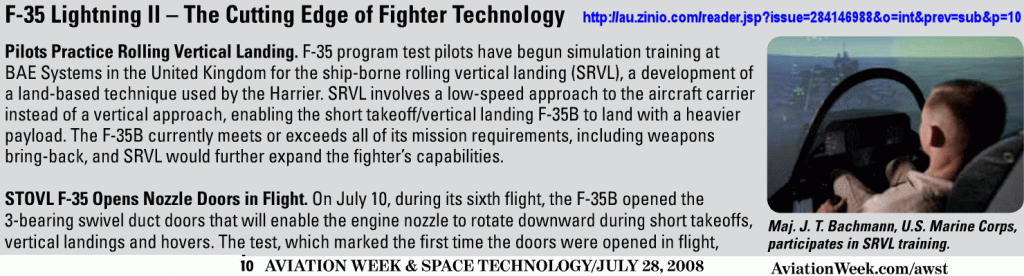 Click thumbnail on left
Aviation Week & Space Technology | Aug-04-08 | Inside | Zinio Digital Magazines
Click thumbnail on left
Aviation Week & Space Technology | Aug-04-08 | Inside | Zinio Digital Magazines ________________________
As has been mentioned earlier this long informative post is worthwhile scrolling down to read here:
Preparing for take-off: UK ramps up JSF carrier integration effort 11 Dec
2008 International Defence Review
Military Nuts -> The F-35 JSF/Lightning II thread ___________________________
Scroll down to
Rolling Landings here:
"...Rolling Landings
The Lockheed Martin F-35B JSF has a lower payload "bring back" capability when using a vertical landing than the 2300kg that the RN had hoped for - it may therefore be necessary to jettison some unused weapons before landing and with modern weapons being extremely costly this is a significant issue.
In the summer of 2004 the MOD asked BAE Systems to investigate the possibility of ship borne rolling vertical landings (SRVL) - an SRVL approach would exploit the ability of the short take-off and vertical landing F-35B to use vectored thrust to slow the speed of the aircraft while still gaining the benefit of wing-borne lift. This offers the possibility of significantly increasing "bring-back" payload compared with a vertical recovery, while also reducing stress on the single-engined aircraft's propulsion system. Factors to be taken into consideration is the cost, feasibility and underpinning safety case of conducting shipborne rolling vertical landings aboard a CVF, adoption could also drive changes to the carrier design, pilot training regime and JCA flight control laws.
Following the initial UK studies, the American JSF programme office sponsored a more detailed analysis of the SRVL concept with Lockheed in 2004-5, culminating with a simulator trial at NASA's Ames Research Center in California in late 2005.
It was revealed in April 2007 that Qinetiq's VAAC Harrier testbed will be used to demonstrate flight-control limits for a SRVL mode potentially applicable to the Lockheed Martin F-35B Joint Strike Fighter. The VAAC testbed will perform a series of flight trials, potentially using a large-deck aircraft carrier such as the French navy's FNS Charles de Gaulle, and concluding with a final evaluation of a preferred SRVL approach and landing using a "dummy deck" at Boscombe Down around November 2007. An MOD spokesman said "Consideration of the aerodynamic performance of JSF together with the available deck area of CVF design [same page immediately above this quote: "...In July 2007 it was officially stated that the flight deck area for the UK CVF variant was "nearly 13,000 sq m" (slightly less than previous statements had indicated)...] has shown that significant benefits could be realised by extending the principles of land-based RVL to shipborne operations ... the increasing maturity of this body of analysis and simulation indicates SRVL could be performed safely by JSF on CVF, although the effects of equipment failures and adverse conditions require further investigation".
Using SRVL F-35B aircraft would approach the carrier from astern at about 60 knots indicated air speed, 35 knots relative assuming 25 knots wind over deck (the maximum speed of a CVF will be 25 knots, so 25kts WOD is achievable even in dead calm) on a steep 5-6 degree glide path. Touch down would be about 150 feet from the stern with a stopping distance of 300 to 400 feet depending on conditions (wet flight deck, pitching ships etc). That would leave around 300 feet of flight deck for margin or even "bolters".
The SRVL technique has a significant impact on ship designs and aviation operations, Commander Tony Ray told a conference in February 2008 "We expect to trade some STOVL flexibility for increased bring-back and fuel. We have to .. check for for relevant CV criteria that apply to slower SRVL operations. For example flightpath control will be a far more important flight criteria for SRVL than it has been for STOVL. It is a CV trait creeping in"...."
Navy Matters | Future Aircraft Carrier Part 24