Originally Posted by WE Branch Fanatic
Running on empty – how the Royal Navy nearly kept HMS Ark Royal into the 1980s
Royal Navy Carriers matter disproportionately. Admiral Kidd’s 1978 reminder of the unique value of RN carriers remains valid. Today, with the USN focused on China, NATO may again rely heavily on Britain’s Queen Elizabeth class to secure the Atlantic. Nearly fifty years after Ark Royal
paid off, Royal Navy strike carriers continue to provide NATO with capabilities far out of proportion to their number.
History may not repeat itself but it does rhyme. With respect to the point about RN carriers mattering disproportionally have a look at this:
Britain’s world: The strategy of security in twelve geopolitical maps - Council on Geostrategy

Page 50-
Defending Europe.
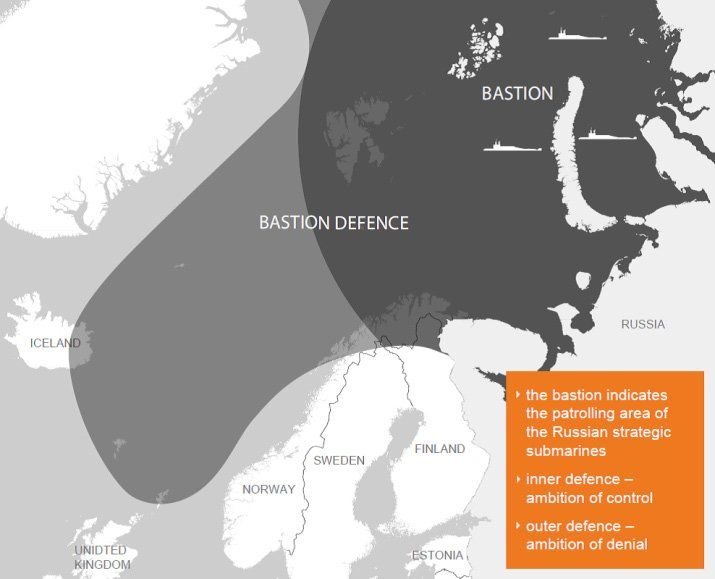
The 'GIUK' Gap shown is the not the old GIUK Gap, it is the Greenland -Iceland -Norway Gap favoured by NATO since the early 1980s and does not involve surrendering the Norwegian Sea or the Nordics.
The Northerly deployment of the RN (with attached NATO units) Carrier Strike Group is shown. The main strength of the Russian Northern Fleet is submarines (many with long range missiles) and long range anti ship missile carrying bombers - so a deck full of F-35Bs (working in conjunction with and controlled by AAW warships), and multiple ASW helicopters (working in conjunction with and cued by frigates with towed arrays), and controlling things such as NATO submarines and MPA, is going to be essential.
This map illustrates that pretty much the whole Norwegian Sea is an area the Russians would wish to deny to NATO. NATO needs to be able to reinforce and resupply by sea, and to have amphibious options.
I accept that the carrier/sea control thread is quite long, so here are links to specific posts that discuss particular things:
1.
The initial post - which contains a link to an official report, my main conclusions, and is of course the start of the thread.
2.
The comment by a former US Navy flyer that the main role of the [USN] carrier in the Atlantic was Anti Air Warfare.
3.
The employment of USN helicopters in lieu of the old S-3 Viking.
4.
Early USN recognition of the value of ASW helicopters.
5.
Exercise Teamwork 88.
6.
Intercepting Russian aircraft and tracking Russian submarines during the CSG21 deployment.
7.
The late Professor Eric Grove speaking at the IISS about the Cold War and today.
8.
1980s US Naval Strategy.
9.
The potential vulnerability of Soviet cruise missile firing submarines.
10.
Dr John Lehman talking about the NATO Maritime Strategy.
11.
Routine NATO ASW.
12.
The late Sharkey Ward talking about defence in depth and the limitations of the
Invincible class
.
13.
Videos from the CSG21 deployment - including intercepting Russian aircraft and tracking their submarines.
14.
Using airborne radar to keep submarines down and to cause them difficulty.
15.
Early RN recognition of the importance of the ASW helicopter with dipping sonar.
16.
The reasons for putting multiple ASW helicopters in one ship.
17.
Video of Sonar 2087/Merlin combination.
18.
CVF Residual Threats Study - yes, they were always intended to be able to protect task groups or forces ashore.
19.
A 2008 exercise pairing a frigate with sonar 2087 and Merlins aboard a carrier.
20.
The RN Maritime Operating Concept and similar US documents.
21.
Air defence and Shooting Archers - naval fighters for long range defence.
22.
Carrier operations in the Adriatic in the 1990s.
23.
USN Super Hornets splashing Houthi anti ship missiles.
24.
A simple scenario with simple speed/time/distance calculations.
25.
The ability of USN fighters from the carrier in the Red Sea to respond to ships being attacked. Proximity is a virtue.
26.
The control of intercepts by surface warships.
27.
Control of Sea Harrier intercepts by destroyers in the Falklands - a key role for the anti air warfare ship.
28.
Russian use of the TU-22 bomber and the Kh-22 anti ship missile.
29.
Simple calculations to demonstrate defence in depth.
30.
A Navy Lookout article of the carrier and sea control.
Edited to add:
31. A post containing a quote from the JAPCC about airborne ASW - and the ability of ASW helicopters to protect the ships in a task group.
32. Exercise Steadfast Defender 24.
I have seen a video in which Professor Justin Bronk comments that many critics of Western air power argue for a reduced number of aircraft and increased numbers of surface to air and surface to surface systems, missing the point about aircraft doing the job more effectively and efficiently. The same logic applies at sea.