https://www.afr.com/companies/transp...4-p5jw7rOusted
Regional Express Airlines executive chairman Lim Kim Hai says private equity firm PAG has its own agenda for the group known as Rex, ahead of a shareholder vote where he will fight to have his board seat reinstated.
Trading in Rex shares was halted on Monday pending a material announcement. Sources said the airline might need to raise fresh capital to get the remainder of its regionally focused fleet back in the air.
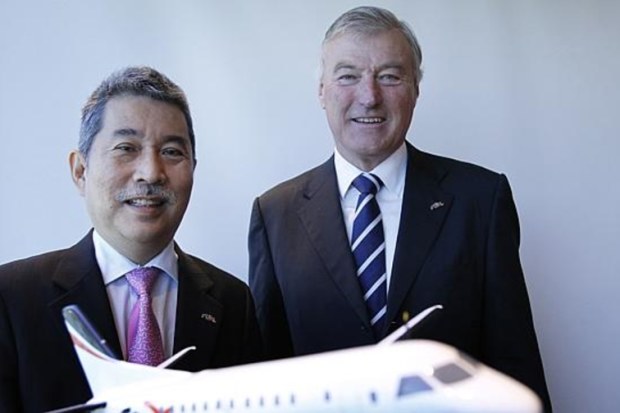
Rex ousted executive chairman Lim Kim Hai with his replacement, former transport minister John Sharp. Louise Kennerley
Mr Lim told
The Australian Financial Review it is “hard to answer without putting the company in jeopardy” exactly what had prompted the Rex board rift that led to his being deposed as chairman.
“I think we can put it down to PAG having its personal agenda and persuading the rest of the board members to follow suit,” he said.
“I won’t speak ill of the dead or the dying. Suffice to say that I think it will be in the best interest of the company,” he added, referring to the prospect of his return as chairman.
But Mr Lim said he remained the best person to lead the board, in light of the vote to spill all board members except for a representative appointed by PAG. The private equity fund has the right to two board seats under the terms of a $150 million investment made in November 2020, but only utilises one.
Golden triangle
During Virgin Australia’s time in voluntary administration,
PAG agreed to provide Rex with a $150 million convertible note to fund its expansion into the golden triangle, flying jets acquired from the old Virgin business between Sydney, Melbourne and Brisbane.
Under the agreement, PAG’s $150 million debt can be converted to equity for $1.50 a share, versus its 56¢ a share closing price last week. Mr Lim said he held no fears about PAG converting its debt to equity.
“I would be only too happy if they choose to convert it,” he said, adding that such an outcome was “highly unlikely”. PAG declined to comment but confirmed it was not trying to exit its investment in Rex.
Rex declined to comment on a report over the weekend suggesting it had called in Deloitte to help restructure the airline.
Until this week,
Rex had emphasised the profitability of the jet business over its regional flights outside of those where it receives government subsidies. It posted a loss last financial year.
Rex’s financial woes could become another headache for the Albanese government, coming just weeks after regionally focused airline Bonza’s demise. King Island councillor Marcus Blackie,
whose public spat with Mr Lim made headlines, emphasised Rex’s importance to the town’s economy.Lack of scale
“We rely disproportionately on aviation for the routine transportation of mail, urgent freight and courier items, newspapers, perishable foods and export seafood,” Mr Blackie said.
“To the best of my knowledge flights remain profitable for all airline operators currently servicing King Island.”
Multiple industry sources disputed Rex’s claim that its Sydney-Melbourne-Brisbane operations are profitable, pointing to load factors in the 60 per cent range and a lack of scale.
“The rates they are paying for those old Virgin aircraft were cheap coming out of COVID but have normalised from rents of around $180,000 a month to market rates,” one source said.
Rex also needs to invest considerably in its fleet of 35-year-old Saab aircraft.
Rex is still waiting to recover operations from four of its fleet of Saabs, which use the same type of engine as a United States military helicopter. The airline will also face accusations – which it denies – that it did not pay for Saab parts collected from an aircraft wrecking yard during the pandemic. US aviation company Jet Midwest has launched legal proceedings, due to be heard on August 9, against Rex over payment.