


737 VNAV descent debacle

Thread Starter

Joined: Mar 2019
Posts: 8
Likes: 1
From: earth
737 VNAV descent debacle
His all,
so currently there is what seems to be a huge debate on VNAV PTH descent speed and energy management between many pilots I’m flying with and currently there are two leading trains of thought and I wanted to see what the consensus was here.
thought 1. During the descent in common VNAV (FMC U14.1) the aircraft when descending in VNAV PTH will “hang” around the FMC imputed speed/bug speed to maintain the pre calculated patch and mostly is upper winds are close enough. This means the speed will go away from the bug up and down but no pilot intervention is really needed unless the FMC DRAG REQUIRED or THRUST REQUIRED message is shown. Basically just let us do its thing.
Thought 2. VNAV PTH descent is still inherently dumb and should constantly be managed so as to never let the speed stray away from the bug speed. This thought also includes updating the VNAV calculation ever so often by putting the current top waypoint at the top again and executing the force Vnav to recalculate the path.
Basically the just is one says leave Vnav the other says micro manage because it can’t be trusted
would love to here everyone’s thoughts and also if anyone knows any Boeing published documents that would basically answer the question and put the debate to an end that would be amazing!
so currently there is what seems to be a huge debate on VNAV PTH descent speed and energy management between many pilots I’m flying with and currently there are two leading trains of thought and I wanted to see what the consensus was here.
thought 1. During the descent in common VNAV (FMC U14.1) the aircraft when descending in VNAV PTH will “hang” around the FMC imputed speed/bug speed to maintain the pre calculated patch and mostly is upper winds are close enough. This means the speed will go away from the bug up and down but no pilot intervention is really needed unless the FMC DRAG REQUIRED or THRUST REQUIRED message is shown. Basically just let us do its thing.
Thought 2. VNAV PTH descent is still inherently dumb and should constantly be managed so as to never let the speed stray away from the bug speed. This thought also includes updating the VNAV calculation ever so often by putting the current top waypoint at the top again and executing the force Vnav to recalculate the path.
Basically the just is one says leave Vnav the other says micro manage because it can’t be trusted
would love to here everyone’s thoughts and also if anyone knows any Boeing published documents that would basically answer the question and put the debate to an end that would be amazing!


Joined: Jul 2012
Aviation Qualifications: ATPL
Posts: 189
Likes: 29
From: Aus
One vote here for Thought 1, unless under specific speed control. Constantly trying to keep the exact speed using thrust and speedbrake is a waste of energy (both yours and that of the aircraft). I find it usually (on the 777, but the idle descent logic is the same) averages out pretty well in the end if you just leave it alone. Forcing a path recalculation isn't going to change much for an idle profile with everything else remaining unchanged.
If you need to maintain the speed, intervene and use VNAV SPD. You can fix the profile if necessary as you get closer to the constraint.
If you need to maintain the speed, intervene and use VNAV SPD. You can fix the profile if necessary as you get closer to the constraint.

Joined: Dec 2005
Aviation Qualifications: ATPL
Posts: 4,973
Likes: 326
From: Hong Kong
If you're on the path, let it run. If ATC ask for a speed then do something about it. If you're fast you can either stay on the path and slow down with a bit of brake or you can use VNAV speed which will put you high, needing brake to stay on the path. Either way... you need the brake (or if you're slow, thrust). A pitch and thrust will give you a speed and path. The Airplane doesn't care what mode you use.

Beacon Outbound
Joined: Mar 2002
Aviation Qualifications: ATPL
Posts: 710
Likes: 22
From: "Home is were the answer machine is"
Just leave the damn thing alone (unless a specified speed is required).
People who say that they don't trust VNAV actually mean that they don't understand it. These are the people who won't use VNAV to descent from FL300 to 3000 feet, but will use VNAV from 3000 feet to 300 feet because even they accept that a VNAV NPA is easier than doing it in VS.
People who say that they don't trust VNAV actually mean that they don't understand it. These are the people who won't use VNAV to descent from FL300 to 3000 feet, but will use VNAV from 3000 feet to 300 feet because even they accept that a VNAV NPA is easier than doing it in VS.
Gender Faculty Specialist
Joined: Mar 2002
Aviation Qualifications: ATPL
Posts: 2,321
Likes: 428
From: In your head.
You don't need to keep the exact speed but to allow your speed to decrease below the target speed by up to 15 knots and then let the aircraft bung on a bag full of thrust just looks and feels horrendously gash and inaccurate. Standards!
My thoughts are to keep the speed at your target speed as a minimum with absolutely minimal but timely thrust increases (oh my, you might have to monitor it a bit), which are usually only temporary, but to allow your speed to increase over the target speed, if it needs to, but without it getting to the point where you get an overspeed disconnect.
Just because the autopilot is in doesn't mean you can't and shouldn't be flying it.
My thoughts are to keep the speed at your target speed as a minimum with absolutely minimal but timely thrust increases (oh my, you might have to monitor it a bit), which are usually only temporary, but to allow your speed to increase over the target speed, if it needs to, but without it getting to the point where you get an overspeed disconnect.
Just because the autopilot is in doesn't mean you can't and shouldn't be flying it.

Joined: Sep 2008
Aviation Qualifications: ATPL
Posts: 3,426
Likes: 1,191
From: 41S174E
I quite often go down in VNAVSPD , do a manual change over from Mach to IAS and let the path wander above or below by a few hundred feet while the wind does its thing. As often as not it will be back on the profile by about FL 200 and it avoids the situation where you add thrust only to need speed brake two minutes later.
Thread Starter
Joined: Mar 2019
Posts: 8
Likes: 1
From: earth
You don't need to keep the exact speed but to allow your speed to decrease below the target speed by up to 15 knots and then let the aircraft bung on a bag full of thrust just looks and feels horrendously gash and inaccurate. Standards!
My thoughts are to keep the speed at your target speed as a minimum with absolutely minimal but timely thrust increases (oh my, you might have to monitor it a bit), which are usually only temporary, but to allow your speed to increase over the target speed, if it needs to, but without it getting to the point where you get an overspeed disconnect.
Just because the autopilot is in doesn't mean you can't and shouldn't be flying it.
My thoughts are to keep the speed at your target speed as a minimum with absolutely minimal but timely thrust increases (oh my, you might have to monitor it a bit), which are usually only temporary, but to allow your speed to increase over the target speed, if it needs to, but without it getting to the point where you get an overspeed disconnect.
Just because the autopilot is in doesn't mean you can't and shouldn't be flying it.
Thread Starter
Joined: Mar 2019
Posts: 8
Likes: 1
From: earth
I quite often go down in VNAVSPD , do a manual change over from Mach to IAS and let the path wander above or below by a few hundred feet while the wind does its thing. As often as not it will be back on the profile by about FL 200 and it avoids the situation where you add thrust only to need speed brake two minutes later.
Gender Faculty Specialist
Joined: Mar 2002
Aviation Qualifications: ATPL
Posts: 2,321
Likes: 428
From: In your head.

Joined: Nov 2007
Aviation Qualifications: ATPL
Posts: 512
Likes: 829
From: UK
If one is continually messing with the FMC, is the other pilot in the loop, do they know what the PF is trying to achieve, what happens if ATC step in with a request?
Seems a lot of faff at a busy stage of flight - for what real benefit?
Seems a lot of faff at a busy stage of flight - for what real benefit?
Joined: Feb 2003
Posts: 540
Likes: 336
From: Blue sky
From the FCOM: "A path descent uses the target speed for planning purposes only. There is no attempt to maintain the target speed during the idle portion of the descent"
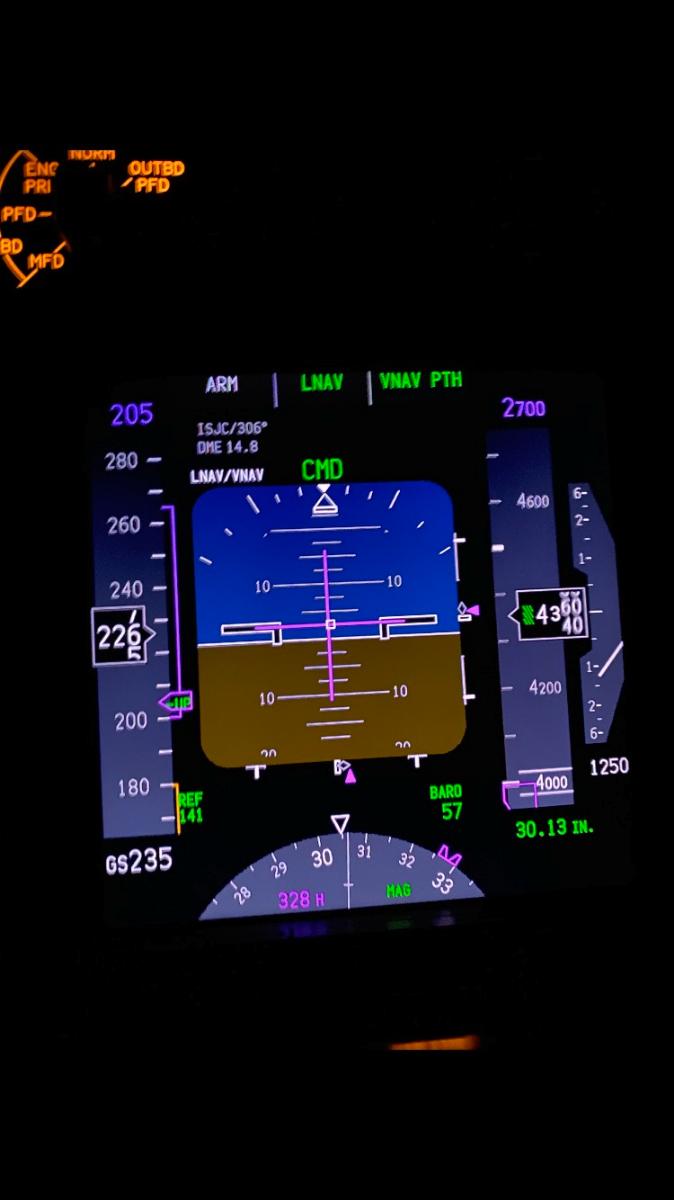
There is actually a very nice option available for the operators in which the FMC "speed range" is shown on the speed tape like a magenta bar when in VNAV descent. Making this option a standard would make a lot of pilots more comfortable with the speed situation and let VNAV do its job the way it was designed to. This is still different from the "energy compensation" when a temporary level off is made through a MCP altitude (however, reading the FCOM I'm not sure if this is an option or a standard).
PF uses basic modes, time available PM makes the changes in the FMC. Either you continue to fly with basic modes or you revert to VNAV is up to you. But you get a second opinion that is - if programmed correctly - a good guideline for the PF. Not sure how many times the chit-chat on the flightdeck takes over (because we love to finish the story we started...), and the VNAV path becomes an "oh !!!!" realization.
There is actually a very nice option available for the operators in which the FMC "speed range" is shown on the speed tape like a magenta bar when in VNAV descent. Making this option a standard would make a lot of pilots more comfortable with the speed situation and let VNAV do its job the way it was designed to. This is still different from the "energy compensation" when a temporary level off is made through a MCP altitude (however, reading the FCOM I'm not sure if this is an option or a standard).
PF uses basic modes, time available PM makes the changes in the FMC. Either you continue to fly with basic modes or you revert to VNAV is up to you. But you get a second opinion that is - if programmed correctly - a good guideline for the PF. Not sure how many times the chit-chat on the flightdeck takes over (because we love to finish the story we started...), and the VNAV path becomes an "oh !!!!" realization.
Joined: Jul 2009
Aviation Qualifications: Spotter
Posts: 241
Likes: 50
From: Coast to Coast...
This is a VERY Boeing problem. Because of the ridiculous amounts of software versions floating about within FMS systems of aircraft, different people have different ideas and experiences of how good/bad VNAV descents are. I've seen aircraft that rolled off the same assembly line display different behaviour! Simple not an issue on Airbus, even if they have different FMSs (Honeywell/Thales).
Thread Starter
Joined: Mar 2019
Posts: 8
Likes: 1
From: earth
From the FCOM: "A path descent uses the target speed for planning purposes only. There is no attempt to maintain the target speed during the idle portion of the descent"
There is actually a very nice option available for the operators in which the FMC "speed range" is shown on the speed tape like a magenta bar when in VNAV descent. Making this option a standard would make a lot of pilots more comfortable with the speed situation and let VNAV do its job the way it was designed to. This is still different from the "energy compensation" when a temporary level off is made through a MCP altitude (however, reading the FCOM I'm not sure if this is an option or a standard).
PF uses basic modes, time available PM makes the changes in the FMC. Either you continue to fly with basic modes or you revert to VNAV is up to you. But you get a second opinion that is - if programmed correctly - a good guideline for the PF. Not sure how many times the chit-chat on the flightdeck takes over (because we love to finish the story we started...), and the VNAV path becomes an "oh !!!!" realization.
There is actually a very nice option available for the operators in which the FMC "speed range" is shown on the speed tape like a magenta bar when in VNAV descent. Making this option a standard would make a lot of pilots more comfortable with the speed situation and let VNAV do its job the way it was designed to. This is still different from the "energy compensation" when a temporary level off is made through a MCP altitude (however, reading the FCOM I'm not sure if this is an option or a standard).
PF uses basic modes, time available PM makes the changes in the FMC. Either you continue to fly with basic modes or you revert to VNAV is up to you. But you get a second opinion that is - if programmed correctly - a good guideline for the PF. Not sure how many times the chit-chat on the flightdeck takes over (because we love to finish the story we started...), and the VNAV path becomes an "oh !!!!" realization.
Beacon Outbound
Joined: Mar 2002
Aviation Qualifications: ATPL
Posts: 710
Likes: 22
From: "Home is were the answer machine is"

Joined: Dec 1998
Aviation Qualifications: ATPL
Posts: 575
Likes: 398
From: UK
The problem comes when you’re given a speed and a “decend to xxxx by xxx”. It can do the path or it can do the speed. If you want both you have to work at it. As someone said - moving the thrust levers manually / using the speed brake is one option.
I also find hitting the “descend now” prompt 5-10miles before calculated TOD usually results in a better flown descent as it will start down at approx 1000ft/min until it catches the profile.
I also find hitting the “descend now” prompt 5-10miles before calculated TOD usually results in a better flown descent as it will start down at approx 1000ft/min until it catches the profile.
Joined: Dec 2020
Aviation Qualifications: ATPL
Posts: 179
Likes: 79
From: Amsterdam
I do think Airbus has a big advantage here over the 737.
Airbus has a speed range for the managed descent.
+/-20kts if I remember from the planned descent speed. It's shown very nicely on the PFD.
Secondly Airbus has flap extension markers (1) and (2) on the ND. Obviously pilot discretion but a very handy tool to have. I guess 737 has the DECEL point for speed reduction hence flap extension.
Airbus has a speed range for the managed descent.
+/-20kts if I remember from the planned descent speed. It's shown very nicely on the PFD.
Secondly Airbus has flap extension markers (1) and (2) on the ND. Obviously pilot discretion but a very handy tool to have. I guess 737 has the DECEL point for speed reduction hence flap extension.
Joined: Dec 2003
Posts: 2,338
Likes: 821
From: Tring, UK
Sometimes it’s just not possible to do a whole descent in VNAV PTH without intervention if there are rapid changes in wind velocity on the way down. Often, you’re just above or in a jet core so attempting to fly a fixed angle in the descent leads to under/over speed in fairly short order.
Joined: Dec 2013
Posts: 132
Likes: 72
From: Milan
I do think Airbus has a big advantage here over the 737.
Airbus has a speed range for the managed descent.
+/-20kts if I remember from the planned descent speed. It's shown very nicely on the PFD.
Secondly Airbus has flap extension markers (1) and (2) on the ND. Obviously pilot discretion but a very handy tool to have. I guess 737 has the DECEL point for speed reduction hence flap extension.
Airbus has a speed range for the managed descent.
+/-20kts if I remember from the planned descent speed. It's shown very nicely on the PFD.
Secondly Airbus has flap extension markers (1) and (2) on the ND. Obviously pilot discretion but a very handy tool to have. I guess 737 has the DECEL point for speed reduction hence flap extension.