


Why does the Airbus A300/310 series only have 1 trim switch per yoke instead of 2?

Thread Starter
Joined: Apr 2025
Posts: 30
Likes: 0
From: Milky Way Galaxy
Why does the Airbus A300/310 series only have 1 trim switch per yoke instead of 2?
Most planes have 2 electric trim switches per yoke as a safety measure as one completes the circuit, activating the system, whereas the other controls the motor to activate the trim. Plus, its also required by regulations (as far as I remember).
So my questions are: Why did the Airbus A300/A310 series only have a single trim-switch per yoke? Was this the result of a more advanced design choice for its era? If so, why wasn’t this feature used on any other aircraft that came later on?

An Airbus A310's trim switch
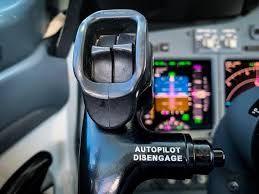
A Boeing trim switch
So my questions are: Why did the Airbus A300/A310 series only have a single trim-switch per yoke? Was this the result of a more advanced design choice for its era? If so, why wasn’t this feature used on any other aircraft that came later on?
An Airbus A310's trim switch
A Boeing trim switch


Joined: Apr 2019
Aviation Qualifications: CPL
Posts: 19
Likes: 16
From: YUL
On the A300, the physical switch actuates 2 switches on the electrical circuit.
From the FCOM:
"Each electric trim rocking lever actuates two switches. If switches provide contradictory orders both pitch trim systems disengage."
Now why was this approach not used on other aircraft design? Maybe for fear of a condition where the physical switch is actually jammed in one direction or the other. A double jam is probably a lot less likely.
From the FCOM:
"Each electric trim rocking lever actuates two switches. If switches provide contradictory orders both pitch trim systems disengage."
Now why was this approach not used on other aircraft design? Maybe for fear of a condition where the physical switch is actually jammed in one direction or the other. A double jam is probably a lot less likely.
Thread Starter
Joined: Apr 2025
Posts: 30
Likes: 0
From: Milky Way Galaxy
On the A300, the physical switch actuates 2 switches on the electrical circuit.
From the FCOM:
"Each electric trim rocking lever actuates two switches. If switches provide contradictory orders both pitch trim systems disengage."
Now why was this approach not used on other aircraft design? Maybe for fear of a condition where the physical switch is actually jammed in one direction or the other. A double jam is probably a lot less likely.
From the FCOM:
"Each electric trim rocking lever actuates two switches. If switches provide contradictory orders both pitch trim systems disengage."
Now why was this approach not used on other aircraft design? Maybe for fear of a condition where the physical switch is actually jammed in one direction or the other. A double jam is probably a lot less likely.


Joined: Nov 1999
Aviation Qualifications: ATPL
Posts: 3,139
Likes: 740
From: UK
Yes. That was answered in post#2:
my bold.
So if one trim switch under the larger rocker becomes faulty; both trim switches will be disregarded on that yoke. The next thing that will happen is: "You have control", (or maybe use manual pitch trim via the trim wheel, but I don't know if A300 has physical trim wheels ?).
One large switch rocker is easier to operate than two smaller ones that have to be pushed together.
So if one trim switch under the larger rocker becomes faulty; both trim switches will be disregarded on that yoke. The next thing that will happen is: "You have control", (or maybe use manual pitch trim via the trim wheel, but I don't know if A300 has physical trim wheels ?).
One large switch rocker is easier to operate than two smaller ones that have to be pushed together.
Thread Starter
Joined: Apr 2025
Posts: 30
Likes: 0
From: Milky Way Galaxy
Yes. That was answered in post#2:
my bold.
So if one trim switch under the larger rocker becomes faulty; both trim switches will be disregarded on that yoke. The next thing that will happen is: "You have control", (or maybe use manual pitch trim via the trim wheel, but I don't know if A300 has physical trim wheels ?).
One large switch rocker is easier to operate than two smaller ones that have to be pushed together.
my bold.
So if one trim switch under the larger rocker becomes faulty; both trim switches will be disregarded on that yoke. The next thing that will happen is: "You have control", (or maybe use manual pitch trim via the trim wheel, but I don't know if A300 has physical trim wheels ?).
One large switch rocker is easier to operate than two smaller ones that have to be pushed together.
Yea but how would the computer understand that it’s the rocker that’s stuck and not the pilot that’s putting the trim input?
Also, the A300 does have trim wheels. Tho I do think it wouldn’t really be a problem even if it didn’t, most planes that don’t have trim wheels do have an emergency pair of electric trim switches in the middle just in case. I do wonder why didn’t use this design in any other planes tho. It seems more efficient to just have 1 trim button on the yoke, and use the wheels/emergency trim switches only in the case of an emergency

Last edited by 777Supremecist; 20th January 2026 at 13:57.
Thread Starter
Joined: Apr 2025
Posts: 30
Likes: 0
From: Milky Way Galaxy
I think this is a safety issue with the A300 trim switch. if, for some reason, the entire trim switch gets jammed in one position. Wouldn’t that cause a trim runaway? What sort of safety measures did the Airbus engineers put out for that situation?
Maybe a button in each yoke that deactivates the entire trim switch for thar particular yoke to prevent a trim runaway? That would kinda defeat the ergonomic purpose for it, creating a solution for a solution.
If I was the designer, I would put 2 electric-trim cutoff knobs on each side of the cockpit in case it gets stuck. The pilots would resort to using the trim wheels
Maybe a button in each yoke that deactivates the entire trim switch for thar particular yoke to prevent a trim runaway? That would kinda defeat the ergonomic purpose for it, creating a solution for a solution.
If I was the designer, I would put 2 electric-trim cutoff knobs on each side of the cockpit in case it gets stuck. The pilots would resort to using the trim wheels

Joined: Apr 2004
Aviation Qualifications: LAME
Posts: 2,279
Likes: 186
From: Dorset UK
I was on the A300 for 14 years.
IIRC in the event of a trim run away you hold the manual trim wheel and the pitch trim systems disengage, leaving you with manual pitch trim.
IIRC in the event of a trim run away you hold the manual trim wheel and the pitch trim systems disengage, leaving you with manual pitch trim.
Joined: Sep 2022
Aviation Qualifications: ATPL
Posts: 328
Likes: 183
From: Perpetually circling OCK for some reason
Joined: Mar 2006
Posts: 2,632
Likes: 134
From: USA
Having flown a few planes with the split or dual switch design, I’ve never had any trouble moving both simultaneously. I guess it comes down to the design, but I’m sure they take an average size thumb into account when they build the switches.
Joined: Sep 2005
Posts: 279
Likes: 4
From: ???
As someone already mentioned, in the highly unlikely event of having both switches physically stuck in one position, you would simply grab and hold the trim wheel which would disengage both pitch trim systems. Manual pitch trim would then be available via the trim wheel
Joined: Oct 2019
Aviation Qualifications: Non-Aircrew
Posts: 1,689
Likes: 1,069
From: USA
The advantage to the split switch is that if one of them is failing, but hasn't failed yet, then it might be detected as either being more difficult to move than the other or move more easily.
With the single toggle driving both at the same time there isn't a ready comparison. Even noting a difference, it might be laid to just being a different aircraft.
Often changes are gradual and won't be noticed until there is a really big jump. Example - I took out about 2 q-tips volume of dust from around a mouse wheel yesterday. I had not noticed until the wheel was difficult to turn that it had been getting more difficult to move.
Having them both provides a possible basis for comparison - like having two watches, as long as they agree one can be sure, but if they diverge, it's an indication something needs to be checked.
My vote for a single toggle would be that it is far easier to put a water/coffee/soda intrusion seal on it.
I look at this as a plateau of interface design. They both work, they have both been reliable enough to not attract attention to them. And moving from one design to the other doesn't seem to offer a substantial advantage.
With the single toggle driving both at the same time there isn't a ready comparison. Even noting a difference, it might be laid to just being a different aircraft.
Often changes are gradual and won't be noticed until there is a really big jump. Example - I took out about 2 q-tips volume of dust from around a mouse wheel yesterday. I had not noticed until the wheel was difficult to turn that it had been getting more difficult to move.
Having them both provides a possible basis for comparison - like having two watches, as long as they agree one can be sure, but if they diverge, it's an indication something needs to be checked.
My vote for a single toggle would be that it is far easier to put a water/coffee/soda intrusion seal on it.
I look at this as a plateau of interface design. They both work, they have both been reliable enough to not attract attention to them. And moving from one design to the other doesn't seem to offer a substantial advantage.
Joined: Sep 2016
Posts: 936
Likes: 67
From: USA
As someone already mentioned, in the highly unlikely event of having both switches physically stuck in one position, you would simply grab and hold the trim wheel which would disengage both pitch trim systems. Manual pitch trim would then be available via the trim wheel
If so then yes that's one solution. But a far better one would be to not have the problem in the first place.
Joined: Sep 2005
Posts: 279
Likes: 4
From: ???
Both systems are designed to prevent pitch trim runaway by only activating the pitch trim if both switches are in the same position.
both designs will runaway if both switches are stuck in the same position. On A300/310 there is an audio whooler to alert crew if THS continuously runs for more than 1 second. The runaway can be stopped by grabbing and holding the trim wheel. This will cause the pitch trim to automatically disengage.
On the dual rocker switch design, you need to grab and hold the trim wheel and disengage the pitch trim manually via the guarded switches.
Both designs have been proven to work. Both designs have protections against pitch trim runaway, Airbus just does it more elegantly by providing automatic pitch trim disengagement in case of switch position disagree or grabbing of trim wheel.
Joined: Sep 2016
Posts: 936
Likes: 67
From: USA
On the dual rocker switch design, you need to grab and hold the trim wheel and disengage the pitch trim manually via the guarded switches.
Both designs have been proven to work. Both designs have protections against pitch trim runaway
Joined: Nov 1999
Aviation Qualifications: ATPL
Posts: 3,139
Likes: 740
From: UK

.........My vote for a single toggle would be that it is far easier to put a water/coffee/soda intrusion seal on it.
I look at this as a plateau of interface design. They both work, they have both been reliable enough to not attract attention to them. And moving from one design to the other doesn't seem to offer a substantial advantage.
I look at this as a plateau of interface design. They both work, they have both been reliable enough to not attract attention to them. And moving from one design to the other doesn't seem to offer a substantial advantage.
Joined: Sep 2016
Posts: 936
Likes: 67
From: USA
The particular advantage has been given multiple times in this thread already: there is no trim runaway with a single jam. And the aviation industry seems to agree with the advantage outweighing the disadvantages, being that most airplanes have this design.