


Oxygen Time for B777 pilots

Thread Starter

Joined: Jul 2009
Aviation Qualifications: SLF
Posts: 8
Likes: 2
From: France
Oxygen Time for B777 pilots
Hello everyone,
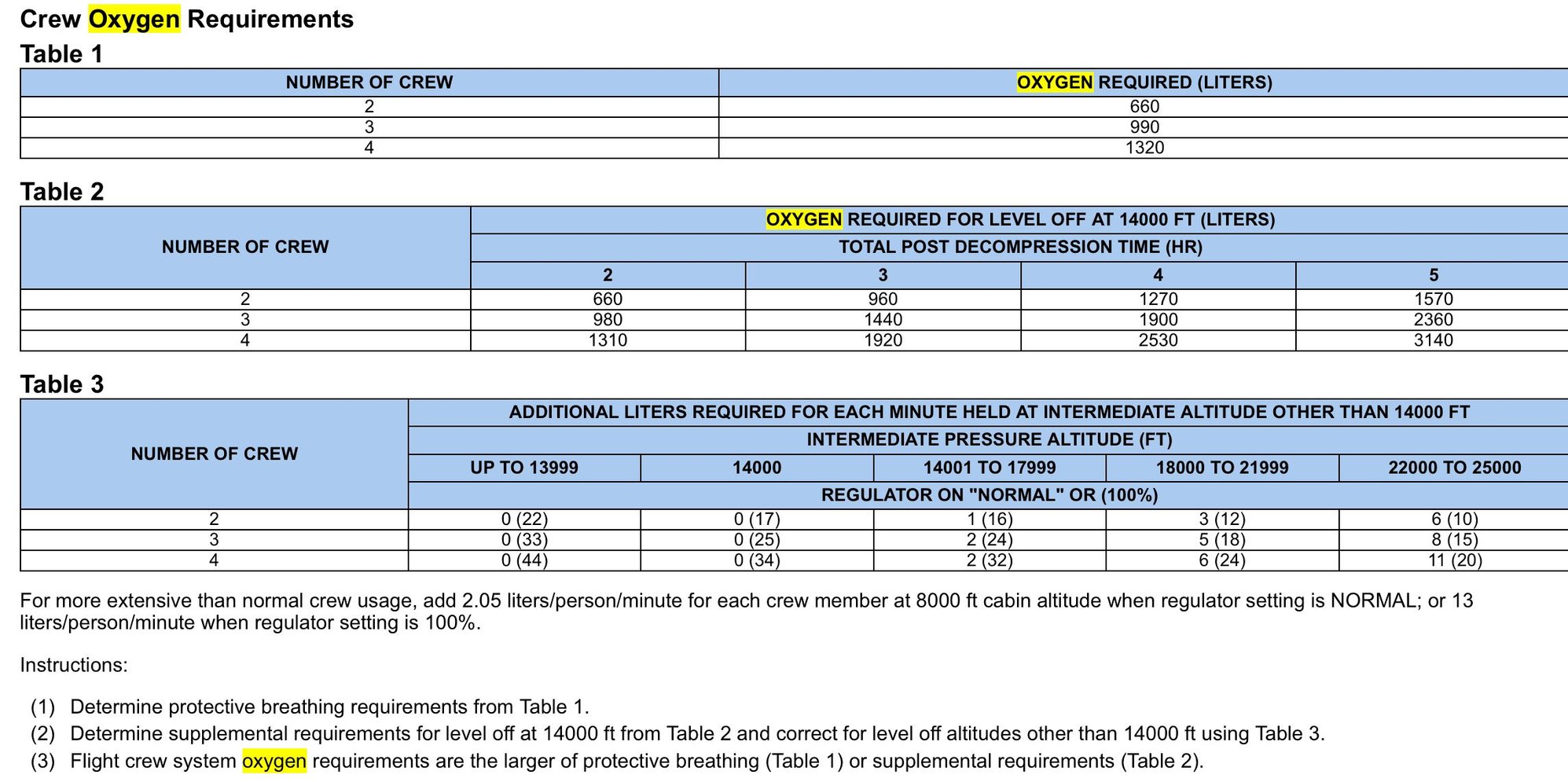
As instructor, I try to obtain a good idea about how many time in 100% O2 mode (in protective breathing situation) have 2 B777 pilots with a full O2 bottle of 3150 liters at 1850 PSI. Does anybody know how to calculate that with the B777 PD tables ? Thanks a lot in advance…
As instructor, I try to obtain a good idea about how many time in 100% O2 mode (in protective breathing situation) have 2 B777 pilots with a full O2 bottle of 3150 liters at 1850 PSI. Does anybody know how to calculate that with the B777 PD tables ? Thanks a lot in advance…


Joined: Feb 2015
Aviation Qualifications: PPL
Posts: 1,758
Likes: 358
From: Cincinnati, Ohio
Bonjour, Monsieur Philemon! As a sufferer of Chronic Obstructive Pulmonary Disease (COPD), I have been tethered to cannulated oxygen for twelve years. Though annoying, it beats the heck out of the alternatives! Here are a couple of articles which I hope will help you find the answer to your question: O2 Tank Depletion Rates Oxygen Tank Size Duration Bon Chance, Mon Ami!
- Edvard
- Edvard
Joined: Sep 2017
Aviation Qualifications: Non-Aircrew
Posts: 1,025
Likes: 1,057
From: Bremen
Table 3, 2 crew, up to 13999 ft, 100%, gives 22 l/min
3150 l / 22 l/min = 143 min = 2:23 hours.
At higher pressure altitudes, the air is less dense, so 100% requires less oxygen, and endurance is longer.
The Table 3 note suggests that at 8000 ft the rate should be 26 l/min.
3150 l / 22 l/min = 143 min = 2:23 hours.
At higher pressure altitudes, the air is less dense, so 100% requires less oxygen, and endurance is longer.
The Table 3 note suggests that at 8000 ft the rate should be 26 l/min.

Thread Starter
Joined: Jul 2009
Aviation Qualifications: SLF
Posts: 8
Likes: 2
From: France
So, for you, the consumption of the 22 L/p/min. from Table 2 (altitude below 14 000 ft alt. pressure) is for 2 pilots and not for only one, that is to say 11 L/P/min ?
Also, about the « note », do you think that we must add the figure of 13 L/p/min to the 11 L/p/min. of Table 2 (new consumption : 11 + 13 = 24 L/p/min.) or this first consumption (13) replaces completely the latter (11) ?
Tks again…
Also, about the « note », do you think that we must add the figure of 13 L/p/min to the 11 L/p/min. of Table 2 (new consumption : 11 + 13 = 24 L/p/min.) or this first consumption (13) replaces completely the latter (11) ?
Tks again…
Joined: Sep 2017
Aviation Qualifications: Non-Aircrew
Posts: 1,025
Likes: 1,057
From: Bremen
Also, about the « note », do you think that we must add the figure of 13 L/p/min to the 11 L/p/min. of Table 2 (new consumption : 11 + 13 = 24 L/p/min.) or this first consumption (13) replaces completely the latter (11) ?
Joined: Feb 2015
Aviation Qualifications: PPL
Posts: 1,758
Likes: 358
From: Cincinnati, Ohio
For comparison, to maintain a >94% blood oxygenation for my medical needs (staying conscious and alive!) at 607' ASL, I breathe 1.5 liters/min. of 95% pure oxygen. The gas is supplied by a concentrator which utilizes a zeolite molecular sieve. I used to need 4 l/m, but when I was hospitalized for a cardiac arrhythmia two years ago, I was treated with BiPAP: BiLevel Positive Airway Pressure. This therapy opened some of the cigarette-clogged alveoli in my poor old lungs, resulting in a much improved oxygen requirement. Lord knows I rue the day I took up smoking. It took forty-eight years for me to put those "health tubes" down. The Grim Reaper was in the room and he was walking directly toward me! Rapidly!
- Ed
- Ed
Joined: Sep 2017
Aviation Qualifications: Non-Aircrew
Posts: 1,025
Likes: 1,057
From: Bremen
Yeah, that's essentially "normal mode", where the oxygen is added to the outside air. That's not sufficient when that air is toxic (smoke etc.).
Joined: Sep 2017
Aviation Qualifications: Non-Aircrew
Posts: 1,025
Likes: 1,057
From: Bremen
https://pros-blog.padi.com/dan-safet...-aid-prepared/ says 100% oxygen for a diver is a "flow rate of at least 10-15 litres per minute (lpm)".
24 lpm would clearly be too much.
Actual oxygen consumption obviously depends on the physique of the person, big people need more than small people, etc.
24 lpm would clearly be too much.
Actual oxygen consumption obviously depends on the physique of the person, big people need more than small people, etc.
Thread Starter
Joined: Jul 2009
Aviation Qualifications: SLF
Posts: 8
Likes: 2
From: France
My big interrogation now concerns the sentence beginning by "add" : for a consumption at 100% in an extensive utlisation, must we "add" 13 L/pilot/min. to 11 L/pilot/min. (i.e. 24 L/pilot/min. total) or simply "replace" 11 L/pilot/min. by 13 L/pilot/min. ? Because the time available per pilot won't of course be the same...

Joined: Jul 2019
Posts: 27
Likes: 16
From: Australia
As an aside, patients in acute pulmonary failure can be administered as much as 60 (sixty) liters/min!
must we "add" 13 L/pilot/min. to 11 L/pilot/min. (i.e. 24 L/pilot/min. total) or simply "replace
Exesss o2 intake is best avoided and is harmful also. Look up oxygen toxicity.

Joined: Jan 2000
Aviation Qualifications: ATPL
Posts: 29
Likes: 0
From: USA
Pilots are often surprised that the duration of oxygen available for protective breathing is quite limited. This is because the oxygen consumption rate for smoke protection is far greater than the supplemental oxygen required for a decompression event.
Per FAR 121.337 (relating to protective breathing equipment) the flight crew is required to have a 15 minute supply at a cabin altitude of 8,000’. This amounts to 300 liters per flight crewmember. The 660 liter requirement for two crewmembers is only for 15 minutes of protection. It probably includes an additional 10 percent reserve to account for possible mask leakage when operating in the emergency mode (100 percent with positive pressure).
Based on Table 1, with a full 3150 liter bottle, and 2 pilots, you will have 1 hour and 12 minutes of oxygen.
3150/(660*4) = 3150/2640 = 1.19 hours = 1 hour and 12 minutes
If you have 4 pilots on the flight deck, you only will have approximately 36 minutes.
Keep in mind that this protection from smoke and fumes is available to the flight deck crew. The only protection available for the cabin crew is by the PBE. The passengers have no protection. The passenger oxygen masks are only designed to address a decompression event.
This underscores the need to eliminate the source of the smoke or fumes as soon as possible.
Per FAR 121.337 (relating to protective breathing equipment) the flight crew is required to have a 15 minute supply at a cabin altitude of 8,000’. This amounts to 300 liters per flight crewmember. The 660 liter requirement for two crewmembers is only for 15 minutes of protection. It probably includes an additional 10 percent reserve to account for possible mask leakage when operating in the emergency mode (100 percent with positive pressure).
Based on Table 1, with a full 3150 liter bottle, and 2 pilots, you will have 1 hour and 12 minutes of oxygen.
3150/(660*4) = 3150/2640 = 1.19 hours = 1 hour and 12 minutes
If you have 4 pilots on the flight deck, you only will have approximately 36 minutes.
Keep in mind that this protection from smoke and fumes is available to the flight deck crew. The only protection available for the cabin crew is by the PBE. The passengers have no protection. The passenger oxygen masks are only designed to address a decompression event.
This underscores the need to eliminate the source of the smoke or fumes as soon as possible.
Thread Starter
Joined: Jul 2009
Aviation Qualifications: SLF
Posts: 8
Likes: 2
From: France
Pilots are often surprised that the duration of oxygen available for protective breathing is quite limited. This is because the oxygen consumption rate for smoke protection is far greater than the supplemental oxygen required for a decompression event.
Per FAR 121.337 (relating to protective breathing equipment) the flight crew is required to have a 15 minute supply at a cabin altitude of 8,000’. This amounts to 300 liters per flight crewmember. The 660 liter requirement for two crewmembers is only for 15 minutes of protection. It probably includes an additional 10 percent reserve to account for possible mask leakage when operating in the emergency mode (100 percent with positive pressure).
Based on Table 1, with a full 3150 liter bottle, and 2 pilots, you will have 1 hour and 12 minutes of oxygen.
3150/(660*4) = 3150/2640 = 1.19 hours = 1 hour and 12 minutes
If you have 4 pilots on the flight deck, you only will have approximately 36 minutes.
Keep in mind that this protection from smoke and fumes is available to the flight deck crew. The only protection available for the cabin crew is by the PBE. The passengers have no protection. The passenger oxygen masks are only designed to address a decompression event.
This underscores the need to eliminate the source of the smoke or fumes as soon as possible.
Per FAR 121.337 (relating to protective breathing equipment) the flight crew is required to have a 15 minute supply at a cabin altitude of 8,000’. This amounts to 300 liters per flight crewmember. The 660 liter requirement for two crewmembers is only for 15 minutes of protection. It probably includes an additional 10 percent reserve to account for possible mask leakage when operating in the emergency mode (100 percent with positive pressure).
Based on Table 1, with a full 3150 liter bottle, and 2 pilots, you will have 1 hour and 12 minutes of oxygen.
3150/(660*4) = 3150/2640 = 1.19 hours = 1 hour and 12 minutes
If you have 4 pilots on the flight deck, you only will have approximately 36 minutes.
Keep in mind that this protection from smoke and fumes is available to the flight deck crew. The only protection available for the cabin crew is by the PBE. The passengers have no protection. The passenger oxygen masks are only designed to address a decompression event.
This underscores the need to eliminate the source of the smoke or fumes as soon as possible.
But Boeing gives us a particular information below table 3 (see above the sentence) that we could translate by a "real" O2 consumption, in this case, for extensive utilisation at 100%, 13 L/pilot/min., which is less than the 22 issued from regulation (300 L + 10% of potential leakakes per pilot). My initial question looked for a real endurance iso a required one.
