


787 APU Autostart

Thread Starter

Joined: Feb 2004
Posts: 1,410
Likes: 37
From: Australia
787 APU Autostart
Not sure if I'm missing some logic here here, but is there a time delay between 3 engine generators going offline (in the air) and the APU door beginning to open for an autostart?
Air India event:
I assume we can ignore the cutoff to run part. Of course there will be spooldown time (unless addtional logic is attached to the fuel cutoff levers?
What is the generator trip speed? 55%N2 like a CF6, or higher? During main engine start, the generator symbols don't appear on EICAS until idle has been reached.
The RAT certainly had no issues deploying much earlier.
Thanks.
Air India event:
The aircraft achieved the maximum recorded airspeed of 180 Knots IAS at about 08:08:42 UTC and immediately thereafter, the Engine 1 and Engine 2 fuel cutoff switches transitioned from RUN to CUTOFF position one after another with a time gap of 01 sec.
As per the EAFR, the Engine 1 fuel cutoff switch transitioned from CUTOFF to RUN at about 08:08:52 UTC. The APU Inlet Door BEGAN opening at about 08:08:54 UTC, consistent with the APU Auto Start logic.
What is the generator trip speed? 55%N2 like a CF6, or higher? During main engine start, the generator symbols don't appear on EICAS until idle has been reached.
The RAT certainly had no issues deploying much earlier.
Thanks.


Joined: Feb 2001
Aviation Qualifications: ATPL
Posts: 501
Likes: 35
From: UK
Hi NSEU
I suspect that level of detail isn’t in the FCOM. Perhaps in a maintenance manual? From a pilot perspective if you’ve lost three generators inflight you’re having a bad day in the office so the precise N2 wouldn’t be something to concern oneself about - probably! As you are probably aware the Boeing manuals tend to give just enough info and no more.
I suspect that level of detail isn’t in the FCOM. Perhaps in a maintenance manual? From a pilot perspective if you’ve lost three generators inflight you’re having a bad day in the office so the precise N2 wouldn’t be something to concern oneself about - probably! As you are probably aware the Boeing manuals tend to give just enough info and no more.


Joined: Feb 2002
Aviation Qualifications: AME
Posts: 4,183
Likes: 1,119
From: UK
From memory, I think it's an either/or logic.
If both fuel switches are set to cut off there's usually a no break power transfer to alternate supply, EG. APU or Ground Power. This will happen before the engine spools down too low to cause the generator to trip off due to low voltage/frequency etc.
If there's no alternative power available and therefore nothing to power transfer to I'm guessing the logic waits for the generator output to go out of limits and then trips.
Caveat, I'm doing this from memory of a training course I did over a decade ago. It's not something an every day line engineer has to think about too often.
If both fuel switches are set to cut off there's usually a no break power transfer to alternate supply, EG. APU or Ground Power. This will happen before the engine spools down too low to cause the generator to trip off due to low voltage/frequency etc.
If there's no alternative power available and therefore nothing to power transfer to I'm guessing the logic waits for the generator output to go out of limits and then trips.
Caveat, I'm doing this from memory of a training course I did over a decade ago. It's not something an every day line engineer has to think about too often.

Joined: Jul 2013
Aviation Qualifications: Non-Aircrew
Posts: 5,682
Likes: 3,347
From: Everett, WA
Something to remember.
On the 787 (also 777 and 747-8), when the fuel control switch is cycled to CUTOFF, the electrical generation doesn't stop when the engine N2/N3 drops too low - it happens much sooner than that.
In order to facilitate a 'breakless' power transfer during an engine shutdown, the fuel control switch sends a signal to the electrical system, which reconfigures to drop the related generators from the system before they drop off line. This takes ~0.25 seconds, not the several seconds it takes for the N2/N3 to drop sub-idle.
So in the case of the Air India 787, the system would have lost all main-bus power generation a fraction of a second after the second fuel control switch was moved to CUTOFF, commanding the RAT deployment.
On the 787 (also 777 and 747-8), when the fuel control switch is cycled to CUTOFF, the electrical generation doesn't stop when the engine N2/N3 drops too low - it happens much sooner than that.
In order to facilitate a 'breakless' power transfer during an engine shutdown, the fuel control switch sends a signal to the electrical system, which reconfigures to drop the related generators from the system before they drop off line. This takes ~0.25 seconds, not the several seconds it takes for the N2/N3 to drop sub-idle.
So in the case of the Air India 787, the system would have lost all main-bus power generation a fraction of a second after the second fuel control switch was moved to CUTOFF, commanding the RAT deployment.
Fleet Manager


Joined: Aug 2006
Aviation Qualifications: CPL
Posts: 7,089
Likes: 2,952
From: Ontario, Canada
This discussion is perfectly fine, please continue on topic. Please actively prevent it becoming another hamsterwheel of thread drift into the accident in general.
(Hopefully, it this slightly less frequented forum, it stays focused with the interest group!)
Thanks, Pilot DAR
Moderator
(Hopefully, it this slightly less frequented forum, it stays focused with the interest group!)
Thanks, Pilot DAR
Moderator
Joined: Sep 2017
Aviation Qualifications: Non-Aircrew
Posts: 1,037
Likes: 1,065
From: Bremen
So, once the RAT is providing some electrical power and hydraulics, the APU auto-start sequence begins with the opening of the air inlet?
Joined: Jul 2013
Aviation Qualifications: Non-Aircrew
Posts: 5,682
Likes: 3,347
From: Everett, WA
The 787 APU has a dedicated battery, so there is no reason to wait until the RAT is 'on-line' to commence the start sequence.
Joined: Aug 2005
Posts: 192
Likes: 23
From: Albuquerque USA
Thread Starter
Joined: Feb 2004
Posts: 1,410
Likes: 37
From: Australia
According to the transcript, the RAT had deployed and started to provide hydraulic power. Around 7 seconds later, the APU door started opening. I suppose we would need to know which parameter is being monitored for "door open". Is it triggered when the door cracks open or only after it has travelled a certain amount. I know on the 777, there is a closed switch which loses its earth when the door moves away from fully closed, so the aircraft should get a change in status immediately.
Thread Starter
Joined: Feb 2004
Posts: 1,410
Likes: 37
From: Australia
Whle I understand the recording function of the forward recorder would continue on the local battery, would not a very large majority of recorded data parameters have ceased being supplied to the recorder immediately on loss of main-bus power? Do we have any general idea of which ones? And between the RAT and the attempted relight of the engines, is there an identifiable point in the sequence in which power source for most of the data parameter sources would have resumed?

I assume the CCR L is used in data gathering, but I don't know if this is forwarded on to the flight recorder during this time. Since the engine parameters were known, I think we can assume that the engine EECs were talking to the flight recorder.
Joined: Jul 2013
Aviation Qualifications: Non-Aircrew
Posts: 5,682
Likes: 3,347
From: Everett, WA
Whle I understand the recording function of the forward recorder would continue on the local battery, would not a very large majority of recorded data parameters have ceased being supplied to the recorder immediately on loss of main-bus power? Do we have any general idea of which ones? And between the RAT and the attempted relight of the engines, is there an identifiable point in the sequence in which power source for most of the data parameter sources would have resumed?
I'm not familiar with the specifics of the 787 avionics, but the following are required for continued safe flight and landing, and are on the battery:
Left EICAS
Left PFD
One ADIRU (likely the left).
At least one level of the FBW system
Thread Starter
Joined: Feb 2004
Posts: 1,410
Likes: 37
From: Australia
Yes, any information that comes from LRUs that are not on the battery buss would be lost when main bus power is lost.
I'm not familiar with the specifics of the 787 avionics, but the following are required for continued safe flight and landing, and are on the battery:
Left EICAS
Left PFD
One ADIRU (likely the left).
At least one level of the FBW system
I'm not familiar with the specifics of the 787 avionics, but the following are required for continued safe flight and landing, and are on the battery:
Left EICAS
Left PFD
One ADIRU (likely the left).
At least one level of the FBW system
Joined: Jul 2013
Aviation Qualifications: Non-Aircrew
Posts: 5,682
Likes: 3,347
From: Everett, WA
Naturally, the interfacing electronics between the EECs and the FDR need to stay powered for that data to do any good, but it appears that on the 787 they keep enough stuff on the battery that the EEC provided engine parameters still made it to the battery powered FDR (that's not the case on many aircraft).
Thread Starter
Joined: Feb 2004
Posts: 1,410
Likes: 37
From: Australia
Joined: Jul 2013
Aviation Qualifications: Non-Aircrew
Posts: 5,682
Likes: 3,347
From: Everett, WA
Actually, now that I think about it, most engines, including GE, have some engine sensor data hardwired to the aircraft, so the EECs don't necessarily need to be powered. The CF6, for example, had N1, N2, vibration and oil quantity. But I'm sure the engines were still above the required N2 to maintain PMA power.
However, as the reliability of the FADECs has been proven, the need for analog backup has slowly gone away. A big reason why the analog rotor speeds went to aircraft was for use in the engine vibration system, but on the GEnx (both 787 and 747-8), the engine vibration data is calculated on the engine using the "Engine Monitor Unit" - EMU - so those vibe related parameters are no longer sent to the airframe).
I'm not sure that the 787 EICAS gets any backup analog rotor speed signals...
Joined: Jan 2025
Aviation Qualifications: Non-Aircrew
Posts: 640
Likes: 782
From: New Zealand
The engines both re-lit (even if the right did not accelerate), so the EECs were absolutely powered.
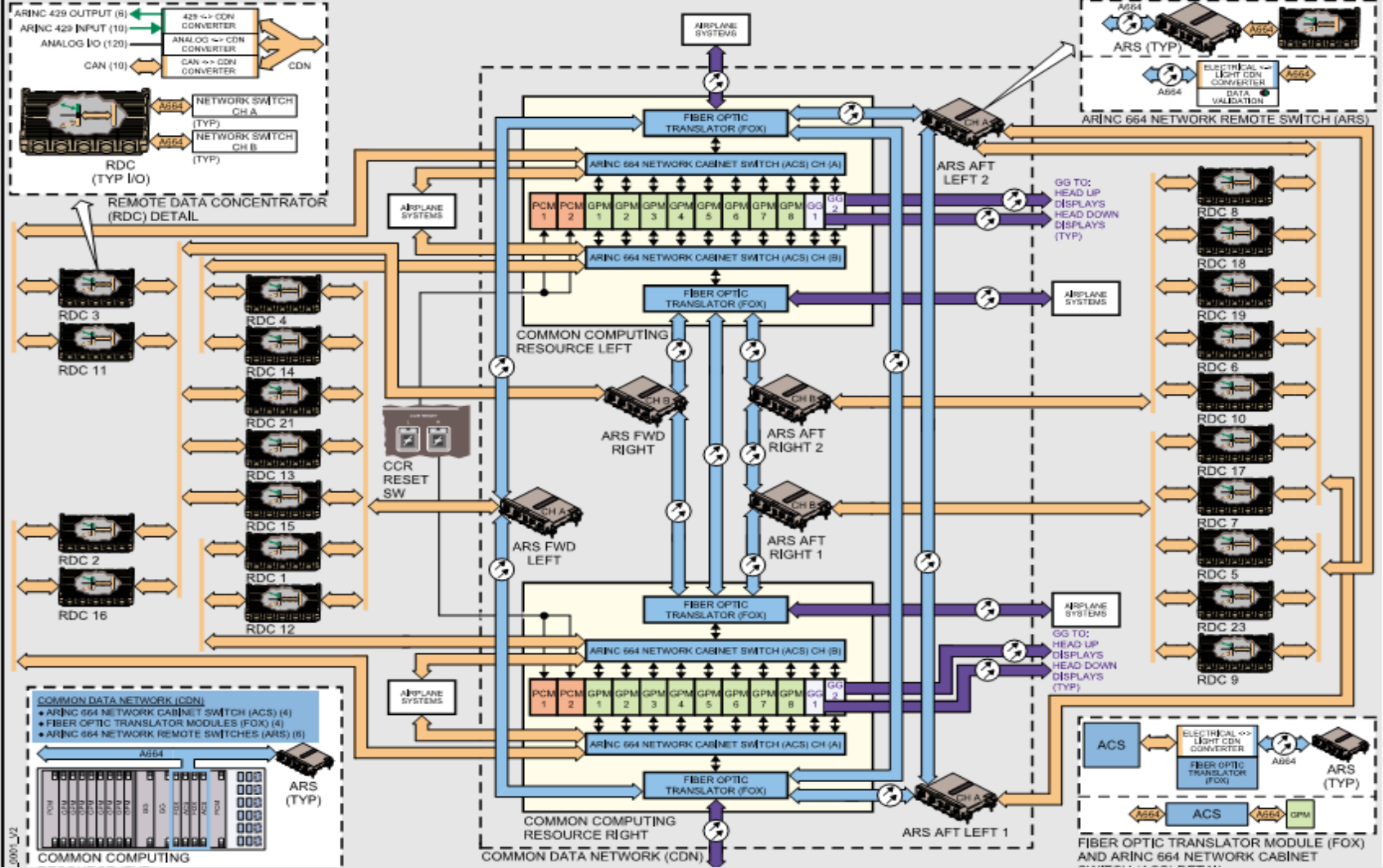
The left CCR is powered on battery/RAT (necessary for APU start, apparently). At least one of the channel A and B cabinet switches in the CCR L must also be powered; I expect both.
It looks like all the RDCs have A/B channels connected to the A/B networks, so you can lose all the switches on one channel and still talk to all the RDCs.
I'm not sure how many of the remote network switches (ARSs) and RDCs would be powered, though.
My guess is any RDC powered on battery had routes available to the CCR and through to the EAFR, and would have been recorded if it was a recorded parameter. It sounds like the integrated DFDAU in the EAFR sniffs data straight out of the CDN.
I wouldn't be surprised to find >50%, maybe even >80% of recorded parameters present.
The left CCR is powered on battery/RAT (necessary for APU start, apparently). At least one of the channel A and B cabinet switches in the CCR L must also be powered; I expect both.
It looks like all the RDCs have A/B channels connected to the A/B networks, so you can lose all the switches on one channel and still talk to all the RDCs.
I'm not sure how many of the remote network switches (ARSs) and RDCs would be powered, though.
My guess is any RDC powered on battery had routes available to the CCR and through to the EAFR, and would have been recorded if it was a recorded parameter. It sounds like the integrated DFDAU in the EAFR sniffs data straight out of the CDN.
I wouldn't be surprised to find >50%, maybe even >80% of recorded parameters present.

Joined: Sep 2017
Aviation Qualifications: Non-Aircrew
Posts: 1,037
Likes: 1,065
From: Bremen
I'm surprised it's not the opening of the inlet, is there an outlet that needs to be opened first? Fuel to be pumped?
Thread Starter
Joined: Feb 2004
Posts: 1,410
Likes: 37
From: Australia
On the 777, the door must also be open (and rpms below 12% before the start sequence begins). The DC fuel pump is also activated with the switch moved from OFF to ON.
Joined: Feb 2024
Posts: 11
Likes: 3
From: France
I hope my question is not too much outside the topic.
If all main-bus power was lost around 08:08:43, how is it possible there were FR24 ADS-B transmissions with time stamps until 08:08:51?
PL
Something to remember.
On the 787 (also 777 and 747-8), when the fuel control switch is cycled to CUTOFF, the electrical generation doesn't stop when the engine N2/N3 drops too low - it happens much sooner than that.
In order to facilitate a 'breakless' power transfer during an engine shutdown, the fuel control switch sends a signal to the electrical system, which reconfigures to drop the related generators from the system before they drop off line. This takes ~0.25 seconds, not the several seconds it takes for the N2/N3 to drop sub-idle.
So in the case of the Air India 787, the system would have lost all main-bus power generation a fraction of a second after the second fuel control switch was moved to CUTOFF, commanding the RAT deployment.
On the 787 (also 777 and 747-8), when the fuel control switch is cycled to CUTOFF, the electrical generation doesn't stop when the engine N2/N3 drops too low - it happens much sooner than that.
In order to facilitate a 'breakless' power transfer during an engine shutdown, the fuel control switch sends a signal to the electrical system, which reconfigures to drop the related generators from the system before they drop off line. This takes ~0.25 seconds, not the several seconds it takes for the N2/N3 to drop sub-idle.
So in the case of the Air India 787, the system would have lost all main-bus power generation a fraction of a second after the second fuel control switch was moved to CUTOFF, commanding the RAT deployment.
PL