


787 Fuel Tank Pressure & NGS System

Thread Starter

Joined: Feb 2004
Posts: 1,410
Likes: 37
From: Australia
787 Fuel Tank Pressure & NGS System
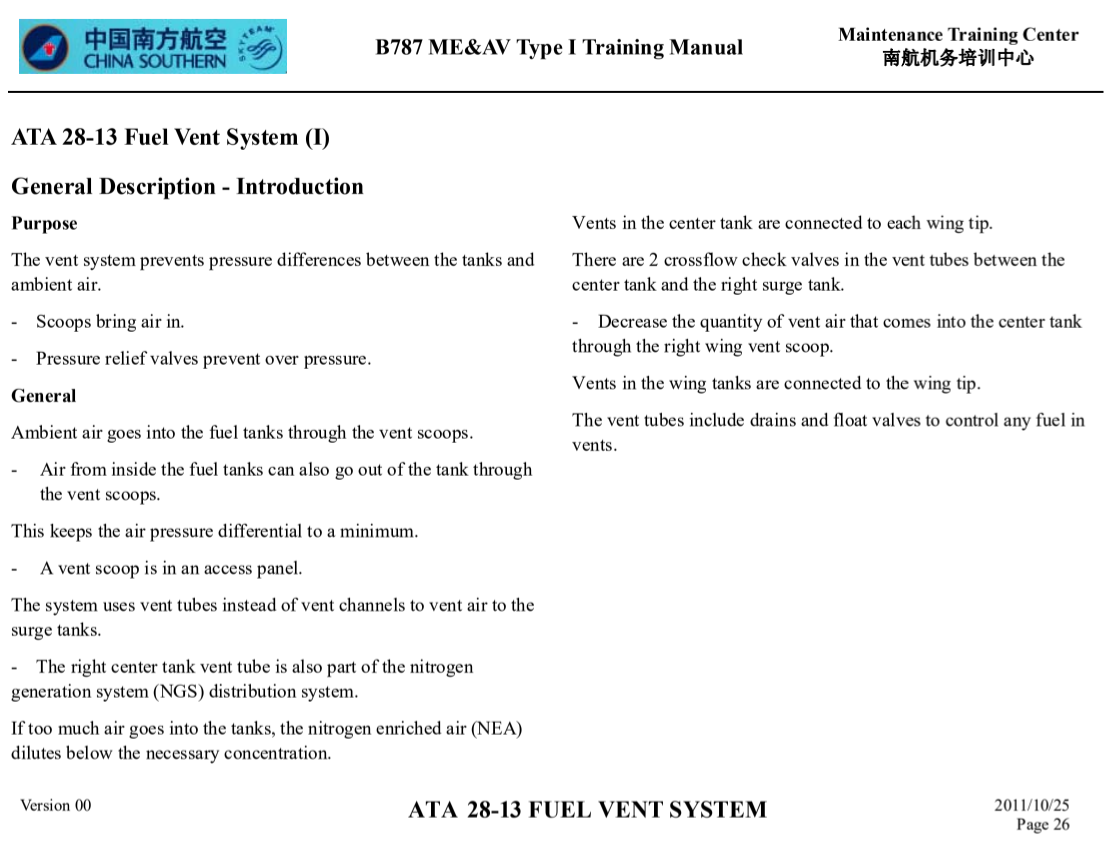
Hi folks, I'm trying to understand the fuel tank venting/pressurisation system on the 787-8. I did see a diagram of this system, but it had check valves in unexpected places. On more traditional aircraft, tanks are pressurised by the NACA scoops under the wings, but I don't see any of these in 787 photos.... just what looks like overpressure valves.
Do the fuel tanks rely solely on pressure from the NGS system, and if the pressure is generated electrically, would a dual engine failure (as some theorised in the Air India incident) stop the generation system operating? If so, how are vacuums prevented in the tanks. Can air get into the tank through the surge tank drains or other places?
Also, MEL 29-11-03-02 for the Centre Hydraulic System Left Pump Auto function inops the NGS system. I know the NGS and Centre Hydraulic Pumps are driven by the "Large Motor Power System", but why should AUTO hydraulic pump operation affect the NGS?
Thank you.
Do the fuel tanks rely solely on pressure from the NGS system, and if the pressure is generated electrically, would a dual engine failure (as some theorised in the Air India incident) stop the generation system operating? If so, how are vacuums prevented in the tanks. Can air get into the tank through the surge tank drains or other places?
Also, MEL 29-11-03-02 for the Centre Hydraulic System Left Pump Auto function inops the NGS system. I know the NGS and Centre Hydraulic Pumps are driven by the "Large Motor Power System", but why should AUTO hydraulic pump operation affect the NGS?
Thank you.

Joined: May 2024
Aviation Qualifications: CPL
Posts: 379
Likes: 36
From: Kaupuala
Because
Because the engines have the mechanical (3000psi) pumps and the Electrical load shed by the six elec pumps is more important for a battery start... The mechanical.pump has alot of suck, and will almost certainly overcome whatever vacuum establishes in the tanks?? Easy, wag.
Presuming two engines inop
Presuming two engines inop
Last edited by BugBear; 2nd July 2025 at 05:48.
Thread Starter
Joined: Feb 2004
Posts: 1,410
Likes: 37
From: Australia
Thread Starter
Joined: Feb 2004
Posts: 1,410
Likes: 37
From: Australia
Because the engines have the mechanical (3000psi) pumps and the Electrical load shed by the six elec pumps is more important for a battery start... The mechanical.pump has alot of suck, and will almost certainly overcome whatever vacuum establishes in the tanks?? Easy, wag.
Sorry, not competely following you. Battery start? Are you saying during start, the ON pump position always causes loadshedding. And the NGS is one of the loadshed systems, so it can't be relied upon to work all of the time? Or does ON automatically loadshed the NGS at all time?
Thanks!
Joined: May 2024
Aviation Qualifications: CPL
Posts: 379
Likes: 36
From: Kaupuala
BTW. I think the engines were providing thrust. Weakly, perhaps due to lack of fuel due to failed electrical pumps. Mechanical (geared) pumps only. Engines don't just stop
Thread Starter
Joined: Feb 2004
Posts: 1,410
Likes: 37
From: Australia
Of course, understood. There would be more than just loadshed in that situation. It was just the DDG/MEL that was a little confusing.
It's funny that Boeing/GE say that suction feed won't be an issue except during high altitude climbs. There may be 3000psi pump output, but I don't think there would be 3000psi of suck. The fuel has to go through a filter and two heat exhangers. I think I'd still be relying on some kind of check valve system to let air into the tanks.
Thanks and cheers
BTW. I think the engines were providing thrust. Weakly, perhaps due to lack of fuel due to failed electrical pumps.
Thanks and cheers
Joined: Feb 2009
Posts: 945
Likes: 445
From: Austria
Consider a pressure washer.
It provides massive pressure at the nozzle, but the mass flow is still rather moderate as the water is just squeezed through a tiny hole. The suction on the other end is so low that it will not collapse the normal garden hose that is in no way designed to withstand negative pressure. A small hole requires a much larger pressure than a large pipe if the same mass flow per second is to go through it.
Same for the engines. If the set of small-diameter fuel injection nozzles are fed 3000psi, it is very well possible to feed the pump with a large diameter, low pressure pipe that both withstands a little boost pressure from the tank pumps or a light negative pressure when the tank pumps are out of service.
Since the 1959 accident to the GDR-built 152 airliner, there is no accident I am aware of in which lack of tank ventilation (in absence of icing) played a role in starving the engines.
It provides massive pressure at the nozzle, but the mass flow is still rather moderate as the water is just squeezed through a tiny hole. The suction on the other end is so low that it will not collapse the normal garden hose that is in no way designed to withstand negative pressure. A small hole requires a much larger pressure than a large pipe if the same mass flow per second is to go through it.
Same for the engines. If the set of small-diameter fuel injection nozzles are fed 3000psi, it is very well possible to feed the pump with a large diameter, low pressure pipe that both withstands a little boost pressure from the tank pumps or a light negative pressure when the tank pumps are out of service.
Since the 1959 accident to the GDR-built 152 airliner, there is no accident I am aware of in which lack of tank ventilation (in absence of icing) played a role in starving the engines.

Joined: Dec 2003
Posts: 2,349
Likes: 843
From: Tring, UK
With a liquid, suck is a poor description. If you try and pump more than the tank pressure (~14psi @SL) + gravity head will force through the pipework to the pump, you will get a partial vacuum somewhere in the line and/or cavitation in the pump. Fortunately, we have known about this problem for the last couple of centuries, maybe longer, so I think it is a given that the plumbing is of sufficient dimensions that this should not be an issue, at least on takeoff. There is probably a regulation somewhere that states how much oversupply a fuel system should be able to produce - there certainly is for piston engines.


Joined: Feb 2002
Aviation Qualifications: AME
Posts: 4,183
Likes: 1,118
From: UK
I haven't got the MEL or the electrical schematic in front of me, but I think with the auto function INOP the pump runs continuously, the motor controllers share various loads, so I'm assuming the NGS will only function when the pump is not running.

Thread Starter
Joined: Feb 2004
Posts: 1,410
Likes: 37
From: Australia
A wealth of information. Thanks gentlemen.
The 787 vent system is indeed like the ones I'm used. The vent system is designed to put a few psi positive pressure on the fuel, which will no doubt help keep the vapours in check in the absence of the NGS and help with cavitation issues.
The 787 vent system is indeed like the ones I'm used. The vent system is designed to put a few psi positive pressure on the fuel, which will no doubt help keep the vapours in check in the absence of the NGS and help with cavitation issues.
Joined: Jan 2025
Aviation Qualifications: Non-Aircrew
Posts: 640
Likes: 782
From: New Zealand
NGS and HYD L are in the lower right.
It looks like there isn't a dedicated NGS motor controller; instead it is powered from either the HYD L CMSC or the cabin air compressor R2 CMSC.
Running two motors simultaneously on the same variable-frequency drive is considered possible but not preferred in industry; I am not sure whether it's something Boeing does. I would be expecting to stop the motors, rearrange the contactors, then restart the motors.

As for vacuums... remember it can't be 3000PSI of suck; suck isn't a thing. It's ambient pressure pushing in. At sea level you have ~15PSI of air pushing the fuel into the pump; at altitude it might be 7-8PSI. You don't want a near-perfect vacuum on the fuel because then it starts to boil on you.
It looks like there isn't a dedicated NGS motor controller; instead it is powered from either the HYD L CMSC or the cabin air compressor R2 CMSC.
Running two motors simultaneously on the same variable-frequency drive is considered possible but not preferred in industry; I am not sure whether it's something Boeing does. I would be expecting to stop the motors, rearrange the contactors, then restart the motors.
As for vacuums... remember it can't be 3000PSI of suck; suck isn't a thing. It's ambient pressure pushing in. At sea level you have ~15PSI of air pushing the fuel into the pump; at altitude it might be 7-8PSI. You don't want a near-perfect vacuum on the fuel because then it starts to boil on you.
Thread Starter
Joined: Feb 2004
Posts: 1,410
Likes: 37
From: Australia
As for vacuums... remember it can't be 3000PSI of suck; suck isn't a thing. It's ambient pressure pushing in. At sea level you have ~15PSI of air pushing the fuel into the pump; at altitude it might be 7-8PSI. You don't want a near-perfect vacuum on the fuel because then it starts to boil on you.
It looks like there isn't a dedicated NGS motor controller; instead it is powered from either the HYD L CMSC or the cabin air compressor R2 CMSC.
Thanks.

Joined: Jan 2008
Aviation Qualifications: LAME
Posts: 44
Likes: 161
From: 3rd rock from the Sun
Just I/B of the overpressure valve. Select the Hires download option.
Thread Starter
Joined: Feb 2004
Posts: 1,410
Likes: 37
From: Australia
Hires photo of a 78-8 underwing.
Just I/B of the overpressure valve. Select the Hires download option.
Just I/B of the overpressure valve. Select the Hires download option.
Cheers!
Joined: Feb 2002
Aviation Qualifications: AME
Posts: 4,183
Likes: 1,118
From: UK
Both CCRs have eight individual processor modules (GPMs?) that can be referred to as L1 to L8 and R1 to R8.
Last edited by TURIN; 3rd July 2025 at 21:18.
Joined: Aug 2007
Posts: 59
Likes: 64
From: UK
No, the 787 has a classic vent system. The NGS just pumps nitrogen enriched air into the ullage, the tank is still repressurized in descent via the vent system (this is the sizing case for the NGS). The NGS is on the MMEL.
Joined: May 2024
Aviation Qualifications: CPL
Posts: 379
Likes: 36
From: Kaupuala
With a liquid, suck is a poor description. If you try and pump more than the tank pressure (~14psi @SL) + gravity head will force through the pipework to the pump, you will get a partial vacuum somewhere in the line and/or cavitation in the pump. Fortunately, we have known about this problem for the last couple of centuries, maybe longer, so I think it is a given that the plumbing is of sufficient dimensions that this should not be an issue, at least on takeoff. There is probably a regulation somewhere that states how much oversupply a fuel system should be able to produce - there certainly is for piston engines.
Pumps Produce DeltaP .... No Pull, Push only.
Joined: Jan 2025
Aviation Qualifications: Non-Aircrew
Posts: 640
Likes: 782
From: New Zealand
Side note; found this in the GEnx TCDS:
3.5psi absolute seems like a fairly solid vacuum when dealing with liquids, and nearly half vapour. I see no conditions saying a thrust reduction is acceptable, or that these don't apply at takeoff.
It seems that the 3.5psia minimum applies to both 787 engines, whereas other engine families and the same engine on other aircraft only need to operate to 5psia.
FUEL PRESSURE LIMITS AT THE ENGINE PUMP INLET
The limit is from minimum fuel pressures of not less than true vapor pressure plus 5.0 psi
to a maximum of 70 psig.
For the GEnx-1B, on the 787 aircraft, the minimum fuel pressure limit is extended down
to minimum fuel pressure of 3.5 psia and maximum vapor-to-liquid ratio (v/l) of 0.45 for
up to 60 minutes followed by up to 600 minutes with minimum fuel pressure of 3.5 psia
and a maximum vapor-to-liquid ratio (v/l) of 0.28.
The limit is from minimum fuel pressures of not less than true vapor pressure plus 5.0 psi
to a maximum of 70 psig.
For the GEnx-1B, on the 787 aircraft, the minimum fuel pressure limit is extended down
to minimum fuel pressure of 3.5 psia and maximum vapor-to-liquid ratio (v/l) of 0.45 for
up to 60 minutes followed by up to 600 minutes with minimum fuel pressure of 3.5 psia
and a maximum vapor-to-liquid ratio (v/l) of 0.28.
It seems that the 3.5psia minimum applies to both 787 engines, whereas other engine families and the same engine on other aircraft only need to operate to 5psia.
Joined: Feb 2025
Posts: 153
Likes: 248
From: Earth
NGS and HYD L are in the lower right.
It looks like there isn't a dedicated NGS motor controller; instead it is powered from either the HYD L CMSC or the cabin air compressor R2 CMSC.
Running two motors simultaneously on the same variable-frequency drive is considered possible but not preferred in industry; I am not sure whether it's something Boeing does. I would be expecting to stop the motors, rearrange the contactors, then restart the motors.
It looks like there isn't a dedicated NGS motor controller; instead it is powered from either the HYD L CMSC or the cabin air compressor R2 CMSC.
Running two motors simultaneously on the same variable-frequency drive is considered possible but not preferred in industry; I am not sure whether it's something Boeing does. I would be expecting to stop the motors, rearrange the contactors, then restart the motors.