


Approach category

Thread Starter


Joined: Apr 2001
Aviation Qualifications: ATP+Mil
Posts: 4,925
Likes: 615
From: surfing, watching for sharks
Approach category
If you’ve ever argued with a pilot, you know opinion doesn’t go as far as a solid reference, if one exists. As such seeking out a reference regarding at what point does one become governed by a particular approach category.
Assigned 180 kts to the FAF, released from ATC speed control inside of it. I say on an approach that has straight in minimums, that the minimums for a particular category apply from the FAF in. Other pilot says that once established on the FAC, even well outside the FAF that higher category minimums apply.
Assigned 180 kts to the FAF, released from ATC speed control inside of it. I say on an approach that has straight in minimums, that the minimums for a particular category apply from the FAF in. Other pilot says that once established on the FAC, even well outside the FAF that higher category minimums apply.


Joined: Jan 2006
Aviation Qualifications: CPL
Posts: 1,410
Likes: 46
From: Between a rock and a hard place
Skybrary might not be the best reference but it's easier for Google to find than to find the relevant chapter and paragraph of PANS-OPS or TERPS. (The list is identical to my OM-C): https://skybrary.aero/articles/appro...categorisation
Speed ranges exists for all published segments from the initial approach fix to threshold speed and missed approach. Does that help settle the argument?
Are you thinking a scenario whether you have to fly maximum e.g. max 160 KIAS from the FAF if you're a Category C airplane?
Speed ranges exists for all published segments from the initial approach fix to threshold speed and missed approach. Does that help settle the argument?
Are you thinking a scenario whether you have to fly maximum e.g. max 160 KIAS from the FAF if you're a Category C airplane?
Thread Starter
Joined: Apr 2001
Aviation Qualifications: ATP+Mil
Posts: 4,925
Likes: 615
From: surfing, watching for sharks
In my mind, no. The other pilot, yes which is why I’m seeking a reference. I do accept such a granular level explanation of the requirements may not exist but figured I’d search just in case.
Joined: Dec 2001
Aviation Qualifications: ATPL
Posts: 3,766
Likes: 424
From: GA, USA
So if you fly 120 kts at minimums then you are Category B and if you fly 140kts you should apply the minimums for category C.
What your speed is outside of the final approach fix is irrelevant.
1.4.1 Aircraft performance has a direct effect on the airspace and visibility required for the various manoeuvres associated with the conduct of instrument approach procedures. The most significant performance factor is aircraft speed. Accordingly, categories of typical aircraft have been established.
1.4.2 The criterion taken into consideration for the classification of aeroplanes by categories is the indicated airspeed at threshold (Vst).
1.4.3 Aircraft categories will be referred to by their letter designations as follows:
1.4.2 The criterion taken into consideration for the classification of aeroplanes by categories is the indicated airspeed at threshold (Vst).
1.4.3 Aircraft categories will be referred to by their letter designations as follows:
- Category A: less than 169 km/h (91 kt) indicated airspeed (IAS)
- Category B: 169 km/h (91 kt) or more but less than 224 km/h (121 kt) IAS
- Category C: 224 km/h (121 kt) or more but less than 261 km/h (141 kt) IAS
- Category D: 261 km/h (141 kt) or more but less than 307 km/h (166 kt) IAS
- Category E: 307 km/h (166 kt) or more but less than 391 km/h (211 kt) IAS
- Category H: see 1.4.7, “Helicopters”.
Joined: Apr 2009
Aviation Qualifications: Non-Aircrew
Posts: 1,601
Likes: 704
From: DM33
Also, the aircraft minimum turn radius may be important on the published missed procedure.

Joined: Jan 2006
Aviation Qualifications: CPL
Posts: 1,410
Likes: 46
From: Between a rock and a hard place
I'm not following what the debate is about. The minimums apply at... minimums. Not sure what can happen outside the FAF conceptually that bears on this.

Joined: Sep 2016
Posts: 937
Likes: 67
From: USA
Joined: Dec 2001
Aviation Qualifications: ATPL
Posts: 3,766
Likes: 424
From: GA, USA
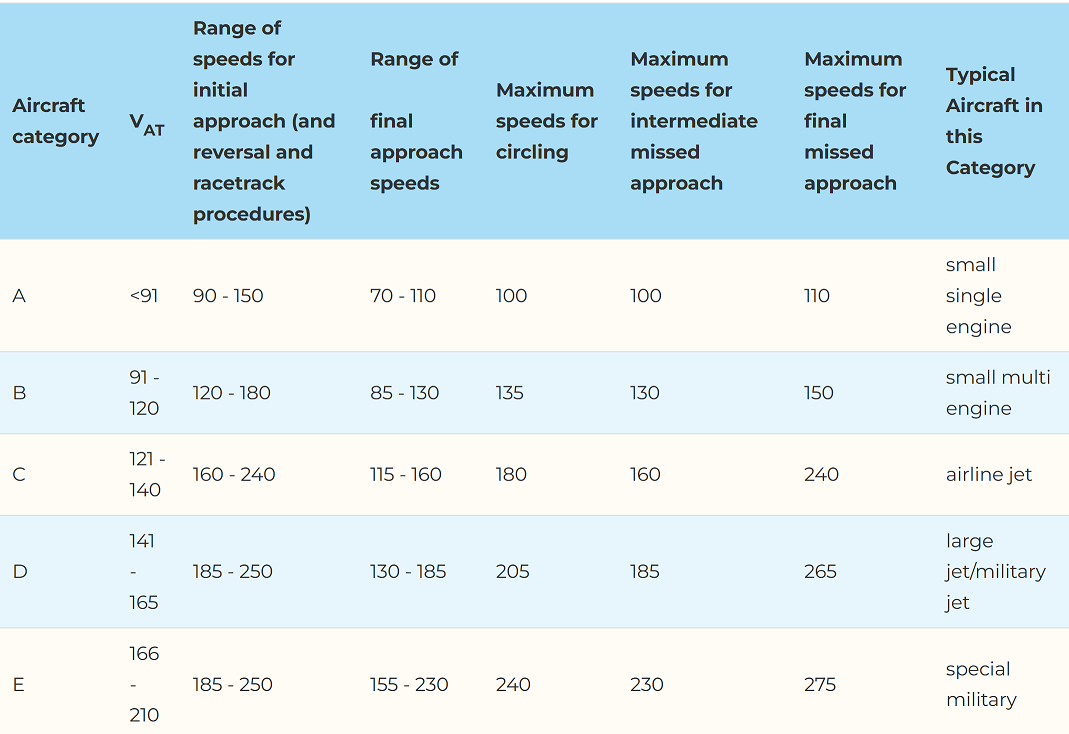
This is not my area of expertise, but sure enough max (and min?) speeds may be relevant when any maneuvering (turning) is involved. Not all approaches are vectored straight in ILS. There are plenty of RNP (AR) approaches that will have you maneuver way below the mountain tops, I flew one with a 1,75 Arc RF leg in the final segment and 2,40 Arc RF leg in the intermediate segment, approved for Cat C/D aircraft. The OP asked when you're governed by your aircraft category. I would argue from the IAF, based on the table below (which is ICAO PANS-OPS). Will it work to fly most approaches faster? Most likely, they aren't edge cases.
Which means you can be well above your max category speed at the IAF and still be at the correct threshold speed for your category.
So no, speed at IAF does not apply
Now if a non normal condition increases your Vref then you need to apply the higher category minimums if applicable.
Could also mean you’re no longer legal to fly that approach if it’s a A/B only.
Joined: Dec 2002
Aviation Qualifications: ATP+Mil
Posts: 3,985
Likes: 568
From: Where the Quaboag River flows, USA
Westie,
This FAA InFO Letter (link below) should answer the question. Also, FAA AIM 5-4-7 as reference, which says and I quote,
If it is necessary to operate at a speed in excess of the upper limit of the speed range for an aircraft's category, the minimums for the higher category should be used. This may occur with certain aircraft types operating in heavy/gusty wind, icing, or non-normal conditions. For example, an airplane which fits into Category B, but is circling to land at a speed of 145 knots, should use the approach Category D minimums.
“Should” being the operative word, it’s not mandatory.
https://www.faa.gov/sites/faa.gov/files/InFO23001.pdf
This FAA InFO Letter (link below) should answer the question. Also, FAA AIM 5-4-7 as reference, which says and I quote,
If it is necessary to operate at a speed in excess of the upper limit of the speed range for an aircraft's category, the minimums for the higher category should be used. This may occur with certain aircraft types operating in heavy/gusty wind, icing, or non-normal conditions. For example, an airplane which fits into Category B, but is circling to land at a speed of 145 knots, should use the approach Category D minimums.
“Should” being the operative word, it’s not mandatory.
https://www.faa.gov/sites/faa.gov/files/InFO23001.pdf
Joined: Jan 2006
Aviation Qualifications: CPL
Posts: 1,410
Likes: 46
From: Between a rock and a hard place
So no, speed at IAF does not apply
Joined: Dec 2002
Aviation Qualifications: ATP+Mil
Posts: 3,985
Likes: 568
From: Where the Quaboag River flows, USA
Under PANS-OPS, yes; TERPS, no. The AIM only says the initial segment should be flown at 200 KIAS.
Last edited by galaxy flyer; 31st May 2025 at 20:00.
Joined: Jan 2006
Aviation Qualifications: CPL
Posts: 1,410
Likes: 46
From: Between a rock and a hard place
Okay, I did not know that galaxy flyer.
My point is that you have start with checking the plate and see what Category the entire approach is designed for and comply with the speeds accordingly (accounting for differences between TERPS and PANS-OPS). If 99 % of your approaches are vectors to a straight final segment the only relevant restriction is perhaps the minima.
My point is that you have start with checking the plate and see what Category the entire approach is designed for and comply with the speeds accordingly (accounting for differences between TERPS and PANS-OPS). If 99 % of your approaches are vectors to a straight final segment the only relevant restriction is perhaps the minima.
Joined: Apr 2009
Aviation Qualifications: Non-Aircrew
Posts: 1,601
Likes: 704
From: DM33
Joined: Dec 2002
Aviation Qualifications: ATP+Mil
Posts: 3,985
Likes: 568
From: Where the Quaboag River flows, USA
FAA AIM 5-4-9, subparagraph 3 says.
3. When the approach procedure involves a procedure turn, a maximum speed of not greater than 200 knots (IAS) should be observed from first overheading the course reversal IAF through the procedure turn maneuver to ensure containment within the obstruction clearance area.
The speed being the maximum should have been obvious
3. When the approach procedure involves a procedure turn, a maximum speed of not greater than 200 knots (IAS) should be observed from first overheading the course reversal IAF through the procedure turn maneuver to ensure containment within the obstruction clearance area.
The speed being the maximum should have been obvious
Joined: Dec 2001
Aviation Qualifications: ATPL
Posts: 3,766
Likes: 424
From: GA, USA
As is common…we’re going down the rabbit hole of chasing minutiae.
We’ve provided ICAO and FAA references.
At the end of the flight what really matters is what the STAR and approach plates dictate as far as altitudes and speeds.
We’ve provided ICAO and FAA references.
At the end of the flight what really matters is what the STAR and approach plates dictate as far as altitudes and speeds.
Joined: Apr 2009
Aviation Qualifications: Non-Aircrew
Posts: 1,601
Likes: 704
From: DM33
Thanks for the reference.
How often in a radar environment would you expect to fly a procedure turn even if one is depicted on the plate?
If, as I suspect, the answer is seldom then the initial statement "The AIM only says the initial segment should be flown at 200 KIAS" seems to have implied a restriction that seldom actually exists.

How often in a radar environment would you expect to fly a procedure turn even if one is depicted on the plate?
If, as I suspect, the answer is seldom then the initial statement "The AIM only says the initial segment should be flown at 200 KIAS" seems to have implied a restriction that seldom actually exists.
Joined: Dec 2002
Aviation Qualifications: ATP+Mil
Posts: 3,985
Likes: 568
From: Where the Quaboag River flows, USA
It’s all minutiae and written exam trivia until it’s not…
https://www.icao.int/APAC/Meetings/2...%20-%20Bali%20[Compatibility%20Mode].pdf
https://www.icao.int/APAC/Meetings/2...%20-%20Bali%20[Compatibility%20Mode].pdf
Joined: Dec 2002
Aviation Qualifications: ATP+Mil
Posts: 3,985
Likes: 568
From: Where the Quaboag River flows, USA
It’s all minutiae and exam trivia until it’s not…. Air China 129 circling at Busan, Korea.
There’s an excellent ICAO ALAR presentation from 2012 but I can’t copy/paste the link.
172_driver,
The 99% case is where the problem lies—the 1% that catches the crew out.
There’s an excellent ICAO ALAR presentation from 2012 but I can’t copy/paste the link.
172_driver,
The 99% case is where the problem lies—the 1% that catches the crew out.