


A/T: is it really helping you ?


Joined: Feb 2003
Posts: 541
Likes: 336
From: Blue sky
If I have a speed bug 20kt below my current speed, I want idle....
Also during flare the 777 system sometimes retarded too late, leading to some floating. The 777 A/T is overridable and I found that to be fortunate since we have to overide it quite often. During the sim training I flew with a guy coming from the 37. He didn't hesitate to constantly override it.
Also during flare the 777 system sometimes retarded too late, leading to some floating. The 777 A/T is overridable and I found that to be fortunate since we have to overide it quite often. During the sim training I flew with a guy coming from the 37. He didn't hesitate to constantly override it.
BTW basic flare of a Boeing jet: you guys need to read the FCTM. Floating is generally caused by wrong target pitch (too high pitch in the flare). That is you, the pilot.
The 777 A/T does a damn good job, it just doesn’t work like you are trained when controlling it yourselves. It is not a copycat of you, it can do a lot more and is usually better at it. On 3000 hours I’ve had to override the A/T once (coming from the 737 as well).
The problem with 737 (NG) experience is that to avoid float people are told to reduce idle earlier. You cannot do so as it creates dangers in case of low level go-around (plenty of tailstrike examples in the go-around available worldwide). You need to know your target pitch for the flare and realise you fly it on the ground. You don’t float it on the ground trying to be smooth. You set idle too fast withbthe same target pitch and you lose pitch control, leading to float subsequent hard landing. I will admit attitude can be delicate, but manageable.
In short: people don’t know their target pitch for the flare, and then blame A/T for the float. Once again, read the fctm.
Last edited by BraceBrace; 25th July 2024 at 15:05.

Joined: Jul 2023
Posts: 61
Likes: 15
From: United States
Appreciate your comment. I flew DC-9's (F/O) at EAL from 1986-1989. Gulfstream 550. Our Part 91 company took delivery of the very first one in 2006 ( around then). Flew it for nearly 20 years then recently retired. As far as knowing your pitch attitude during flare? That was not the problem. It was a wind gust at around 60 feet that did it.
But I do agree in concept to your point. You "over-flare" or input too much pre-flare then yes if the A/T are still engaged. Also there is the much more throttle movement from the A/T as you extend the flaps. Just not crazy about A/T on any approach I decide I would rather do it myself. Not to mention that the non-stop use of both A/P and A/T from just after takeoff to just before landing is simply not a great idea. Hand fly during the climb (for as long as you want) and manual from 10K down is my practice unless task load is too high.
But I do agree in concept to your point. You "over-flare" or input too much pre-flare then yes if the A/T are still engaged. Also there is the much more throttle movement from the A/T as you extend the flaps. Just not crazy about A/T on any approach I decide I would rather do it myself. Not to mention that the non-stop use of both A/P and A/T from just after takeoff to just before landing is simply not a great idea. Hand fly during the climb (for as long as you want) and manual from 10K down is my practice unless task load is too high.
Last edited by WITCHWAY550; 25th July 2024 at 15:07. Reason: added comment
Thread Starter
Joined: Apr 2022
Posts: 267
Likes: 21
From: France
No I'm not sure.
On most cases, the AT reduces correctly during the flare at the right height.
But the AT sometimes does not sense everything. Less than 10% of the time it will misjudge.
It was in New York this time, there was an updraft or a headwind gust, and I clearly felt that there was too much thrust.
Keeping 50% thrust late during the flare will lead to longer touchdown, with everything else (notably pitch) the same.
On the 777 there is a very comfortable margin to tailstrike. The normal touchdown pitch being as low as 3°. If I was working at my airline maintenance department, I would be more worried about nose landings than tailstrikes. I'd love to have the data on this.
Is it the same matter as the question posed by this topic ? Not really, but it's very related.
Thrust commands long term flight path. There is a saying that goes : war is too serious a matter to be entrusted to military men.
I would say : flight path is too serious a matter to be entrusted to automation.
On most cases, the AT reduces correctly during the flare at the right height.
But the AT sometimes does not sense everything. Less than 10% of the time it will misjudge.
It was in New York this time, there was an updraft or a headwind gust, and I clearly felt that there was too much thrust.
Keeping 50% thrust late during the flare will lead to longer touchdown, with everything else (notably pitch) the same.
On the 777 there is a very comfortable margin to tailstrike. The normal touchdown pitch being as low as 3°. If I was working at my airline maintenance department, I would be more worried about nose landings than tailstrikes. I'd love to have the data on this.
Is it the same matter as the question posed by this topic ? Not really, but it's very related.
Thrust commands long term flight path. There is a saying that goes : war is too serious a matter to be entrusted to military men.
I would say : flight path is too serious a matter to be entrusted to automation.
Joined: Feb 2003
Posts: 541
Likes: 336
From: Blue sky
3 degrees?
Nose wheel landing is the same, but shouldn’t be a problem if you know how to flare. It is a consequence of overcorrecting by the pilot. That is not the A/T. Again you are blaming the A/T for something you are supposed to be able to do.
"If the autothrottle is engaged, the thrust lever begins to reduce toward idle at 25
feet. If the autothrottle is not engaged, after the flare is initiated, smoothly retard
the thrust levers to idle, and make small pitch attitude adjustments to maintain the
desired descent rate to the runway. Hold sufficient back pressure on the control
column to keep the pitch attitude constant. A touchdown attitude as depicted in the
figure below is normal with an airspeed of approximately VREF. Ideally, main
gear touchdown should occur simultaneously with thrust levers reaching idle."
The rest is in the fctm (concerning too abrupt flare and speed control).
Ps: 737 drivers are initially pretty bad 777 drivers... no joke, just reality. Coming from the 737 you need to learn to calm down. 777 needs calm, smoothness and a ’less is more’ approach.
Nothing against you, but based on what you write I would really focus on reading the books and learning what is in there, before explaining what is supposedly all wrong. First learn what you need to learn.
Nose wheel landing is the same, but shouldn’t be a problem if you know how to flare. It is a consequence of overcorrecting by the pilot. That is not the A/T. Again you are blaming the A/T for something you are supposed to be able to do.
"If the autothrottle is engaged, the thrust lever begins to reduce toward idle at 25
feet. If the autothrottle is not engaged, after the flare is initiated, smoothly retard
the thrust levers to idle, and make small pitch attitude adjustments to maintain the
desired descent rate to the runway. Hold sufficient back pressure on the control
column to keep the pitch attitude constant. A touchdown attitude as depicted in the
figure below is normal with an airspeed of approximately VREF. Ideally, main
gear touchdown should occur simultaneously with thrust levers reaching idle."
The rest is in the fctm (concerning too abrupt flare and speed control).
Ps: 737 drivers are initially pretty bad 777 drivers... no joke, just reality. Coming from the 737 you need to learn to calm down. 777 needs calm, smoothness and a ’less is more’ approach.
Nothing against you, but based on what you write I would really focus on reading the books and learning what is in there, before explaining what is supposedly all wrong. First learn what you need to learn.
Last edited by BraceBrace; 25th July 2024 at 16:18.
Thread Starter
Joined: Apr 2022
Posts: 267
Likes: 21
From: France
Yes, three degrees !
We have a FDA soft that give us this sort of figure. I just checked, out of all my flights (including landings done by captains with thousands of hours on this plane), the average pitch at touchdown is given just under 3°.
Before saying I need to read the manual, you should read the manual too. This figures are given in the FCTM : landing flare profile, normal touchdown attitude. And before saying the figures are given slightly under 4°, rather than slightly under 3, read the introduction that says it is computed for a full forward CG, whereas in real life you're closer to full aft CG than to full forward.. Also the touchdown is given at Vref, and you can touchdown at a slightly higher speed. Both of these explain why the average is at a lower figure than those given by the FCTM.
I'm not saying it's all wrong. It's not wrong in itself. I'm saying that the boeing and other conventional planes control system are thought as an evolution from the control systems of much older aeroplanes, when automation wasn't a thing, and it should be re-designed from a clean sheet.
A bit like how the 737 max is an evolution from a much older plane and should have been re-designed from a clean sheet
We have a FDA soft that give us this sort of figure. I just checked, out of all my flights (including landings done by captains with thousands of hours on this plane), the average pitch at touchdown is given just under 3°.
Before saying I need to read the manual, you should read the manual too. This figures are given in the FCTM : landing flare profile, normal touchdown attitude. And before saying the figures are given slightly under 4°, rather than slightly under 3, read the introduction that says it is computed for a full forward CG, whereas in real life you're closer to full aft CG than to full forward.. Also the touchdown is given at Vref, and you can touchdown at a slightly higher speed. Both of these explain why the average is at a lower figure than those given by the FCTM.
I'm not saying it's all wrong. It's not wrong in itself. I'm saying that the boeing and other conventional planes control system are thought as an evolution from the control systems of much older aeroplanes, when automation wasn't a thing, and it should be re-designed from a clean sheet.
A bit like how the 737 max is an evolution from a much older plane and should have been re-designed from a clean sheet
Joined: Feb 2003
Posts: 541
Likes: 336
From: Blue sky
And before saying the figures are given slightly under 4°, rather than slightly under 3, read the introduction that says it is computed for a full forward CG, whereas in real life you're closer to full aft CG than to full forward.. Also the touchdown is given at Vref, and you can touchdown at a slightly higher speed. Both of these explain why the average is at a lower figure than those given by the FCTM.
3 degrees seemed upper range to me, but I’m primarily a freighter guy. Worst case flare is an empty 200F. It comes in on a 3deg glide with a negative pitch because of the floored Vref, hence excess speed for ages. With incorrect pitch control it will float forever, and that is not because of the A/T, and the solution is not to fly below Vref as it is outright dangerous for the engine out case. Landing attitude might be as low as 1or 1,5 degs, but it will be perfectly manageable with correct pitch control. Not by idling early. And that same correct pitch control ends up in good flares on any 777 version, because the ”pitch up” requires the same small gentle smoothness.
Flaring a 777 correctly is a matter of pitch control, with only a hint of pitch up required coming down on an ILS. Early idle is not the solution.
Ps: 777 was not an evolution. It was brand new.
Thread Starter
Joined: Apr 2022
Posts: 267
Likes: 21
From: France
"Prejudice" because we were talking about tailstrike clearance. To go from 3 degrees to 7.5 is plenty. On the previous plane I flew, the tailstrike clearance was more or less the same (A321, or A320 with flaps 3.). So since you seemed to say tailstrike was not far, I thought you were saying the margin was low.
If you come at a negative pitch angle then you have all reasons to worry about nose landing gear and fewer to worry about the tailstrike. Especially on a freighter which is shorter than the 300.
You can pitch 10-12° instead of 7.5-9° before scraping the tail.
There is no reason at all to worry about tailstrike on an empty 77F. However if you had a forward wind gust there would be some risk of NLG landing.
I'm not talking about "idling early" which would mean too early. I'm talking about idling earlier or later than what the AT would do. Can the AT account for a number of factors ranging from head/tail gusts, down/updrafts, position relative to the glide and the runway markings, air density variation over the runway THR, approach slope... which the pilot does ?
Does it retard later if the speed is slightly low and earlier if the speed is slightly high, or does it always retard at the same height ?
If you come at a negative pitch angle then you have all reasons to worry about nose landing gear and fewer to worry about the tailstrike. Especially on a freighter which is shorter than the 300.
You can pitch 10-12° instead of 7.5-9° before scraping the tail.
There is no reason at all to worry about tailstrike on an empty 77F. However if you had a forward wind gust there would be some risk of NLG landing.
I'm not talking about "idling early" which would mean too early. I'm talking about idling earlier or later than what the AT would do. Can the AT account for a number of factors ranging from head/tail gusts, down/updrafts, position relative to the glide and the runway markings, air density variation over the runway THR, approach slope... which the pilot does ?
Does it retard later if the speed is slightly low and earlier if the speed is slightly high, or does it always retard at the same height ?
Joined: Dec 2003
Posts: 2,343
Likes: 822
From: Tring, UK
I would say that on the 777, a large amount of what happens below 30R is down to ground effect, engines be damned. With jets you are literally flying the aeroplane onto the runway with a low rate of descent.
Like BraceBrace, I’ve been on the Triple for a while having come off the 737. Yes, I tended in the early days to be much more ready to override the AT, but I can’t remember the last time I needed to do it. If it’s really gusty, and I mean REALLY, go for Vref+10, otherwise let it do the work. In something that’s 65m wide and 74m long, landing at up to 250T the indicated airspeed only roughly correlates with what’s actually going on over the whole area of the aeroplane.
Sometime I find myself trying to finesse the landings and the easiest thing to do (which I see with people fresh out of the conversion course) is to flare, think that not much is happening then flare again and shortly after start going back up again. The “secret” is to do what the AFM says: somewhere around 25-30R, check back slightly, literally a degree or two, HOLD THE ATTITUDE, then the aircraft will settle nicely onto the tarmac after most of the RoD has been taken off by the pitch change and entry into ground effect. Easy!
Like BraceBrace, I’ve been on the Triple for a while having come off the 737. Yes, I tended in the early days to be much more ready to override the AT, but I can’t remember the last time I needed to do it. If it’s really gusty, and I mean REALLY, go for Vref+10, otherwise let it do the work. In something that’s 65m wide and 74m long, landing at up to 250T the indicated airspeed only roughly correlates with what’s actually going on over the whole area of the aeroplane.
Sometime I find myself trying to finesse the landings and the easiest thing to do (which I see with people fresh out of the conversion course) is to flare, think that not much is happening then flare again and shortly after start going back up again. The “secret” is to do what the AFM says: somewhere around 25-30R, check back slightly, literally a degree or two, HOLD THE ATTITUDE, then the aircraft will settle nicely onto the tarmac after most of the RoD has been taken off by the pitch change and entry into ground effect. Easy!
Thread Starter
Joined: Apr 2022
Posts: 267
Likes: 21
From: France
I was browsing for something else, and look what I found !
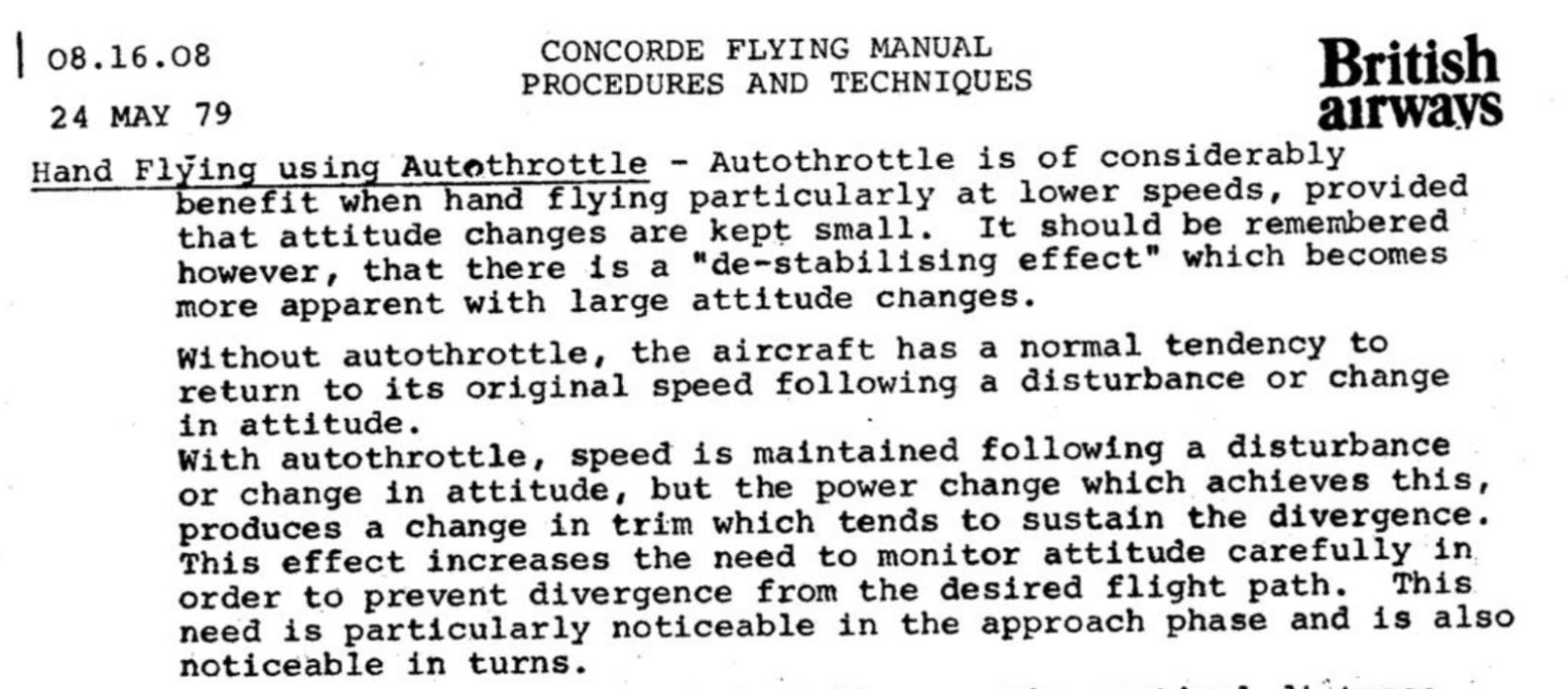
From what I understand, it's a slightly different problem.
It's more related to the fact that an increase in pitch with autothrottle will change thrust and hence long term flight path.
However, on this aircraft, there seems to be something more. For example on approach, if the pitch increases, the thrust increases, the flight path increases too. Since the thrust increased, the pitch trim equilibrium is changed (not valid on modern aircraft with flight controls that compensate for thrust). With more thrust, I guess there is a pitch up effect, and that "sustains the divergence".
We would have the same on a 737, but it so happens that manual flying with A/T ON is prohibited, isn't it ? Maybe it's one of the reasons.
Approximately everytime, since I want the thrust at idle when decelerating to final approach speed and it would keep adding power even with a 20kt difference.
From what I understand, it's a slightly different problem.
It's more related to the fact that an increase in pitch with autothrottle will change thrust and hence long term flight path.
However, on this aircraft, there seems to be something more. For example on approach, if the pitch increases, the thrust increases, the flight path increases too. Since the thrust increased, the pitch trim equilibrium is changed (not valid on modern aircraft with flight controls that compensate for thrust). With more thrust, I guess there is a pitch up effect, and that "sustains the divergence".
We would have the same on a 737, but it so happens that manual flying with A/T ON is prohibited, isn't it ? Maybe it's one of the reasons.
but I can’t remember the last time I needed to do it.
Joined: Feb 2003
Posts: 541
Likes: 336
From: Blue sky
Last edited by BraceBrace; 16th August 2024 at 01:41.

Joined: Aug 2024
Posts: 4
Likes: 0
From: France
Hello guys,
Can someone explain the interest of the inverse flying of the A220. Indeed i start my ffs lesson in one week, and after having some hour spent in FFS of the 220 for fun with friend, i don’t understand the inverse Ulaw and i want to know what the A/T doing whene hand flying the a220 with A/T on. Indeed, you have the attitude chevron and you have to tell by the bug the trs and the speed bug (to tell where do you want to go to the plane). In A/T mode the chevron desappears ? Is it possible to hand fly this airplane like a vfr ? The A/T will enter in a classic mode ?
why on the b777 trs is not a possible to show but in the a220 is a primary flight information ? On the inverse U what is the logic of choosing a pre trim, a speed bug and adapt with the TLA ? Wath is the benefit. I heard sometimes whene the A/P is set off you have a shack on the palne due to a bad trim. I prefere the GEC logic. As i understand the trs must follow the speed bug so what is the benefit to separate the both. Because there is no interest to fly with bad trimmed aircraft. Is it to avoid FAA restriction like the thales FCPC L21 ?
i really want if somebody is flying this beautiful Airbus a220 can explain this and if this is helpfull, because the later time in the L3 we doesn’t find any interest of that. Maybe some differences between the plane and the plane level-1 simulation.
Jeanloudavid B767omn
Can someone explain the interest of the inverse flying of the A220. Indeed i start my ffs lesson in one week, and after having some hour spent in FFS of the 220 for fun with friend, i don’t understand the inverse Ulaw and i want to know what the A/T doing whene hand flying the a220 with A/T on. Indeed, you have the attitude chevron and you have to tell by the bug the trs and the speed bug (to tell where do you want to go to the plane). In A/T mode the chevron desappears ? Is it possible to hand fly this airplane like a vfr ? The A/T will enter in a classic mode ?
why on the b777 trs is not a possible to show but in the a220 is a primary flight information ? On the inverse U what is the logic of choosing a pre trim, a speed bug and adapt with the TLA ? Wath is the benefit. I heard sometimes whene the A/P is set off you have a shack on the palne due to a bad trim. I prefere the GEC logic. As i understand the trs must follow the speed bug so what is the benefit to separate the both. Because there is no interest to fly with bad trimmed aircraft. Is it to avoid FAA restriction like the thales FCPC L21 ?
i really want if somebody is flying this beautiful Airbus a220 can explain this and if this is helpfull, because the later time in the L3 we doesn’t find any interest of that. Maybe some differences between the plane and the plane level-1 simulation.
Jeanloudavid B767omn
 Unatural feeling
Thread Starter
Joined: Apr 2022
Posts: 267
Likes: 21
From: France
I'm sorry I can't help regarding the A220, but I seem to understand that there is a displayed TRS in addition to the speed bug.
As you've understood, this topic illustrates that there is no logic in having two speed bugs, as any difference between the two will create an unstable behavior.
As you've understood, this topic illustrates that there is no logic in having two speed bugs, as any difference between the two will create an unstable behavior.
Joined: Aug 2024
Posts: 4
Likes: 0
From: France
Does anyone know how is traduce a speed to a hand force in a flight control. If someone know because i used to know that the gec will enter the plane in idle descent with no excess of the TRS, it’s can be interesting to know the behaviour of the plane whene the speed bug is 10 kts above the trs.
does the plane will increase the vertical speed until the plane is at the trs ?
The software has the same logic between a climb or descent ?
You will enter in a full thrust climb ?
(i talk about the B777)
does the plane will increase the vertical speed until the plane is at the trs ?
The software has the same logic between a climb or descent ?
You will enter in a full thrust climb ?
(i talk about the B777)
