


Boeing: Flying LNAV/VNAV without VNAV

Thread Starter
Joined: Nov 2008
Posts: 28
Likes: 0
From: Europe
Boeing: Flying LNAV/VNAV without VNAV
Dear all.
Here's a scenario from a recent simulator exercise (a bit simplified).
On the MCP panel, both Vertical Navigation (VNAV) Switch and Approach (APP) Switch are INOP. Everything else is operational.
Can an ILS be flown to ILS DA(H) and/or can a LNAV/VNAV be flown to LNAV/VNAV DA(H), using the remaining operational functions of the autopilot (e.g. LOC+V/S or LNAV+V/S?
Here's a scenario from a recent simulator exercise (a bit simplified).
On the MCP panel, both Vertical Navigation (VNAV) Switch and Approach (APP) Switch are INOP. Everything else is operational.
Can an ILS be flown to ILS DA(H) and/or can a LNAV/VNAV be flown to LNAV/VNAV DA(H), using the remaining operational functions of the autopilot (e.g. LOC+V/S or LNAV+V/S?


Joined: Dec 2005
Aviation Qualifications: ATPL
Posts: 4,974
Likes: 326
From: Hong Kong
Of course you can fly the ILS down to DA - you don't need any of those things. You can do the whole thing manual and raw data if you like. Personally I'd go with LOC/VS but if the LOC button was U/S as well, then LNAV should still do it, you'd just need to monitor the raw data and intervene with Heading Sel if necessary.


Joined: Feb 2008
Posts: 92
Likes: 21
From: earth
At my company you could fly ILS, RNAV overlay and RNP LNAV in this scenario. The limitation on an ILS would be increased visibility of 1200m. The RNAV overlay and RNP LNAV can be flown in V/S.
We couldn’t fly RNP LNAV/VNAV or RNP AR as these must be flown in VNAV PATH.
so ILS yes, LNAV/VNAV to DA no.
We couldn’t fly RNP LNAV/VNAV or RNP AR as these must be flown in VNAV PATH.
so ILS yes, LNAV/VNAV to DA no.
Thread Starter
Joined: Nov 2008
Posts: 28
Likes: 0
From: Europe
Thank you all so far. We all seem to agree on the ILS-part of the question.
I'd love to get some more inputs on the LNAV/VNAV approach. Is the VNAV path pointer and deviation scale (a.k.a. "Chinese glide slope" ) on the ND sufficient as the sole reference for vertical path during an LNAV/VNAV approach?
I've been told "no", but I'm not able to find any documentation on this. I've been looking in the FAR/AIM, TERPS, PANS-OPS, EASA AirOps, our FCOM and AFM.
However, I found limitations that increases demonstrated RNP when using only FD or even flying "raw data" from MAP mode. This means we can't fly LNAV approach following MAP-mode with the HDG-bug I presume?
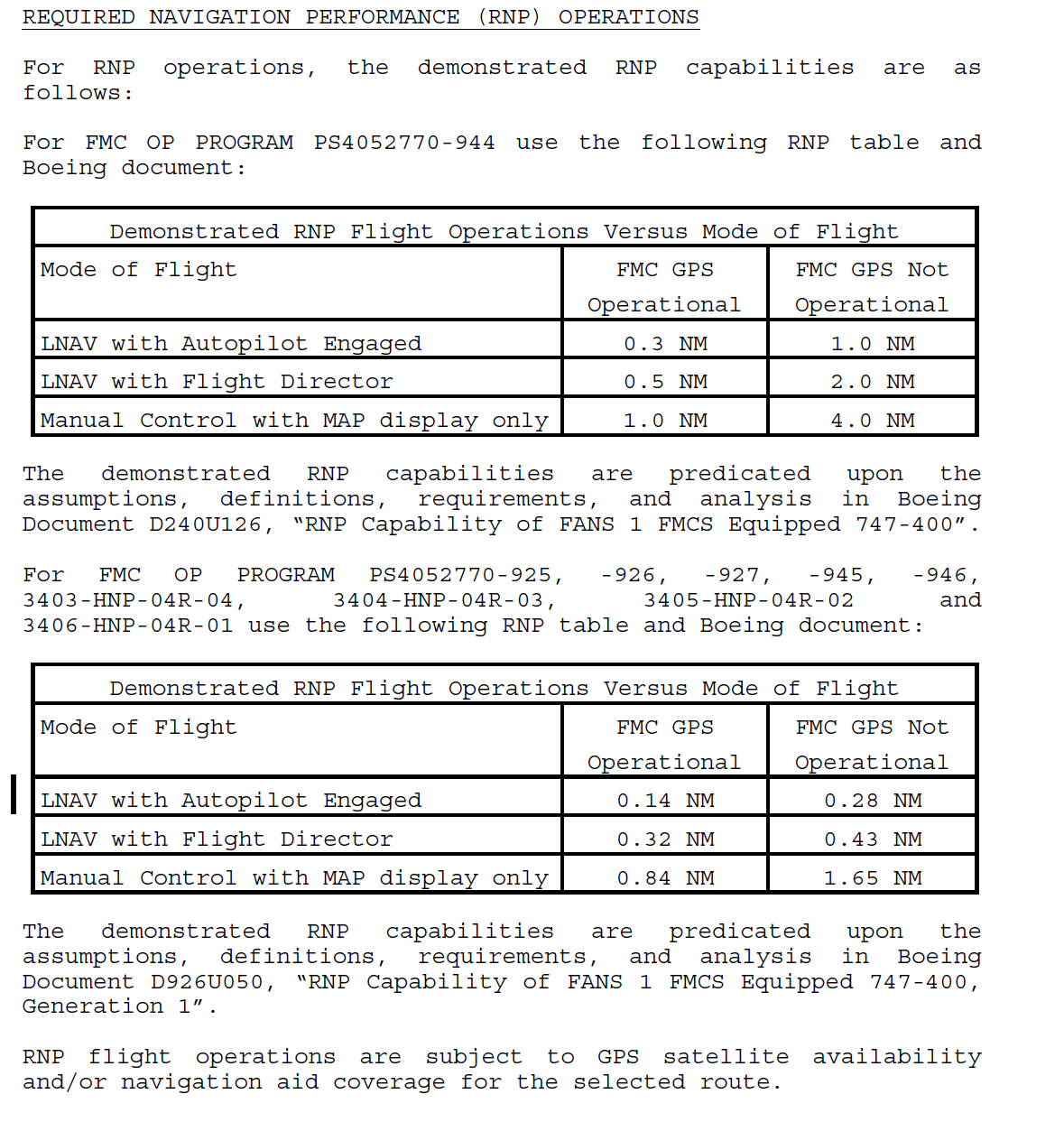
I'd love to get some more inputs on the LNAV/VNAV approach. Is the VNAV path pointer and deviation scale (a.k.a. "Chinese glide slope" ) on the ND sufficient as the sole reference for vertical path during an LNAV/VNAV approach?
I've been told "no", but I'm not able to find any documentation on this. I've been looking in the FAR/AIM, TERPS, PANS-OPS, EASA AirOps, our FCOM and AFM.
However, I found limitations that increases demonstrated RNP when using only FD or even flying "raw data" from MAP mode. This means we can't fly LNAV approach following MAP-mode with the HDG-bug I presume?
Last edited by Bluescan; 23rd April 2021 at 06:33.
Joined: Apr 2010
Posts: 1,319
Likes: 100
From: IRS NAV ONLY
Have a look at AMC 20-27, p. 13:
As long as you can comply with the above, you don't need AP/FD.
APV BARO-VNAV deviation must be displayed on a vertical deviation display (HSI, EHSI, VDI).
This display must be used as primary flight instruments for the approach. The display must be visible to the pilot and located in the primary field of view (±15 degrees from pilot’s normal line of sight) when looking forward along the flight path.
The deviation display shall have a suitable fullscale deflection based on the required vertical track error.
The nonnumeric display must allow the fight crew to readily distinguish if the vertical deviation exceeds ±75 feet.
If the nonnumeric display does not permit the fight crew to readily distinguish excessive vertical deviations, the approach must be conducted with the flight director and/or the autopilot and a numeric display should allow the pilot to readily distinguish if the vertical deviation exceeds ±75 feet
This display must be used as primary flight instruments for the approach. The display must be visible to the pilot and located in the primary field of view (±15 degrees from pilot’s normal line of sight) when looking forward along the flight path.
The deviation display shall have a suitable fullscale deflection based on the required vertical track error.
The nonnumeric display must allow the fight crew to readily distinguish if the vertical deviation exceeds ±75 feet.
If the nonnumeric display does not permit the fight crew to readily distinguish excessive vertical deviations, the approach must be conducted with the flight director and/or the autopilot and a numeric display should allow the pilot to readily distinguish if the vertical deviation exceeds ±75 feet
Joined: Mar 2001
Posts: 4,562
Likes: 33
From: I wouldn't know.
Oh well, if one has IAN it is absolutely possible to fly RNP approaches to minimum "raw" data, but then, it is a glideslope and loc pointer on the PFD behaving exactly like the real thing, or GLS for that matter. No need to activate VNAV or APProach mode for that, simply activate the relevant approach in the FMC and that is all that is needed to get the pseudo-ILS indication. In our operation we did only need flight director or approach mode for anything below RNP 0.3.
 But I like it.
Thread Starter
Joined: Nov 2008
Posts: 28
Likes: 0
From: Europe
Excellent document Flying Stone.
From that document I understand that flying an LNAV/VNAV approach with LNAV+VS modes is not possible on the B744, since the vertical track "indicator" has a scale of +/- 400ft and not +-75ft.
From that document I understand that flying an LNAV/VNAV approach with LNAV+VS modes is not possible on the B744, since the vertical track "indicator" has a scale of +/- 400ft and not +-75ft.
Joined: Mar 2001
Posts: 4,562
Likes: 33
From: I wouldn't know.
I have no experience on the 747, just on the 737. On that bird we could change the scale of VRNP indicator on the ND on the progress page 4. Is that possible on the 747?
The FMC uses 400 feet as a default Vertical Required Navigation Performance (VRNP) value for oceanic, en route, and terminal phases of flight.
When required, VRNP values may be manually entered or displayed on RNP PROGRESS page 4/4. The FMC will accept manual entry of a VRNP value greater than the default value, but the VERIFY VERT RNP VALUE advisory message will be displayed in the scratchpad. Manual entries are cleared at flight completion.
We used it for example during RNP AR operation, although that was, of course, only approved in LNAV/VNAV.
The flight crew may enter 125 feet for vertical RNP. While there are no vertical RNP values published on the approach chart, the use of 125 feet will cause the NPS amber deviation exceedance alert to occur at 75 feet or slightly less deviation, since vertical ANP will be at least 50 feet at all times.
Of course, since it has been some time since i was on a Boeing, things might have changed in the meantime.
The FMC uses 400 feet as a default Vertical Required Navigation Performance (VRNP) value for oceanic, en route, and terminal phases of flight.
When required, VRNP values may be manually entered or displayed on RNP PROGRESS page 4/4. The FMC will accept manual entry of a VRNP value greater than the default value, but the VERIFY VERT RNP VALUE advisory message will be displayed in the scratchpad. Manual entries are cleared at flight completion.
We used it for example during RNP AR operation, although that was, of course, only approved in LNAV/VNAV.
The flight crew may enter 125 feet for vertical RNP. While there are no vertical RNP values published on the approach chart, the use of 125 feet will cause the NPS amber deviation exceedance alert to occur at 75 feet or slightly less deviation, since vertical ANP will be at least 50 feet at all times.
Of course, since it has been some time since i was on a Boeing, things might have changed in the meantime.
Joined: Apr 2010
Posts: 1,319
Likes: 100
From: IRS NAV ONLY
You could always display relevant PROG page on your MCDU (4 on the 737), which shows your vertical deviation from calculated VNAV path.
Denti, I believe that's only available on aircraft equipped with NPS, at least on the 737.
Denti, I believe that's only available on aircraft equipped with NPS, at least on the 737.
Thread Starter
Joined: Nov 2008
Posts: 28
Likes: 0
From: Europe
Well, maybe I'm reading it too conservative.
I read it as a FD/AP with a mode selected that follows the path, e.g. VNAV, but it is strictly read not specified.
[....] If the nonnumeric display does not permit the fight crew to readily distinguish excessive vertical deviations, the approach must be conducted with the flight director and/or the autopilot and a numeric display should allow the pilot to readily distinguish if the vertical deviation exceeds ±75 feet
Joined: Feb 2003
Posts: 540
Likes: 336
From: Blue sky
These limitations have nothing to do with the aircraft, it is a minima question.
ILS minima require ILS equipment on the ground, so yes, whatever AP/FD functionality you use, the minima remain the standard minima for a CAT I ILS as long as you have ILS indications somewhere on your flightdeck.
If you want to you use VNAV minima, VNAV has to be operational, selectable and active for the approach (RNP based on Baro-VNAV system or any "old" NPA with VNAV minima). If not no VNAV minima can be used as your FD will not give you proper indications based on VNAV, LNAV-V/S minima are to be used.
Don't make life complicated. It's pure regulations. Just select the correct minima.
ILS minima require ILS equipment on the ground, so yes, whatever AP/FD functionality you use, the minima remain the standard minima for a CAT I ILS as long as you have ILS indications somewhere on your flightdeck.
If you want to you use VNAV minima, VNAV has to be operational, selectable and active for the approach (RNP based on Baro-VNAV system or any "old" NPA with VNAV minima). If not no VNAV minima can be used as your FD will not give you proper indications based on VNAV, LNAV-V/S minima are to be used.
Don't make life complicated. It's pure regulations. Just select the correct minima.
Joined: Mar 2001
Posts: 4,562
Likes: 33
From: I wouldn't know.
Indeed, however, there are those Boeings that can actually give the correct representation on the PFD allowing VNAV minima without a FD/AP VNAV or approach mode selected, same as for a GLS or ILS. Yes, it is not always simple, one has to know the specific airframe and its capabilities, it is not even dependent on type or even variant, as Boeing offers so many different customer options.