


Stuff to memorize

Thread Starter
Joined: Aug 2010
Posts: 11
Likes: 0
From: EDDH
Stuff to memorize
Hi,
I am curious what pilots have to memorize in training. What I know is or think are memory items for emergencies and maybe limitations of the aircraft. What else do you need to memorize for daily business? Is there a difference between airplanes or is it always the same you have to have back in your head?
I am curious what pilots have to memorize in training. What I know is or think are memory items for emergencies and maybe limitations of the aircraft. What else do you need to memorize for daily business? Is there a difference between airplanes or is it always the same you have to have back in your head?

Joined: Mar 2002
Posts: 4,569
Likes: 1
From: Florida
[QUOTE=Banana Joe;10846715]Normal procedures, flows and callouts for normal operations. Manufacturers lay them out, but every operator can change them in their Operations Manual.[/QUOTE]
Which is approved by who?
Which is approved by who?

Joined: Mar 2012
Posts: 2,605
Likes: 154
From: Having a margarita on the beach
Hi,
I am curious what pilots have to memorize in training. What I know is or think are memory items for emergencies and maybe limitations of the aircraft. What else do you need to memorize for daily business? Is there a difference between airplanes or is it always the same you have to have back in your head?
I am curious what pilots have to memorize in training. What I know is or think are memory items for emergencies and maybe limitations of the aircraft. What else do you need to memorize for daily business? Is there a difference between airplanes or is it always the same you have to have back in your head?
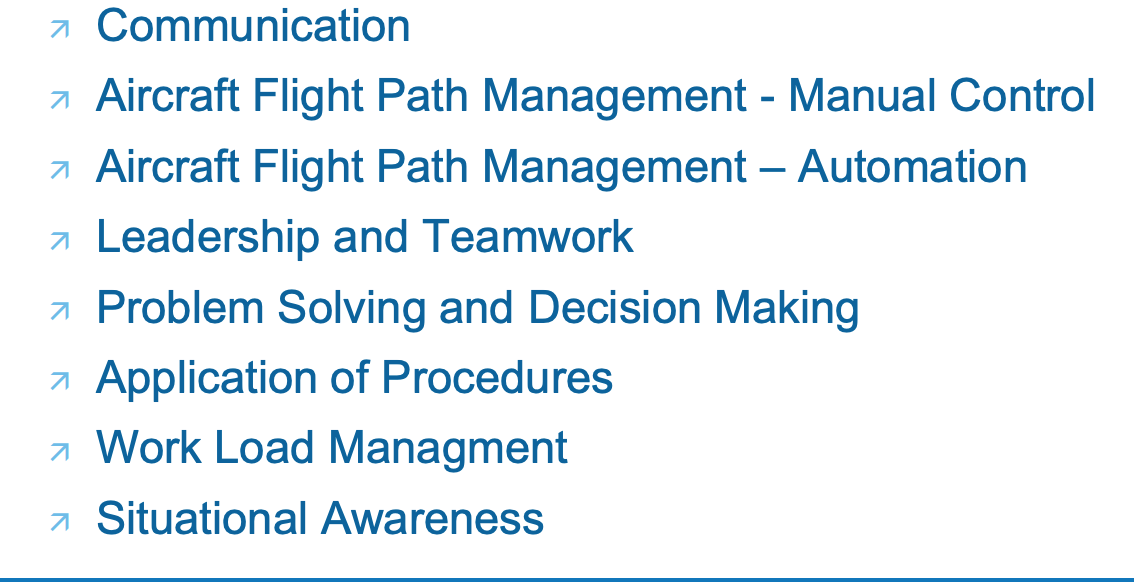
Each and every single competency is a chapter per se, containing several performance indicators that should be observed in the related field.
Many airlines also use a 9th competency, which is Knowledge, with its related performance indicator.
To answer your question, if you are proficient with the above, then you know enough.

Joined: Jul 2013
Aviation Qualifications: Non-Aircrew
Posts: 1,391
Likes: 678
From: Within AM radio broadcast range of downtown Chicago
Out of curiosity sonicbum, could you post the reference for that ICAO material (okay, also out of wanting a shortcut to finding exactly that same material). thnx
WillowRun 6-3
WillowRun 6-3

Joined: Mar 2012
Posts: 2,605
Likes: 154
From: Having a margarita on the beach
I took a screenshot from this presentation but it is not strictly relevant to competencies based training. I recommend you use the ICAO EBT MANUAL for further references on the topic.


Joined: May 2000
Posts: 3,204
Likes: 2
From: Seattle
For the initial Type Rating, a pilot has to essentially memorize the function of every switch and gauge in the cockpit, and tell the examiner what is happening in the affected system when the switch is actuated.


Joined: Nov 1999
Aviation Qualifications: ATPL
Posts: 3,150
Likes: 744
From: UK
To answer the OP, memorise whatever your company wants you to. If you are invited for a SIM ride, and they send you pitch and power settings, and speeds and flap speeds, then definitely memorise those.
Obviously Memory items, SOPs, and flows, need to be learned and committed to memory. Some air law, for example radar service definitions and responsibilities. Minimum take-off and landing separation from aircraft ahead. Wingspan for taxiways, (although this should really be placarded). Anything you might need to know while actually hand flying or taxiing and therefore can't dive into the books.
How long does the BCF last? Ditto crew and passenger Oxygen? Ditto Dragar smoke hood? Important to know - if you are using them you won't have time to look it up.
Traditionally some of the stuff you are expected to memorise is not to fly the actual plane but so that you can pass a type rating. It is very easy for a lazy examiner to go through the books and pull out figures, but sometimes those figures are meaningless. Cabin crew where I once worked had to know and answer correctly the frequency the ELT transmitted on. I mean, ??? Can you change the frequency? No. Do you ever have to alter the frequency? No. Can you select a different frequency? No. So why are you asking me what the frequency is? It is fixed so it is irrelevant.
Power output of a main generator in kW? Who cares? Meaningless unless you also know what the power consumption of all the various electrical systems are. You just need to know how many gennys are needed to supply the whole 'plane, and if you lose a main genny what services do you lose?
There are a few enlightened souls who are realistic. One TRE said to me " If I go and select an obscure or irrelevant fact from the books to ask you about, you could do the same to me, so I don't go there"
Engine limitations I believe should be shown on the instruments, e.g. is the max N1 104% or 103%?, I can't always remember, especially on mixed fleets. Give me a line on the dial, that moves for different flight phases, as Airbus do.
Obviously Memory items, SOPs, and flows, need to be learned and committed to memory. Some air law, for example radar service definitions and responsibilities. Minimum take-off and landing separation from aircraft ahead. Wingspan for taxiways, (although this should really be placarded). Anything you might need to know while actually hand flying or taxiing and therefore can't dive into the books.
How long does the BCF last? Ditto crew and passenger Oxygen? Ditto Dragar smoke hood? Important to know - if you are using them you won't have time to look it up.
Traditionally some of the stuff you are expected to memorise is not to fly the actual plane but so that you can pass a type rating. It is very easy for a lazy examiner to go through the books and pull out figures, but sometimes those figures are meaningless. Cabin crew where I once worked had to know and answer correctly the frequency the ELT transmitted on. I mean, ??? Can you change the frequency? No. Do you ever have to alter the frequency? No. Can you select a different frequency? No. So why are you asking me what the frequency is? It is fixed so it is irrelevant.
Power output of a main generator in kW? Who cares? Meaningless unless you also know what the power consumption of all the various electrical systems are. You just need to know how many gennys are needed to supply the whole 'plane, and if you lose a main genny what services do you lose?
There are a few enlightened souls who are realistic. One TRE said to me " If I go and select an obscure or irrelevant fact from the books to ask you about, you could do the same to me, so I don't go there"
Engine limitations I believe should be shown on the instruments, e.g. is the max N1 104% or 103%?, I can't always remember, especially on mixed fleets. Give me a line on the dial, that moves for different flight phases, as Airbus do.

Joined: Jan 2020
Posts: 0
Likes: 0
From: 900m
Max Weights
Whether required or not, these are pretty essential for a pro.
Once a dispatcher planned me a short trip with much additional fuel, covering every imaginable eventuality - except a straight in operation - and we were a ton over MLW. He had already had the AC fuelled.
Knowing the correct figure at least enabled an off load to be made before TO.
Once a dispatcher planned me a short trip with much additional fuel, covering every imaginable eventuality - except a straight in operation - and we were a ton over MLW. He had already had the AC fuelled.
Knowing the correct figure at least enabled an off load to be made before TO.

Joined: Jul 2010
Posts: 431
Likes: 1
From: OFCR
From a Boeing point of view I constantly review memory items, limitations and maneuvers (both normal and non normal) and last but not least the cockpit flows. That should get you covered for almost any scenario.
