


Idle Reverse while vacating


Joined: Oct 2010
Posts: 422
Likes: 5
From: 5° above the Equator, 75° left of Greenwich
I think Airbus is pretty clear that we should have the reversers stowed before leaving the runway, whether high speed or low speed turn-off...
Anyone care to enlighten a Caribbean pilot on why they should be stowed at a lower speed when on a snow covered runway (25 vs 30 kts)? FCOM says so...
Anyone care to enlighten a Caribbean pilot on why they should be stowed at a lower speed when on a snow covered runway (25 vs 30 kts)? FCOM says so...


Joined: Sep 2011
Posts: 350
Likes: 147
From: FL390
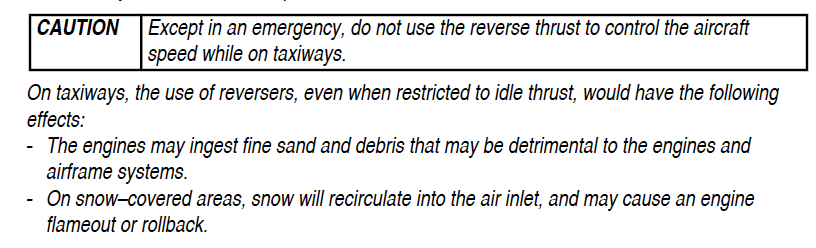
According to Airbus, using reverse below 25kts causes snow to recirculate into the engine inlet and potentially cause a flame-out. Not noticed this myself and have selected idle reverse on a snow-covered taxiway when wheel brakes were doing absolutely nothing to control the speed. Weirdly there's nothing in the FCOM prohibiting reverse use on a taxiway, although it may be that it falls into the same warning category of "do not land the aircraft upside down" or "make sure that both wings are firmly attached before flying".
Edit: you might be misinterpreting the FCOM. I think in this case Airbus wants the reverse stowed at slightly higher than normal speeds.
Edit: you might be misinterpreting the FCOM. I think in this case Airbus wants the reverse stowed at slightly higher than normal speeds.
Only half a speed-brake

Joined: Apr 2003
Posts: 4,459
Likes: 136
From: Commuting not home
Escape Path the 30 kt number is not in the OEM print. Same as FF above, I interpret the 25 kt guidance for snow-covered runways as a suggestion to stow the REV sooner.
Joined: Oct 2010
Posts: 422
Likes: 5
From: 5° above the Equator, 75° left of Greenwich
Escape Path the 30 kt number is not in the OEM print.
Thank you all for your inputs.
Last edited by Escape Path; 29th July 2020 at 17:12. Reason: Failure to apply Grammar for Dummies in real life
Joined: Mar 2006
Posts: 2,633
Likes: 136
From: USA
I guess that’s where the confusion starts from. Our FCOM says to “stow reversers when reaching taxi speed”, then it says that “speeds below 30 kts are considered taxi speeds”. But then it says that on snow covered runways they should be stowed by 25 kts, giving the impression that they should actually be stowed at a slower speed (I.e. later) than on an uncontaminated runway, which didn’t make sense to me.
Thank you all for your inputs.
Thank you all for your inputs.
Joined: Sep 2010
Aviation Qualifications: ATPL
Posts: 884
Likes: 233
From: by the seaside
Escape path
Nearly ran off the runway at Gothenburg after the preceding airbus left their reverse on until clearing the ice covered runway which had been warm sanded. The reverse melted the top layer of ice which allowed the sand to sink and refroze which left us applying emergency reverse until the engines surged. Clue underwear change.


Joined: Apr 2004
Aviation Qualifications: LAME
Posts: 2,280
Likes: 186
From: Dorset UK
Nearly ran off the runway at Gothenburg after the preceding airbus left their reverse on until clearing the ice covered runway which had been warm sanded. The reverse melted the top layer of ice which allowed the sand to sink and refroze which left us applying emergency reverse until the engines surged. Clue underwear change.
Alwasy found GOT interesting in the winter. Saw a BusyBee F27 going sideways when taxiing on an icy ramp and then I slipped and fell getting off our aircraft.
Joined: Mar 2014
Posts: 497
Likes: 0
From: Way north
Aircraft being swung around by a light breeze taxiing on a icy ramp, pilots yelling that the follow me has to continue ahead cause he cannot brake, aircraft doing run up on the runway due ice on the ramp, firefigthers helping pulling C172 back on the taxiway after it slid off....
Oh, and controllers doing 360'ies in cars on the empty ramp
Oh, and controllers doing 360'ies in cars on the empty ramp
Joined: Oct 2010
Posts: 422
Likes: 5
From: 5° above the Equator, 75° left of Greenwich
Check Airman no snow in these Caribbean latitudes, nor any of our destinations, so no check on that. I was just interested in knowing the logic behind the numbers hehe
I wasn’t being able to get my head around a 5kt difference to stow the reversers, but it’s clear now that all they want is for you to stow them a little earlier than on a dry runway.
I wasn’t being able to get my head around a 5kt difference to stow the reversers, but it’s clear now that all they want is for you to stow them a little earlier than on a dry runway.

Joined: Sep 2010
Aviation Qualifications: ATPL
Posts: 884
Likes: 233
From: by the seaside
747 ANC
Was it JAL that didn't like the icy taxiway and rather than use engine thrust shut all 4 down and was blown down an embankment breaking the aircraft..
Had a mate manoeuvre a dc8 after ice rain without brakes or steering using the motors.
Had a mate manoeuvre a dc8 after ice rain without brakes or steering using the motors.
Joined: Apr 2008
Posts: 41
Likes: 0
From: New Zealand
. Our FCOM says to “stow reversers when reaching taxi speed”, then it says that “speeds below 30 kts are considered taxi speeds”. But then it says that on snow covered runways they should be stowed by 25 kts, giving the impression that they should actually be stowed at a slower speed (I.e. later) than on an uncontaminated runway, which didn’t make sense to me.
Thank you all for your inputs.
Thank you all for your inputs.
Joined: Sep 2011
Posts: 350
Likes: 147
From: FL390

Joined: Jun 2009
Posts: 33
Likes: 0
From: Worldwide
Question 1: Has anyone heard of a procedure on the 747 to stow the inboard reversers first during deceleration in order to avoid debris being blown up and sucked into the outboard engines?
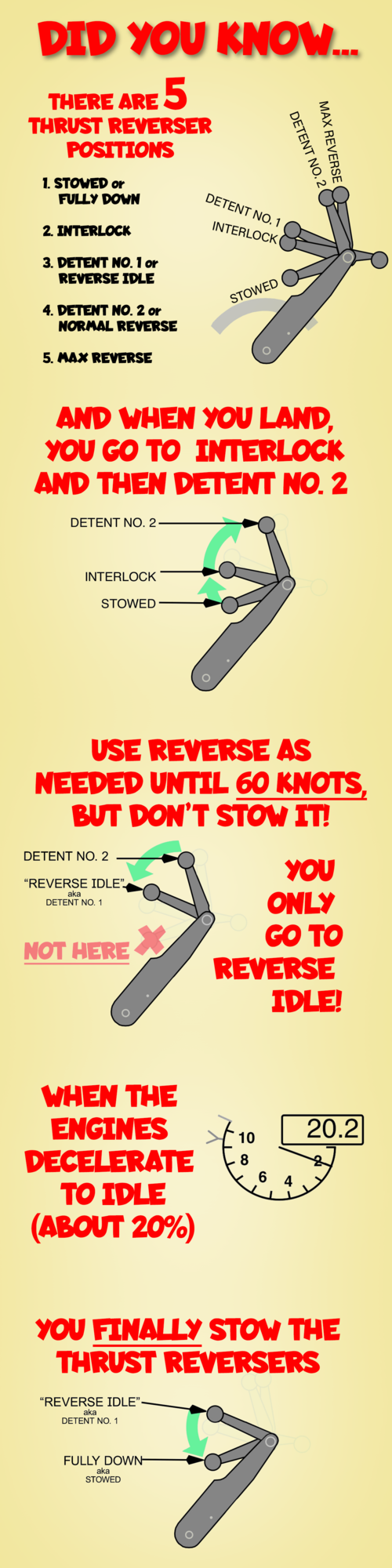
Question 2: The discrepancy between what the FCOM says and what I observe in real life is quite drastic. According to the FCOM, the movement of the reverse thrust levers from full reverse to the idle detent should be initiated latest by 60 knots. When the engines have decelerated to reverse idle, the reverse thrust levers should be positioned to the full down (forward thrust = stowed) position. That would mean that the reversers would be fully stowed at around 30 - 40 knots, just before reaching taxi speed. Does anyone with experience and maybe some technical background on the 747 have any information about the possibility of engine damage because of debris ingestion caused by reaching the fully stowed position at low speeds instead of higher speeds (e.g. around 60 knots)?
Question 2: The discrepancy between what the FCOM says and what I observe in real life is quite drastic. According to the FCOM, the movement of the reverse thrust levers from full reverse to the idle detent should be initiated latest by 60 knots. When the engines have decelerated to reverse idle, the reverse thrust levers should be positioned to the full down (forward thrust = stowed) position. That would mean that the reversers would be fully stowed at around 30 - 40 knots, just before reaching taxi speed. Does anyone with experience and maybe some technical background on the 747 have any information about the possibility of engine damage because of debris ingestion caused by reaching the fully stowed position at low speeds instead of higher speeds (e.g. around 60 knots)?