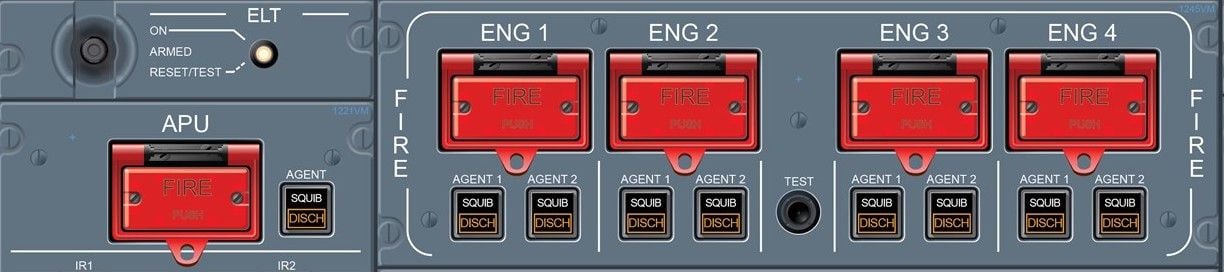
A320 APU Fire Test with APU already running


Joined: Jul 2006
Posts: 1,100
Likes: 111
From: Somewhere over the rainbow
Hi Vilas,
I understand there is no problem of testing it while it's running. But the way it's written, it assumes you arrive at the aircraft with APU off which is never the case in the company I work for. I understand the check must be done for the first flight of the day. Some people will argue that you can't assume maintenance did the check... Well, we trust them to maintain our aircraft airworthy; I think we can trust them to have done a simple no brainer task as an APU fire test 1h before the crew arrive at the aircraft. Or maybe all the pilots working in my company are foolish. lol
I understand there is no problem of testing it while it's running. But the way it's written, it assumes you arrive at the aircraft with APU off which is never the case in the company I work for. I understand the check must be done for the first flight of the day. Some people will argue that you can't assume maintenance did the check... Well, we trust them to maintain our aircraft airworthy; I think we can trust them to have done a simple no brainer task as an APU fire test 1h before the crew arrive at the aircraft. Or maybe all the pilots working in my company are foolish. lol

Joined: Jun 2007
Posts: 3,443
Likes: 39
From: Wanderlust
Systemically it's permitted. Somebody needs to do it. No need for pilots to do the test if maintenance guys have a procedure to start APU only after fire test is done. I train an airline who's procedure says not do the test if APU is running.
Only half a speed-brake

Joined: Apr 2003
Posts: 4,459
Likes: 136
From: Commuting not home
@pinteam
According to Airbus the check should be done with a new crew. How closely each individual airline follows and why (not) would be an endless debate, though still enlightening at some points.
AFAIK running the APU is a not part of the DY.
The quoted sentence "If the APU is already running, ensure that the following check has already been completed. If not, perform it." is not in my recent FCOMs but I see it in the 2014 edition.
For your last sentence: crowd mentality and assuming things can be a biting bitch. For instance, I hear of an airline where the agreed saving technique was to shoot approaches with F3 and increase Vapp by +15 kts for "safety" and "easier landing". Or another one, where when calculated ASD=ASDA on flex takeoff they would modify runway by -100 m at DER to get a "margin" - of course only on the long runways where it was possible. Emergency torches being used for walkarounds "to test them" as supposedly they re-charge when back in the cradle. Having already left a cloud into the blue, E-AI must not be switched off until ECAM MEMO : ice not det, in order to "prevent getting a QAR".
If your OPS always start in the morning at a base where MX power-up and prepare the A/C, including running the APU, there is probably no need to change the drill. Situation-driven SOP, nothing wrong with that. The book provides protocol-driven SOP that are situation independent.
According to Airbus the check should be done with a new crew. How closely each individual airline follows and why (not) would be an endless debate, though still enlightening at some points.
AFAIK running the APU is a not part of the DY.
The quoted sentence "If the APU is already running, ensure that the following check has already been completed. If not, perform it." is not in my recent FCOMs but I see it in the 2014 edition.
For your last sentence: crowd mentality and assuming things can be a biting bitch. For instance, I hear of an airline where the agreed saving technique was to shoot approaches with F3 and increase Vapp by +15 kts for "safety" and "easier landing".
Or another one, where when calculated ASD=ASDA on flex takeoff they would modify runway by -100 m at DER to get a "margin" - of course only on the long runways where it was possible. Emergency torches being used for walkarounds "to test them" as supposedly they re-charge when back in the cradle. Having already left a cloud into the blue, E-AI must not be switched off until ECAM MEMO : ice not det, in order to "prevent getting a QAR".If your OPS always start in the morning at a base where MX power-up and prepare the A/C, including running the APU, there is probably no need to change the drill. Situation-driven SOP, nothing wrong with that. The book provides protocol-driven SOP that are situation independent.
Last edited by FlightDetent; 17th January 2019 at 21:19.
Joined: Feb 2006
Posts: 11
Likes: 0
From: Texas
This didn't happen at an airline, or in an Airbus, but it still relates. Started a trip on an airplane that had maint done overnight that involved running the APU. During preflight checks the APU fire test failed. Called maint and turns out the tech had only recently left so he came back out in just a few mins. Upon talking to him and mentioning the fire test he commented that they (mx) never do the fire test before starting the engines/apu. So just because something is supposed to be done does not mean it will be!
Joined: Jul 2006
Posts: 1,100
Likes: 111
From: Somewhere over the rainbow
Yes you can assume it has be done. Same as you assume the loadsheet has been done accurately or that the maintenance has done all his duty as a good professionnal. We don’t go and check the loading or engines by ourselves. We trust them!
Thread Starter
Joined: Feb 2018
Posts: 36
Likes: 0
From: Earth
perform it."
Apparently, that note is not included in my FCOM dated 4 DEC 18. I guess it depends on the MSN numbers; the latest we have is in early 3000 series. What's yours?
Joined: Oct 2009
Posts: 399
Likes: 0
From: Australia the Awesome
Our FCOM States:
APU FIRE.................IF NOT RUNNING CHECK/TEST
But it appears to be a company specific procedure.
I know in the past i have done it, and the APU continues to run, but the bleed shuts down momentarily.
APU FIRE.................IF NOT RUNNING CHECK/TEST
But it appears to be a company specific procedure.
I know in the past i have done it, and the APU continues to run, but the bleed shuts down momentarily.
Joined: Jun 2007
Posts: 3,443
Likes: 39
From: Wanderlust
CG
Yes. I also can't find it in 1917 manuals. It appears to have been removed but not forbidden. This is in 2014 airbus manufacturer manual. The MSN is given as 9761 A320-214. Actually Airbus publishes new manual in their code which for this is 18CMHE which translates as C-CFM, M-METRIC, H-HONEYWELL, E- ENHANCED GPWS.
Yes. I also can't find it in 1917 manuals. It appears to have been removed but not forbidden. This is in 2014 airbus manufacturer manual. The MSN is given as 9761 A320-214. Actually Airbus publishes new manual in their code which for this is 18CMHE which translates as C-CFM, M-METRIC, H-HONEYWELL, E- ENHANCED GPWS.
Only half a speed-brake
Joined: Apr 2003
Posts: 4,459
Likes: 136
From: Commuting not home
Ever heard of cowling flaps flying open? That, of course, would never happen as it is a dual-check and sign procedure, then verified by pilots.
BTW, the DY check has a list of actions; dare go ask to see the APU fire test on that list?

Thread Starter
Joined: Feb 2018
Posts: 36
Likes: 0
From: Earth
Trust is valid when something is not a part of your procedure. When it is, you cannot assume it has been done.

Joined: Nov 2010
Posts: 1,167
Likes: 180
From: USA
I know cause in our company, aircraft are always shut down completely after the last flight of the day. Then before the first flight in the morning, maintenance will start the APU before the cockpit crew arrive. I never had the chance to come in a dark cockpit so far. Also, never in the 5 years flying Airbus I saw a cockpit crew testing the APU fire pb while it was running. Thus my question. The FCOM Regarding the cockpit preparation assumes the APU was not running. It’s not very clear IMHO that we are supposed to test the APU if already running. In any case, I trust our maintenance to have done it. It’s part of their daily check.
I guess there's a lot of different ways to get the same thing done......
Joined: Jul 2006
Posts: 1,100
Likes: 111
From: Somewhere over the rainbow
Would disagree with you here. FCOM, or any other manual for that matter, doesn't tell you to calculate your own loadsheet nor does it tell you to go and check the loading or engines; however, it does tell you to perform the APU fire test.
Trust is valid when something is not a part of your procedure. When it is, you cannot assume it has been done.
Trust is valid when something is not a part of your procedure. When it is, you cannot assume it has been done.
Joined: Oct 2010
Posts: 422
Likes: 5
From: 5° above the Equator, 75° left of Greenwich
Our FCOM is quite clear: Upon arrival of a new crew taking on the aircraft perform a COMPLETE preflight inspection. It’s not dependent on whether the previous crew or maintenance did it. If that’s the case, I might as well start questioning every single procedure Airbus publishes. How many times have you, during your preflt, found something that’s not right yet it was supposed to be catched on the first flight of the day! Do yourself and your crew a favour and test the thing as instructed on the manual, whether the APU is off or on (as nothing happens). Takes not longer than 3 seconds and who knows, maybe one day you’ll even catch a fault that happened to you but not the previous crew