


Diff between Outflow valves and Positive/Negative Pressure valves?

Thread Starter
Joined: Apr 2008
Posts: 247
Likes: 0
From: Test
Diff between Outflow valves and Positive/Negative Pressure valves?
Hi,
I understand how the outflow valve works. But there's very few reference written on the positive and negative pressure relief valves. Done some search and it seemed to be outflow valves and positive pressure relief valves perform the same roles?
I'm just thinking why is there a need for positive pressure relief valve if outflow valve can perform the task. For redundancy? Or is my understanding wrong? How about the negative pressure relief valves?
How about the delta P? I know there's a specific value that the aircraft cant exceed. How do we recover from an exceedance of Delta P?
Can somebody enlighten me? Thabks for your time.
I understand how the outflow valve works. But there's very few reference written on the positive and negative pressure relief valves. Done some search and it seemed to be outflow valves and positive pressure relief valves perform the same roles?
I'm just thinking why is there a need for positive pressure relief valve if outflow valve can perform the task. For redundancy? Or is my understanding wrong? How about the negative pressure relief valves?
How about the delta P? I know there's a specific value that the aircraft cant exceed. How do we recover from an exceedance of Delta P?
Can somebody enlighten me? Thabks for your time.

Joined: Apr 2001
Posts: 121
Likes: 0
From: EGPH
The relief valves are there in case the outflow valve doesn’t work properly.
If the outflow valve stuck shut when you were climbing then delta P would increase. Without a pressure relief valve the delta P could get a level that could damage the airframe.
That could be a reduction in fatigue life or in extreme the fuselage could split open like a sausage.
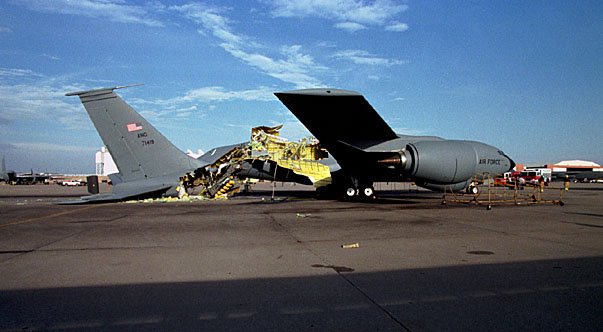
There is I think an example somewhere of a ground test of an aircraft on the ground which they pressurised to test the PRV. The PRV didn’t work and the plane was written off.
Similarly if the outflow valve stuck shut or nearly shut in the cruise you would get a negative delta P as you descended. This hopefully would open the negative pressure relief valve or else the plane might end up like a crushed drunks can.
If the outflow valve stuck shut when you were climbing then delta P would increase. Without a pressure relief valve the delta P could get a level that could damage the airframe.
That could be a reduction in fatigue life or in extreme the fuselage could split open like a sausage.
There is I think an example somewhere of a ground test of an aircraft on the ground which they pressurised to test the PRV. The PRV didn’t work and the plane was written off.
Similarly if the outflow valve stuck shut or nearly shut in the cruise you would get a negative delta P as you descended. This hopefully would open the negative pressure relief valve or else the plane might end up like a crushed drunks can.
Joined: May 2000
Posts: 737
Likes: 0
From: UK
There was a well known instance of someone destroying a KC 135 doing a test with a pressure gauge that had no end stop. He missed it the first time the needle went round, with predictable results...
KC135 Fuselage Pressure Test Explosion
KC135 Fuselage Pressure Test Explosion
Joined: Oct 2007
Posts: 1,003
Likes: 16
From: Here
Joined: Dec 2001
Posts: 941
Likes: 0
From: what U.S. calls ´old Europe´
Unfortunately younger engineers do no longer believe in true (hardware) redundancy... On some modern aircraft there is no more physical positive/negative relief valve, there is just a software function in the outflow valve controller, which operates the failed outflow valve in case the outflow valve or the controller fails... We will probably learn one day, that this is not the best idea.
Joined: Aug 2005
Posts: 1,693
Likes: 0
From: fairly close to the colonial capitol
Control and operation are key differences between the outflow valve, over-press, and negative pressure valves.
The outflow valve(s) is/are under the command of one of two independent pressurization controllers under automatic operation, with position selection by the flight deck crew during manual ops.
For Boeing (through the 787) and Airbus aircraft (through the A350) both the over-pressurization and negative pressure valves operate completely independent of the pressurization system control circuits or manual cockpit commands and both rely on local, independent pressure data to drive their respective operation.
They are always purely mechanical devices, locally controlled for safety and reliability, although there are sometimes monitoring switches for cockpit indication of valve operation. For some aircraft, these valves are combined into one unit. The negative pressure valve is very often a very simple device - a spring-loaded door.
The outflow valve(s) is/are under the command of one of two independent pressurization controllers under automatic operation, with position selection by the flight deck crew during manual ops.
For Boeing (through the 787) and Airbus aircraft (through the A350) both the over-pressurization and negative pressure valves operate completely independent of the pressurization system control circuits or manual cockpit commands and both rely on local, independent pressure data to drive their respective operation.
They are always purely mechanical devices, locally controlled for safety and reliability, although there are sometimes monitoring switches for cockpit indication of valve operation. For some aircraft, these valves are combined into one unit. The negative pressure valve is very often a very simple device - a spring-loaded door.

Joined: Nov 2000
Posts: 256
Likes: 1
From: Netherlands
Few years back I had an actual decompression in a B747. About 5 hrs into the flight, somewhere over Canada, the B controller failed. Failed in such a way that both outflow valves were driven to the full open position. For some reason B controller inhibited transfer to the A controller. Anyways, kinda hectic, donned the masks and went to manual control etc,etc. In manual was able to close both outflow valves. Cabin alt went from approx 6000’ and spiked at approx 13.000 in about 35 to 40 seconds before it went down to 10.000. At 10.000 cab alt we removed the oxy mask and were kinda congratulating ourselves for successfully containing the situation when the next warning went off: overpressure! Off course with both outflow valves shut the airplane now started to overpressurize!!
That’s where the overpressure valves kicked in and saved the day!! Had that valve not been there the plane could have possibly looked like the picture above
That’s where the overpressure valves kicked in and saved the day!! Had that valve not been there the plane could have possibly looked like the picture above
Joined: Sep 1998
Posts: 1,615
Likes: 1
From: wherever
Unfortunately younger engineers do no longer believe in true (hardware) redundancy... On some modern aircraft there is no more physical positive/negative relief valve, there is just a software function in the outflow valve controller, which operates the failed outflow valve in case the outflow valve or the controller fails... We will probably learn one day, that this is not the best idea.
The newest type I know is the CSeries and it has both software protection and 2 safety valves and an extra inward relief valve.
Joined: Jun 2001
Posts: 452
Likes: 0
From: In da north country
The simple way to look at it is;
outflow valves are the regulators, and the over pressure valves are just that. They work on ratio differential. Negative pressure valves(doors) are in the lower cargo doors or the cabin doors themselves. very simple differential pressure systems.
outflow valves are the regulators, and the over pressure valves are just that. They work on ratio differential. Negative pressure valves(doors) are in the lower cargo doors or the cabin doors themselves. very simple differential pressure systems.

Joined: Feb 2004
Posts: 1,410
Likes: 37
From: Australia
Originally Posted by flyburg
Few years back I had an actual decompression in a B747.
Joined: Nov 2000
Posts: 256
Likes: 1
From: Netherlands
Actually, wasn’t too bad if memory serves me right but we were with three pilots.
Joined: Jun 2001
Posts: 4,369
Likes: 3
From: UK.
When you think about it, having no separate positive pressure relief valve is a bit like operating a boiler without safety valves and depending upon furnace fuel control to ensure that the pressure will never rise above the design limit 
Joined: Apr 2003
Posts: 578
Likes: 2
From: Sutton
The three functions of (1) controlling cabin pressure under normal circumstances, (2) preventing maximum differential pressure being exceeded and (3) preventing negative pressure limit exceedance are NORMALLY handled by two separate mechanical valves (all three can be built into the same valve eg the BAe /Hawker 125)
The negative relief valve is a simple lightly sprung valve and is important because conventional civil aircraft structures are designed to withstand significant positive pressure but will collapse like a Coke can with 10% of that value under negative pressure (possible for example in an emergency descent).
Over pressure protection is crucial (as seen from the photo above) because although the pressure number sounds low (less than 10 Pounds Per Square Inch Differential P.S.I.D.) the load taken by the structure is huge. A door 40 inches wide 100 inches height would have 40,000 pounds pressure trying to push it outwards. The way over pressure (failure of auto/manual pressurisation) is dissipated is through the outflow valves so this detection is normally bolted onto the outflow valves and it overrides any signal given by the pressurisation control system.
Outflow valves (normally two) are just connected electronically (or pneumatically in the case of some Garrett systems) to the pressurisation controller and modulate around a slightly open position under normal control (rarely closed as pax need constant air change).
The negative relief valve is a simple lightly sprung valve and is important because conventional civil aircraft structures are designed to withstand significant positive pressure but will collapse like a Coke can with 10% of that value under negative pressure (possible for example in an emergency descent).
Over pressure protection is crucial (as seen from the photo above) because although the pressure number sounds low (less than 10 Pounds Per Square Inch Differential P.S.I.D.) the load taken by the structure is huge. A door 40 inches wide 100 inches height would have 40,000 pounds pressure trying to push it outwards. The way over pressure (failure of auto/manual pressurisation) is dissipated is through the outflow valves so this detection is normally bolted onto the outflow valves and it overrides any signal given by the pressurisation control system.
Outflow valves (normally two) are just connected electronically (or pneumatically in the case of some Garrett systems) to the pressurisation controller and modulate around a slightly open position under normal control (rarely closed as pax need constant air change).
Joined: Jun 2001
Posts: 4,369
Likes: 3
From: UK.
Recollect on the TriStar, if the pressurisation failed, if you started on the left of the a/c & press panel and latched everything out L to R then latched it all back in that usually cured the problem. Computers eh?
