


What happened to those VG's on the 737

Thread Starter

Joined: Apr 2008
Posts: 1
Likes: 2
From: nowhere
What happened to those VG's on the 737
No longer on the Max. From Flight International June 13-19...
"The new circular tailcone eliminates a set of four drag inducing vortex generators on the aft fuselage. These were added to correct a design problem discovered in flight test in the late-1960's. 'The airplane had a vertical bounce to it back in the day, and vortex generators were the aerodynamic fix that smooths that airflow, which stopped the bounce but was additional drag.'"
"The new circular tailcone eliminates a set of four drag inducing vortex generators on the aft fuselage. These were added to correct a design problem discovered in flight test in the late-1960's. 'The airplane had a vertical bounce to it back in the day, and vortex generators were the aerodynamic fix that smooths that airflow, which stopped the bounce but was additional drag.'"


Joined: Jul 2013
Aviation Qualifications: Non-Aircrew
Posts: 5,683
Likes: 3,359
From: Everett, WA
Underfire, I think if you look you'll see what we call "intake strakes" (also known as 'Engine Ears'  ) on most aircraft with big fan engines hanging under the wings. While less than desirable, they are a solution to a very messy problem. With an engine not running during final approach to landing, all that air spilling out of the inlet separates and messes up the airflow over a fair part of the wing (and during an engine out approach, loosing a bunch of lift is rather undesirable), That strake reenergizes that spillage out of the inlet and prevents it from separating the airflow over the wing.
BTW, to the original question, I suspect the aero engineers developed a more elegant fix for the aft fuselage separation problem than the vortex generators...
) on most aircraft with big fan engines hanging under the wings. While less than desirable, they are a solution to a very messy problem. With an engine not running during final approach to landing, all that air spilling out of the inlet separates and messes up the airflow over a fair part of the wing (and during an engine out approach, loosing a bunch of lift is rather undesirable), That strake reenergizes that spillage out of the inlet and prevents it from separating the airflow over the wing.BTW, to the original question, I suspect the aero engineers developed a more elegant fix for the aft fuselage separation problem than the vortex generators...

Joined: Aug 2013
Posts: 30
Likes: 0
From: PA
What about them?
When I speak of the vortex tabs on the wing, I mean the ones on top of the wing
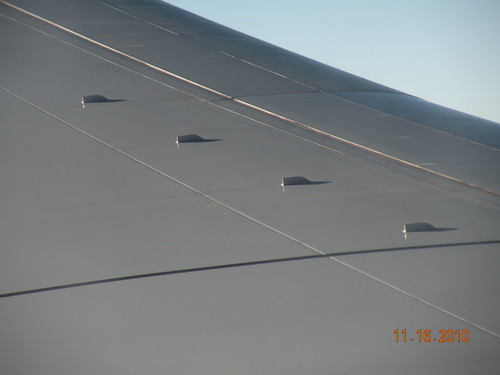
To date, doesnt look like Boeing has been able to design a wing that does not need them.
Underfire, I think if you look you'll see what we call "intake strakes" (also known as 'Engine Ears' ) on most aircraft with big fan engines hanging under the wings.
The new circular tailcone eliminates a set of four drag inducing vortex generators on the aft fuselage.

Last edited by underfire; 11th September 2017 at 10:52.
Thread Starter
Joined: Apr 2008
Posts: 1
Likes: 2
From: nowhere
To be honest...I don't remember any on the 747.

Joined: Jul 2013
Aviation Qualifications: Non-Aircrew
Posts: 5,683
Likes: 3,359
From: Everett, WA
Hmmm -- I'ld question that motive for adding VG's on the aft fuselage.
However if you look at the tail of a 787 near the APU exhaust, you'll see some strange additions - the result of failing the APU fluid leakage testing multiple times.
Joined: Jun 2006
Posts: 265
Likes: 0
From: Brisbane

Joined: Aug 2013
Posts: 30
Likes: 0
From: PA
Nope, had nothing to due with the APU. When the 737 originally entered service, the cabin crews started getting violently ill due to the vertical bounce in the tail
Now, about the other short term fixes that seem to have become permanent, like the tabs on top of the wing....or the vortex generators on the APU intakes....
Joined: Jul 2013
Aviation Qualifications: Non-Aircrew
Posts: 5,683
Likes: 3,359
From: Everett, WA
IGh
This what I "know".
The vortex generators were there on the 737-200 - I know because I saw them. Back when I first started with Boeing (1977), I worked in Renton and we'd go jogging at lunch time using a locker room/shower in a building on the Renton flightline. We'd jog by the 727s and 737s getting ready for delivery - and I'd noticed those big, ugly VGs on the 737 aft body, so I asked about them. The response I got is reflected my post - a few hertz vibration of the aft fuselage that made the cabin crew sick (the response was a bit more graphic, including if the frequency matched the natural frequency of the individual, they'd loose control of their bowels ). Now, it's possible that answer was total BS, but the source was normally pretty accurate.
The other part is a very good friend of mine was responsible for the APU installation on the 737NG - he got a patent and a cash reward for his idea for the "dual asshole" APU exhaust (look at the tail of a 737NG and you'll know what I'm talking about). He never mentioned anything regarding the VG installation affecting the APU. He retired about 10 years before me, but we've stayed in touch - if I don't forget I'll ask him about it next time I see him.
This what I "know".
The vortex generators were there on the 737-200 - I know because I saw them. Back when I first started with Boeing (1977), I worked in Renton and we'd go jogging at lunch time using a locker room/shower in a building on the Renton flightline. We'd jog by the 727s and 737s getting ready for delivery - and I'd noticed those big, ugly VGs on the 737 aft body, so I asked about them. The response I got is reflected my post - a few hertz vibration of the aft fuselage that made the cabin crew sick (the response was a bit more graphic, including if the frequency matched the natural frequency of the individual, they'd loose control of their bowels
). Now, it's possible that answer was total BS, but the source was normally pretty accurate.The other part is a very good friend of mine was responsible for the APU installation on the 737NG - he got a patent and a cash reward for his idea for the "dual asshole" APU exhaust (look at the tail of a 737NG and you'll know what I'm talking about). He never mentioned anything regarding the VG installation affecting the APU. He retired about 10 years before me, but we've stayed in touch - if I don't forget I'll ask him about it next time I see him.
