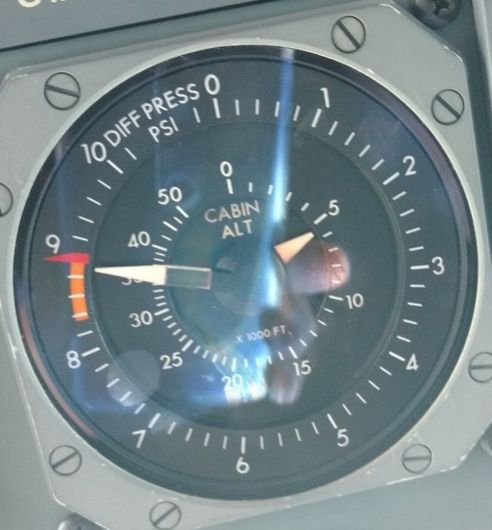
B737NG: High Cabin Diff Pressure

Joined: Jan 2000
Posts: 860
Likes: 0
From: FL410
Slightly off-topic but what are your airline's policy in regards to the 'flight altitude' when requiring a step climb? Would you set the highest flight level anticipated or would you start with the initial cruise level and then increase it as you climb further?
My company suggests entering the initial cruise altitude and then changing it as you climb, to avoid unnecessary 'off-scheduled descent' warnings in case you forget to climb. However this means that you suddenly get a quite annoying pressurisation change in the middle of the cruise when the pressurisation logic changes from 7.8psi diff to 8.35psi (i.e changing cruise level from FL360 to FL380).
Would be interesting to know other operators thoughts around this.
My company suggests entering the initial cruise altitude and then changing it as you climb, to avoid unnecessary 'off-scheduled descent' warnings in case you forget to climb. However this means that you suddenly get a quite annoying pressurisation change in the middle of the cruise when the pressurisation logic changes from 7.8psi diff to 8.35psi (i.e changing cruise level from FL360 to FL380).
Would be interesting to know other operators thoughts around this.
If operating as per Boeing FCOM and FCTM, set the highest expected level. The descent checklist item AIR COND & PRESS should be used to catch it if not climbed to planned maximum. Worst case scenario you get an UNSCHEDULED DESCENT, a non-issue in most airlines these days.

Joined: Dec 2000
Posts: 523
Likes: 0
From: very close to STN!!
From the book. Physical Description
Each CPC (there are two) has these items:
• Cabin pressure sensor
• BITE instruction plate
• Two-line LED display
• BITE control buttons.
And I'm not "saying" anything. Just quoting the book. The chapter on the cabin altitude panel does not go any further than shown.
Last edited by stator vane; 2nd May 2017 at 20:08. Reason: spacing
Joined: Jun 2006
Posts: 265
Likes: 0
From: Brisbane
Slightly off-topic but what are your airline's policy in regards to the 'flight altitude' when requiring a step climb? Would you set the highest flight level anticipated or would you start with the initial cruise level and then increase it as you climb further?
Skyjob and I agreed to disagree in that thread. Furthermore, airline operators differ in their interpretations of Boeing's recommendations, and implement their own SOP's accordingly. Please re-kindle that thread if you wish to discuss it further rather than take this one off topic...
Joined: Jun 2006
Posts: 265
Likes: 0
From: Brisbane
That cabin altitude/diff gauge is an interesting one.
I recall a 737 incident where they did a rapid depressurisation and emergency descent after a window crack, and subsequently found themselves at a low altitude with the cabin altitude above 40,000'.
Very confusing. Except that the cabin altitude wasn't above 40,000' of course, it was way below sea level. You see, they didn't actually have a rapid depressurisation. So they closed the outflow valve manually as per the checklist, descended as per the checklist, and consequently pressurised the cabin way below sea level. That gauge is capable of reading negative, but it doesn't have negative graduations. The needle just moves anti-clockwise until it shows a high cabin altitude. No mention of that in the manuals either. Hmmm.
Last edited by Derfred; 3rd May 2017 at 16:39.
Joined: Feb 2008
Posts: 1,342
Likes: 0
From: Wingham NSW Australia
Clue to Cabin Altitude
As well as the Differential Pressure being a clue Hoppy, I am sure the lack of any Cabin Altitude Warnings (Visual & Aural) as well as the lack of a "Rubber Jungle" in the cabin would/should have told them something ?

Joined: Apr 2016
Posts: 93
Likes: 2
From: Europe
There is also a modification available from boeing which gives a higher differential and a lower cabin altitude , not sure on the differential numbers , but the cabin stays at around 6500 . Could be one of those .