


External aircraft furniture

Thread Starter
Joined: Jan 2008
Posts: 3,154
Likes: 107
From: There and here
External aircraft furniture
A simple question and this would seem the ideal place to get an answer.
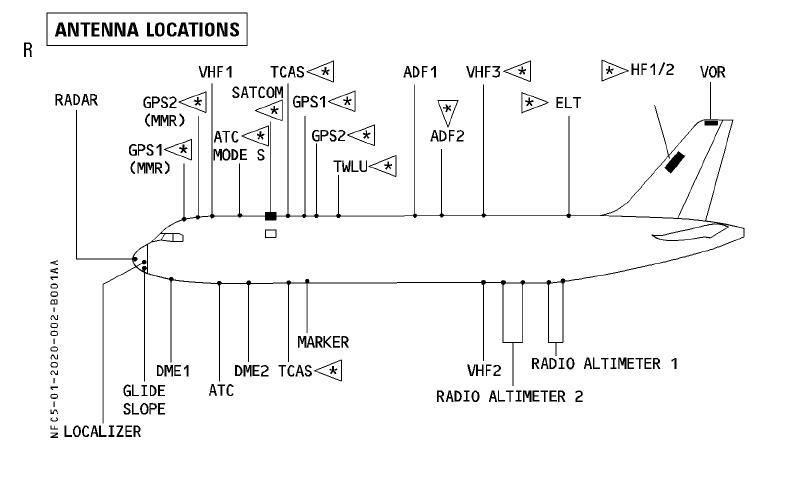
Bearing in mind the ever increasing number of antennae for VHF/VOR/satphone/wifi/etc on the outside of airliners, why are they primarily situated on the top side of the fuselage and not under ? The only negatives I can think of for situating them below is the danger of ground damage due to FOD etc, but perhaps there are aerodynamic considerations as well. Any answers appreciated.
Bearing in mind the ever increasing number of antennae for VHF/VOR/satphone/wifi/etc on the outside of airliners, why are they primarily situated on the top side of the fuselage and not under ? The only negatives I can think of for situating them below is the danger of ground damage due to FOD etc, but perhaps there are aerodynamic considerations as well. Any answers appreciated.


Thread Starter
Joined: Jan 2008
Posts: 3,154
Likes: 107
From: There and here
That could well be so, but sited on the centreline of the fuselage belly, any Sat aerials might have a good chance of a line of sight connection with satellites above and distant ? What about all the antennae that are air to ground ?


Joined: Dec 2007
Posts: 633
Likes: 0
From: Pasadena
Satellite links tend to be from directional antennas, owing to the bandwidth requirement and distance to the satellite.
They need a radome and a line of sight to the specific satellite of choice. Phased array antennas don't point mechanically, but they still need a line of sight.
Most ground-based communications can cope with a much less directional antenna, that can be located in a much less specific location, somewhere handy for power and geometry. Radar altimeters need a downward view, whereas GPS needs a hemispherical sky view.
Engines can be a source of stray reflections and their own emissions - there's a reason that the JSTARS aircraft still have the narrow-diameter low-power engines.
They need a radome and a line of sight to the specific satellite of choice. Phased array antennas don't point mechanically, but they still need a line of sight.
Most ground-based communications can cope with a much less directional antenna, that can be located in a much less specific location, somewhere handy for power and geometry. Radar altimeters need a downward view, whereas GPS needs a hemispherical sky view.
Engines can be a source of stray reflections and their own emissions - there's a reason that the JSTARS aircraft still have the narrow-diameter low-power engines.


Joined: Nov 1999
Aviation Qualifications: ATPL
Posts: 3,139
Likes: 740
From: UK
Hi SHJ,
The transmission/reception pattern of a VHF quarter-wave ground plane aerial can be imagined as a flattened doughnut around the aerial, therefore the performance of such an aerial when the aircraft is flying well above the elevation of the ground station is very similar whether it is located above or below the fuselage. In other words when the aircraft is in the cruise, talking to an ATC station 100 miles away, the path to the ATC aerial from either fuselage location is nearly identical.
However, when the aircraft is on the stand, it will have all sorts of clutter around and underneath it such as steps, refuelling rigs, baggage trucks, catering trucks, air bridges and buildings etc. etc., and in this case the aerial above the fuselage will suffer fewer reflections and obstructions and probably perform better.
VHF transmissions do not need to be direct line of sight clear, but satellite transmissions do.
The transmission/reception pattern of a VHF quarter-wave ground plane aerial can be imagined as a flattened doughnut around the aerial, therefore the performance of such an aerial when the aircraft is flying well above the elevation of the ground station is very similar whether it is located above or below the fuselage. In other words when the aircraft is in the cruise, talking to an ATC station 100 miles away, the path to the ATC aerial from either fuselage location is nearly identical.
However, when the aircraft is on the stand, it will have all sorts of clutter around and underneath it such as steps, refuelling rigs, baggage trucks, catering trucks, air bridges and buildings etc. etc., and in this case the aerial above the fuselage will suffer fewer reflections and obstructions and probably perform better.
VHF transmissions do not need to be direct line of sight clear, but satellite transmissions do.


Joined: Dec 2007
Posts: 633
Likes: 0
From: Pasadena
It gives you a decent extra fraction of a square meter of frontal area, so something like ~0.1%.
Does everyone on board spend more than an extra dollar on the service? If so, then it would be more than worth it, in fuel at least.
Does everyone on board spend more than an extra dollar on the service? If so, then it would be more than worth it, in fuel at least.

