


A320 ADIRS full alignment

Thread Starter

Joined: Apr 2006
Posts: 529
Likes: 0
From: Asia
A320 ADIRS full alignment
on older SOPs it was brought to our attention that a full IRS alignment was equivalent to two hours of continuous operation,
that has ben removed to say that a full alignment must be performed on every change of crew (one hour transit).
is anybody familiar with any of the manufacturers figures time/wear/cost.
thank you.
that has ben removed to say that a full alignment must be performed on every change of crew (one hour transit).
is anybody familiar with any of the manufacturers figures time/wear/cost.
thank you.

Joined: Jun 2007
Posts: 3,443
Likes: 39
From: Wanderlust
MD83FO
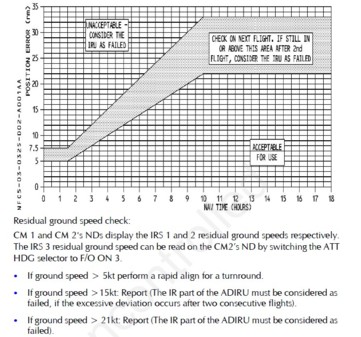
This seems to be your company procedure. Realignment is not required in transit unless the residual ground speed shown is higher than 5KTS. Then a fast alignment can be done which takes 3o SECs. Complete alignment takes 10mts. and is only required when flight is expected over poor navigation coverage area and GPS primary not available
This seems to be your company procedure. Realignment is not required in transit unless the residual ground speed shown is higher than 5KTS. Then a fast alignment can be done which takes 3o SECs. Complete alignment takes 10mts. and is only required when flight is expected over poor navigation coverage area and GPS primary not available
Joined: Jan 2010
Posts: 48
Likes: 0
From: USA
On the modern laser ring gyros or fiber optic gyros in planes, alignment is just a software function, so there's no cost or wear unless you count the extra button presses you need.
The reason why the requirement was dropped was probably because your company's fleet has the newer models with integrated GPS that constantly monitor and correct the error between the two anyway. If GPS were to fail, for example, the IRU will be able to provide a GPS-accurate position for some number of minutes.
The reason why the requirement was dropped was probably because your company's fleet has the newer models with integrated GPS that constantly monitor and correct the error between the two anyway. If GPS were to fail, for example, the IRU will be able to provide a GPS-accurate position for some number of minutes.
