


Increasing jet aircraft range.

Thread Starter
Joined: May 2010
Posts: 645
Likes: 0
From: europe
Increasing jet aircraft range.
Can you experts please advise. The aircraft i fly quotes LRC at M0 .74. When i look at the AFM I note that, as one might expect, the TAS is reduced as weight decreases...so too does the Mach.
I have two questions.
1. If i want to extract as much in terms of range from the aircraft, and assuming still air, would I benefit by flying slower than published? (And by this I mean reducing towards the best L/D speed as indicated in the speed tape) ?
2. When flying into wind, by how much should I increase my IAS or Mach no? Is there a rule of thumb?
3. When flying in tailwind, by how much should I reduce?
In all cases to get max range...not endurance.
Many thanks.
I have two questions.
1. If i want to extract as much in terms of range from the aircraft, and assuming still air, would I benefit by flying slower than published? (And by this I mean reducing towards the best L/D speed as indicated in the speed tape) ?
2. When flying into wind, by how much should I increase my IAS or Mach no? Is there a rule of thumb?
3. When flying in tailwind, by how much should I reduce?
In all cases to get max range...not endurance.
Many thanks.


Joined: May 2000
Posts: 3,204
Likes: 2
From: Seattle
Rule of thumb I've used is increase TAS by 40% of headwind, decrease by 40% of tailwind. Min speed is max endurance. Max speed is where the knee in the fuel flow / TAS curve is (you will likely have to estimate it).
Last edited by Intruder; 21st May 2013 at 07:18.
Joined: Jun 1999
Posts: 408
Likes: 0
From: Queensland
Years ago I generated data for B727-200 levels for best range for various head/tail winds and weights at M.80. At lower levels I used the recommended IAS. That was a huge job with interesting results and it was mainly used on Sydney - Perth runs. TAS and fuel flow changes related to different levels was the best way to adjust for wind gradients Thirty years ago the traffic was sparse enough to not need more complex calculations for speed changes at a fixed level.
Rules of thumb for wind gradients turned out to be a poor substitute for a lot of better preparation.
Rules of thumb for wind gradients turned out to be a poor substitute for a lot of better preparation.
Last edited by autoflight; 22nd May 2013 at 00:10. Reason: clarity
Thread Starter
Joined: May 2010
Posts: 645
Likes: 0
From: europe
Thanks for the replies.
Here is my difficulty in understanding. The LRC schedules call for speeds which are always in excess of green dot speed, so are always faster than the speed for best L/D.
Why would this be.....or have I completely missunderstood all previous teaching that max range IS achieved at best L/D speed?
Here is my difficulty in understanding. The LRC schedules call for speeds which are always in excess of green dot speed, so are always faster than the speed for best L/D.
Why would this be.....or have I completely missunderstood all previous teaching that max range IS achieved at best L/D speed?
Joined: Jun 2004
Posts: 1,843
Likes: 0
From: Australia
Defer dog,
Maximum range cruise categorically is well above max L/D ratio speed. This speed (with very Minor adjustment) is more representative of Max Endurance / Best angle of climb / Minimum rate and angle of descent during OEI DRIFT-down.
Max range cruise occurs on the conventional drag curve at the point of tangency to the curve drawn from the 0/0 origin. In head and tail wind conditions, the 0/0 origin moves left/right in direct relationship to tailwind/headwind (in that order). Whilst on the subject, don't let any jerk convince you that MRC is at or below Mcrit, it's always above at normal operating levels, but EAS defined below the CAS/Mach changeover level.
Maximum range cruise categorically is well above max L/D ratio speed. This speed (with very Minor adjustment) is more representative of Max Endurance / Best angle of climb / Minimum rate and angle of descent during OEI DRIFT-down.
Max range cruise occurs on the conventional drag curve at the point of tangency to the curve drawn from the 0/0 origin. In head and tail wind conditions, the 0/0 origin moves left/right in direct relationship to tailwind/headwind (in that order). Whilst on the subject, don't let any jerk convince you that MRC is at or below Mcrit, it's always above at normal operating levels, but EAS defined below the CAS/Mach changeover level.
Joined: Jun 2011
Posts: 297
Likes: 0
From: Devonshire
For the 707, Boeing published Optimum Altitude data, which showed that as the aircraft's weight decreased with fuel burn-off, the Optimum Altitude increased. This would mean that the Opt. Alt. increased by about 1000 ft./hour. (Of course this would be restricted by other factors in practice.)

Joined: Sep 2008
Aviation Qualifications: ATPL
Posts: 3,435
Likes: 1,201
From: 41S174E
Here is my difficulty in understanding. The LRC schedules call for speeds which are always in excess of green dot speed, so are always faster than the speed for best L/D.
Joined: May 2013
Posts: 121
Likes: 0
From: London
have I completely missunderstood all previous teaching that max range IS achieved at best L/D speed?
However, it would seem to me that If really desperate to save fuel, then use l/d speed for descent.
Rule of thumb I've used is increase TAS by 40% of headwind, decrease by 40% of tailwind. Min speed is max endurance. Max speed is where the knee in the fuel flow / TAS curve is (you will likely have to estimate it).
Joined: Jun 2006
Posts: 716
Likes: 0
From: Europe
A common misunderstanding is that LRC gives you max range. It gives you exactly what is says - long range - but not max range.
-Max endurance speed is whatever you get with the lowest fuel flow. It is not affected by wind. On the Speed/Drag curve, this is the lowest point.
-Max range speed is defined by the lowest fuel flow pr. ground distance covered, thus it is dependent on wind. Assuming no wind, then on the Speed/Drag curve, this is the tangent with the lowest angle.
-Long range cruise speed is slightly higher than max range speed, and is a tradeoff, that gives you a (relatively) big speed increase for a (relatively) small range penalty. On the Speed/Drag curve, this will be a bit further up-and-to-the right from the max range; you will see that although the drag increases, the speed also increases by nearly the same amount.
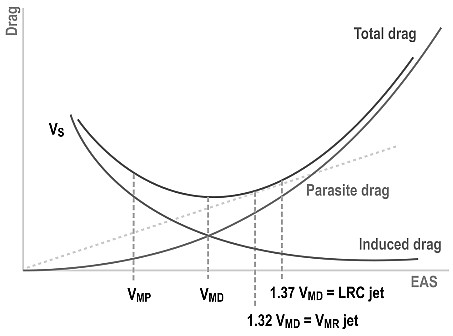
(image courtesy of the internet)
-Max endurance speed is whatever you get with the lowest fuel flow. It is not affected by wind. On the Speed/Drag curve, this is the lowest point.
-Max range speed is defined by the lowest fuel flow pr. ground distance covered, thus it is dependent on wind. Assuming no wind, then on the Speed/Drag curve, this is the tangent with the lowest angle.
-Long range cruise speed is slightly higher than max range speed, and is a tradeoff, that gives you a (relatively) big speed increase for a (relatively) small range penalty. On the Speed/Drag curve, this will be a bit further up-and-to-the right from the max range; you will see that although the drag increases, the speed also increases by nearly the same amount.
(image courtesy of the internet)
Joined: Sep 2008
Aviation Qualifications: ATPL
Posts: 3,435
Likes: 1,201
From: 41S174E
Thanks for that graph.
I use the Cost Index to give me an approximation of VMR in the 737 but I am aware that it is taking account of the wind while in EcON mode so isn't exactly right.
1/From VMR can I work backwards to get VMD in IAS?
2/ Is VMD purely a function of weight and therefore the same IAS at FL380 or 2000ft for a given weight?
I use the Cost Index to give me an approximation of VMR in the 737 but I am aware that it is taking account of the wind while in EcON mode so isn't exactly right.
1/From VMR can I work backwards to get VMD in IAS?
2/ Is VMD purely a function of weight and therefore the same IAS at FL380 or 2000ft for a given weight?
Thread Starter
Joined: May 2010
Posts: 645
Likes: 0
From: europe
Thanks again, Now I think I'm starting to get a clear picture.
So, in essence, what some of you are saying (in a jet) is this:: Best L/D speed for a given weight would give max range, but because the engines may not work as efficiently at this lowish speed, a better mileage per pound of fuel is obtained at a speed somewhat above that of best L/D. Is that it?
What I didn't understand was the post by toffeez. What did you find so scary about my post 6, which, after all, was only another question? Was it that I asked a stupid question?
So, in essence, what some of you are saying (in a jet) is this:: Best L/D speed for a given weight would give max range, but because the engines may not work as efficiently at this lowish speed, a better mileage per pound of fuel is obtained at a speed somewhat above that of best L/D. Is that it?
What I didn't understand was the post by toffeez. What did you find so scary about my post 6, which, after all, was only another question? Was it that I asked a stupid question?
Joined: Jul 2009
Posts: 1,682
Likes: 0
From: France - mostly
Originally Posted by framer
Is VMD purely a function of weight and therefore the same IAS at FL380 or 2000ft for a given weight?
Originally Posted by deefer dog
Best L/D speed for a given weight would give max range, but because the engines may not work as efficiently at this lowish speed, a better mileage per pound of fuel is obtained at a speed somewhat above that of best L/D. Is that it?
VMR is the speed for minimum D/V.
For a parabolic drag polar in still air VMR is equal to VMD times the 4th-power root of 3.
If it assumed that engine efficiency (thrust specific fuel consumption) is constant, then VMD is the speed for max endurance and VMR is the speed for maximum range.
Last edited by HazelNuts39; 23rd May 2013 at 14:46. Reason: Some browsers don't show the root sign
Joined: Jun 2006
Posts: 716
Likes: 0
From: Europe
I use the Cost Index to give me an approximation of VMR in the 737 but I am aware that it is taking account of the wind while in EcON mode so isn't exactly right.
On the 737:
For Vmd (min drag, best endurance), use HOLD page to get holding speed. This is close to Vmd.
For Vmr (max range), set cost index to 0 and fly ECON CRZ.
For Vlrc (long rang cruise), use LRC CRZ. (cost index has no influence).
(For info, LRC is equivalent to ECON speed at cost index around 35-ish. Ie, if you fly at a low cost index, say 15 or 20, going from ECON to LRC will actually decrease your range slightly)
Thread Starter
Joined: May 2010
Posts: 645
Likes: 0
From: europe
HazelNuts, thanks for informative answers. Could you please explain what 4th power root of 3 means.
An example would help. What is the 4th power root of 3 if the starting number was, say, 10?
Thank you.
An example would help. What is the 4th power root of 3 if the starting number was, say, 10?
Thank you.
Joined: Jul 2009
Posts: 1,682
Likes: 0
From: France - mostly
Could you please explain what 4th power root of 3 means.