


787 delamination

Thread Starter
Joined: Feb 2011
Posts: 10
Likes: 0
From: Nairobi
787 delamination checks
Boeing inspects 787 Dreamliner for possible repairs to carbon fiber skin
ttp://bottomline.msnbc.msn.com/_news/2012/02/05/10321423-boeing-inspects-787-dreamliner-for-possible-repairs-to-carbon-fiber-skin
who has more on this?
ttp://bottomline.msnbc.msn.com/_news/2012/02/05/10321423-boeing-inspects-787-dreamliner-for-possible-repairs-to-carbon-fiber-skin
who has more on this?

Joined: Aug 2008
Posts: 490
Likes: 0
From: Spain
787 delamination
(Sorry, Mods - I see this has already appeared in another thread!)
From Flight Global - link below
I believe that large structural use of carbon fibre in civil aviation is new. Let's hope the Dreamliner doesn't fall to earth.
From Flight Global - link below
Boeing again faces a manufacturing quality issue, requiring inspections and repairs of its 787 fleet.
Structural stiffeners were found to be improperly joined to the composite skin in the aft sections of the aircraft, causing parts of the aircraft's carbon fibre structure to delaminate, confirms the airframer.
"Boeing has found that incorrect shimming was performed on support structure on the aft fuselage on certain airplanes in our facility in Everett, [Washington]," said the airframer.
Structural stiffeners were found to be improperly joined to the composite skin in the aft sections of the aircraft, causing parts of the aircraft's carbon fibre structure to delaminate, confirms the airframer.
"Boeing has found that incorrect shimming was performed on support structure on the aft fuselage on certain airplanes in our facility in Everett, [Washington]," said the airframer.
Last edited by Sunnyjohn; 5th February 2012 at 18:07.

Joined: Aug 2001
Posts: 865
Likes: 15
From: Greater Aldergrove
If you read the detail on Flightblogger, it details how this is a manufacturing issue and not a design problem. And it will only potentially lead to a reduced fatigue life, not the risk of dramatic or catastrophic failure. It's another example of poor programme execution from a subcontractor, not of a fundamental flaw in the design. Most importantly, this can be inspected for and addressed.
Joined: Oct 2010
Posts: 1,517
Likes: 0
From: Wayne Manor
it will only potentially lead to a reduced fatigue life, not the risk of dramatic or catastrophic failure. It's another example of poor programme execution from a subcontractor, not of a fundamental flaw in the design.
Most importantly, this can be inspected for and addressed.

Joined: Mar 2001
Posts: 4,562
Likes: 33
From: I wouldn't know.
It's another example of poor programme execution from a subcontractor
it can yes, but the reality as anyone who has dealt with de-lam on flight control surfaces, its often cheaper to bin the part and buy again than to repair a de-lam composite structure.


Joined: May 2000
Posts: 3,204
Likes: 2
From: Seattle
Purely for the benefit of those who, like me, didn't actually know what "delaminating" looked like.
Doesn't look like the kind of thing you want to be happening in midair at any rate. From a naive perspective, is it not of some concern to see highlighted the obvious stress the fuselage is under already? Obviously it's all engineered to withstand it, just seems like it's a bit too reliant on everything being just so..
Doesn't look like the kind of thing you want to be happening in midair at any rate. From a naive perspective, is it not of some concern to see highlighted the obvious stress the fuselage is under already? Obviously it's all engineered to withstand it, just seems like it's a bit too reliant on everything being just so..
Joined: Aug 2001
Posts: 865
Likes: 15
From: Greater Aldergrove
well, technically speaking it is. A reduced life results in the asset having to be amortised over a shorter period with a reduced value at the end of that period, which makes the aircraft more expensive to operate. That makes it a fundamental flaw in the design as potentially it affects the operational cost to the user, which is the result of the actual 'design'.
The subcontractor in this case however is Boeing South Carolina.
Joined: Mar 2001
Posts: 4,562
Likes: 33
From: I wouldn't know.
True enough, back then it was other program issues, iirc too much traveled work. And as a thank you they got the second 787 line, hope they dont work as diligent in that as in their work up til now, that would be truly bad for the program.
Joined: Sep 2010
Posts: 1,339
Likes: 0
From: earth
Jambone
This is not a representation of practical delam. Time, temperature, water and by your most important example stress will result in delimitation. Time will tell if there is a high stress area in the fuselage that will allow the elements to penetrate and degrade a composite fuselage.
Joined: Dec 2003
Posts: 2,347
Likes: 838
From: Tring, UK
Having owned and operated composite aircraft for the last three decades, I was interested to see the wide scale adoption of these materials by Boeing. I am more concerned about the maintenance / repair schedules, as by all accounts they seem rather simplistic, given the 'battle damage' that commercial aircraft suffer during normal operation.
From experience, I know that stress and/or impact damage to load bearing composite structures is nothing like that suffered by bonded metals. The most severe problems can be a long way from the site of the initial 'injury' and be quite hard to detect and even harder to repair. Often the only realistic thing to do is construct a whole new part...
From experience, I know that stress and/or impact damage to load bearing composite structures is nothing like that suffered by bonded metals. The most severe problems can be a long way from the site of the initial 'injury' and be quite hard to detect and even harder to repair. Often the only realistic thing to do is construct a whole new part...

Joined: May 2000
Posts: 3,204
Likes: 2
From: Seattle
Since they put the stiffeners in there, it is most likely because they are required for stiffness. It doesn't ALLUDE to anything other than that there is stress in the area that must be mitigated. It does NOT allude to any excess stress, nor does it indicate the type of stress (tension, compression, shear) the stiffeners mitigate.
Joined: Sep 2010
Posts: 1,339
Likes: 0
From: earth
Fact is we are all 'wet behind the ears' in this regard. The 787 is an unprecedented leap of faith into a composite fuselage. Actually reading the OP's link for the first time it sounds like Boeing are seeing problems already after a short term of fatigue.
Joined: Dec 2010
Posts: 1,165
Likes: 0
From: Middle America
I think the illustration below gives some insight into what I believe the problem is that Boeing uncovered and is dealing with. The cartoon that is inside the rectangular box depicts what happens when the shim between the stiffener and the composite shell doesn't close the gap and the fastener is tightened. Initially, there would be no noticeable problem, but over time, the stresses set up by this condition and the fact it is at a hole (a natural stress riser) in the composite material eventually could lead to delamination at the hole location. I am sure the detected flaw/flaws can be repaired.
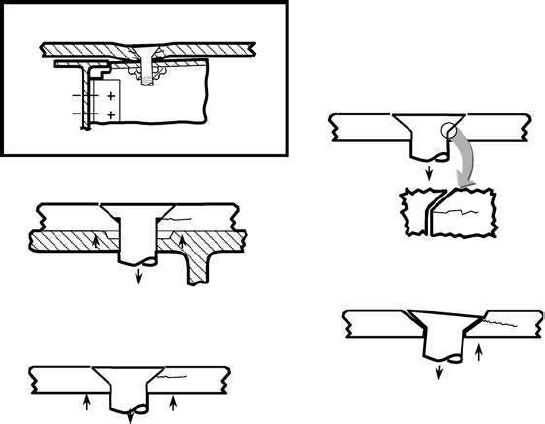
The particular composite Boeing is using in the 787 fuselage application is very strong, more comparable to high strength steel than to aluminum. The composite behavior is different from aluminum. Impacting aluminum causes a dent, taken to extreme, it causes a dent and fracture. Impacting this particular composite result in no dent up until the point the tensile strength of the composite is exceeded. Then it will begin to delaminate meaning separation of the built up layers.
I hope this helps the understanding.
The particular composite Boeing is using in the 787 fuselage application is very strong, more comparable to high strength steel than to aluminum. The composite behavior is different from aluminum. Impacting aluminum causes a dent, taken to extreme, it causes a dent and fracture. Impacting this particular composite result in no dent up until the point the tensile strength of the composite is exceeded. Then it will begin to delaminate meaning separation of the built up layers.
I hope this helps the understanding.
Joined: Dec 2001
Posts: 941
Likes: 0
From: what U.S. calls ´old Europe´
If you read the detail on Flightblogger, it details how this is a manufacturing issue and not a design problem.
Joined: Oct 2007
Posts: 170
Likes: 0
From: Cumbria
Just out of curiosity, and from a non-pilot, non-engineer (also NOT a bean-counter)
why is this delamination issue which appears to a complete idiot layman to be very, very, very worrying as it is in the actual fuselage so much less important than the fact that some in-wing fastener points in 'another aircraft' have developed some cracks?
working on "page count" as a measure of "issue seriousness"
the page-count for what appears to be a complete structural failure = 2 (Boeing 787)
the page-count for what appears to be a fixable minor issue = 6 (another aircraft manufacturers product)
why is this delamination issue which appears to a complete idiot layman to be very, very, very worrying as it is in the actual fuselage so much less important than the fact that some in-wing fastener points in 'another aircraft' have developed some cracks?
working on "page count" as a measure of "issue seriousness"
the page-count for what appears to be a complete structural failure = 2 (Boeing 787)
the page-count for what appears to be a fixable minor issue = 6 (another aircraft manufacturers product)
Joined: Mar 2002
Posts: 4,569
Likes: 1
From: Florida
Delamination is like a piece of plywood that evntually buckles and sags.
Cracks through a solid beam spontaneously snap and the beam collapses.
What level of load, across a supporting structure, is carried (basic everyday stress) plays a part. Only the designer knows what level of basic stress is present. Thus I don't sense a conclusion between a fuselage and wing part without knowing this stress (its not just a load issue)
Cracks through a solid beam spontaneously snap and the beam collapses.
What level of load, across a supporting structure, is carried (basic everyday stress) plays a part. Only the designer knows what level of basic stress is present. Thus I don't sense a conclusion between a fuselage and wing part without knowing this stress (its not just a load issue)

