


RadAlt over forest

Thread Starter
Moderator


Joined: Feb 2000
Aviation Qualifications: CPL
Posts: 14,480
Likes: 178
From: UK
RadAlt over forest
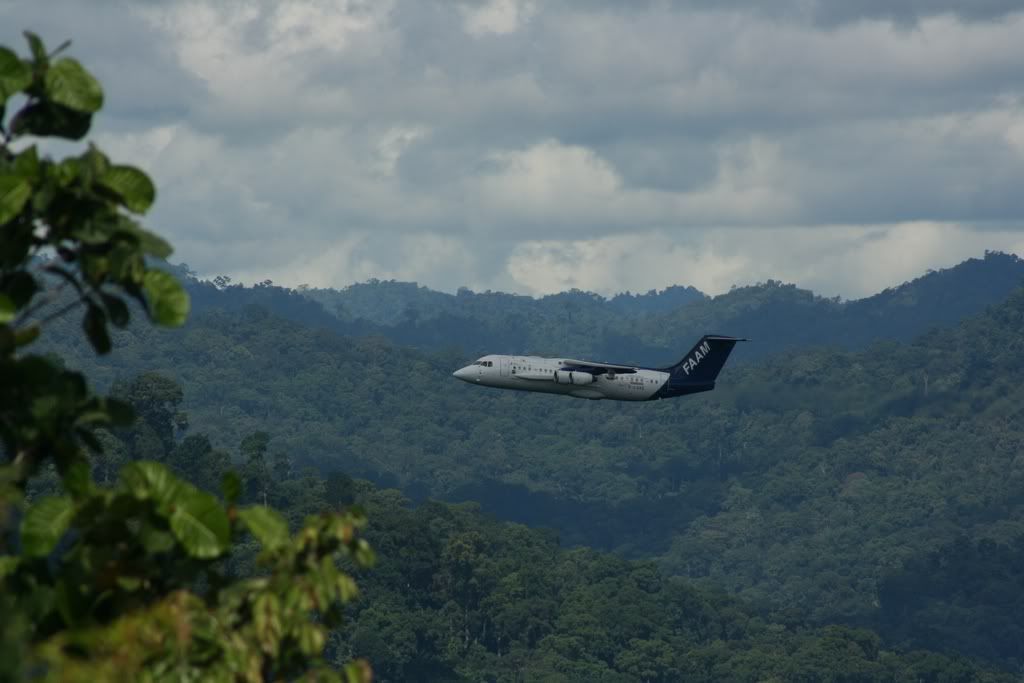
Has anybody experience of operating a GPWS equipped aircraft close to jungle/forest. I'm wondering whether the RadAlt tends to detect the forest canopy or the ground underneath? I've not operated in that environment myself, and the textbooks don't seem to say much.
G
G


Joined: Feb 2003
Posts: 1,078
Likes: 46
From: Brighton
Although I can't answer that query, I have had false returns from a rad alt from very heavy rain. I had an occasion near Tangier back in the 80s, in a 737-200, when at around FL150 in torrential rain the rad alt was giving wildly fluctuating readings for several minutes. We had GPWS fitted but I can't remember whether it reacted. It does show that the rad alt will see things other than the surface.

Joined: Mar 2001
Posts: 4,563
Likes: 35
From: I wouldn't know.
With the small amount of time we are close to treetops i cannot really say if the GPWS reacts to them, but would think there is at least some minor filterin in the RA circuit. However that does not prevent the nice and very unexpected "1000" callout during cruise when another one passes underneath you.
Joined: Feb 2004
Posts: 1,410
Likes: 37
From: Australia
when at around FL150 in torrential rain the rad alt was giving wildly fluctuating readings for several minutes.
RA's react to lakes, rivers, etc... Just how heavy was that rain?

Rgds.
NSEU
Joined: Jan 2005
Posts: 2,315
Likes: 10
From: France
I thought modern rad-alts worked on about 5000MHz (unlike the original AN-APN1 on 440 MHz  ).
).
About the same as Wx radar. So they should 'see' real sh!t below, such as a wet jungle canopy.
You people got me interested.
).About the same as Wx radar. So they should 'see' real sh!t below, such as a wet jungle canopy.
You people got me interested.
Joined: Apr 2000
Posts: 791
Likes: 1
From: UK
Certainly for flying over the Jungle canopy at very low level (in a military helicopter), the radalt generally locks onto the tree tops but one does have the occasionaly spike down to the ground for no apparent reason.
Joined: Jan 2005
Posts: 2,315
Likes: 10
From: France
Originally Posted by Lafyar Cokov
Certainly for flying over the Jungle canopy at very low level (in a military helicopter), the radalt generally locks onto the tree tops but one does have the occasionaly spike down to the ground for no apparent reason.

Joined: Oct 1999
Aviation Qualifications: ATPL
Posts: 7,383
Likes: 933
From: Den Haag
I agree - all the radalts in helicopters I've flown (including my current type which has EGPWS) see the canopy. It goes without saying that it depends on the canopy density - I'm talking about jungle.
I'm very surprised to hear of 1000 ft calls caused by overflying another aircraft - I'd have thought that a spike like that would be filtered out (again, is for the helicopters I've flown)
I'm very surprised to hear of 1000 ft calls caused by overflying another aircraft - I'd have thought that a spike like that would be filtered out (again, is for the helicopters I've flown)

Joined: Jan 2005
Posts: 2,315
Likes: 10
From: France
Originally Posted by 212man
I'm very surprised to hear of 1000 ft calls caused by overflying another aircraft - I'd have thought that a spike like that would be filtered out (again, is for the helicopters I've flown)
But unless you deliberately turn off the rad-alt ... think of slowly overtaking another aircraft below you on the same airway, same track, with the usual 300m vertical separation.... the "1000ft" call suddenly made sense to me!
Anybody else?
Originally Posted by Fullblast
Are you all talkin' about radar-alt or radio-alt?
Just grabbed a couple of manuals and books off the shelf.
Both British and French manuals refer to "radio-altimeter" or "radio-altimètre".
Original American literature refers to it as a "radar altimeter".
Strictly speaking it's radar - it measures a range.
But it's a rather special kind: CW FM radar ('continous-wave' 'frequency modulated' if you want to get technical...).
So it's just a matter of terminology and usage. But we're definitely talking about the same thing.
Joined: Jun 2002
Posts: 485
Likes: 6
From: Avon, CT, USA
It may not pick up the trees. I am basing that on an old story that in Vietnam, F111's had ground following radar that would guide the F111 a few hundred feet off the ground in IFR. In some places the jungle growth was 200 feet high or even higher. Needless to say, a few crews did not return.
I have also heard of some recent helicopter stories where the RA was not giving back accurate data while flying over water.
I have also heard of some recent helicopter stories where the RA was not giving back accurate data while flying over water.
Joined: Jan 2005
Posts: 2,315
Likes: 10
From: France
Originally Posted by ATPMBA
It may not pick up the trees. I am basing that on an old story that in Vietnam, F111's had ground following radar that would guide the F111 a few hundred feet off the ground in IFR. In some places the jungle growth was 200 feet high or even higher. Needless to say, a few crews did not return.
Terrain following is hairy at the best of times.
The consensus here seems to be that the rad-alt will usually latch on to a thick jungle canopy, prefereably wet, but otherwise there may be blips. And non-jungle forests tend to be variable (eh, 411A?) with probably pine forests not showing up at all.
I have also heard of some recent helicopter stories where the RA was not giving back accurate data while flying over water.


Joined: Dec 2007
Posts: 210
Likes: 20
From: Denver, Colorado, USA
GlueBall and Denti,
Would you be as kind as to share what type of aircraft you are flying when you get the 1000' call? I have never heard of this, and find it interesting to say the least.
Thanks!
Would you be as kind as to share what type of aircraft you are flying when you get the 1000' call? I have never heard of this, and find it interesting to say the least.
Thanks!

