


ISS

Thread Starter
Gnome de PPRuNe


Joined: Jan 2002
Aviation Qualifications: Spotter
Posts: 15,188
Likes: 1,201
From: Too close to Croydon for comfort
ISS
Just popped outside to see the majestic passage of the ISS for the first time in several months - sailed right past the moon.
Curious thing, I often get the impression I can see the occasional flashing light, like a strobe close to it - I assume this is just some kind of optical illusion, something to do with my vision or whatever. There was also an interesting comet tail of light opposite the moon tonight as it passed by, but I'm pretty sure that was caused by reflections or smears on me specs!
Curious thing, I often get the impression I can see the occasional flashing light, like a strobe close to it - I assume this is just some kind of optical illusion, something to do with my vision or whatever. There was also an interesting comet tail of light opposite the moon tonight as it passed by, but I'm pretty sure that was caused by reflections or smears on me specs!


Ecce Homo! Loquitur...
Joined: Jul 2000
Aviation Qualifications: Spotter
Posts: 24,540
Likes: 7,271
From: Peripatetic
Russia Launches new useless ISS docking module…..
https://www.nasaspaceflight.com/2021/11/prichal-launch/
Russia launches new docking node to space station
Rgoscosmos launched a new docking node module to the International Space Station (ISS) on Wednesday, November 24 at 13:06 UTC / 8:06 am EST.
Launching from the Baikonur Cosmodrome in Kazakhstan, the module will add additional docking ports to the Russian Segment of the station to provide options for future expansion but is the final Russian model planned for the outpost.
The original design for the Russian Segment of the ISS called for a Universal Docking Module (UDM) to expand the Russian Segment’s available docking ports for the addition of future modules. This module was canceled early in the ISS program due to budget issues.
However, out of the UDM concept grew a new proposal for a Nodal Module (NM), which would provide the Russian Segment with expansion options since all of its docking ports were either in use or reserved for visiting spacecraft.
The node, named Prichal (“pier”), marks a departure from the previous concept of Russian station design, which typically included a core module (which, in the case of ISS, is Zvezda) with an attached spherical docking compartment to which all other modules are docked.
The problem with this design is that it makes the core module an irreplaceable part of the station, as all the other modules would have to be undocked from the core module for the core to be replaced — something which is not technically feasible once all modules have been integrated.
This means that as the core module ages and its systems begin to fail, there is no option but to build a brand-new station, even though the other modules may be newer and perfectly functioning.
The Node Module concept essentially separates the spherical docking compartment from the core module and makes it into a standalone element. All station modules would then dock to the Node Module, the idea being that each module is then replaceable without having to undock them all.
In this sense, Prichal is essentially the Russian equivalent of the Node modules found on the US segment of the station.
It was originally planned that two Science & Power Modules (NEMs) would be docked to Prichal as part of an expansion of the Russian Segment, with a view to then one day separate from the ISS into a free-flying station.
However, in April 2021, Roscosmos announced that the NEMs are no longer planned for the ISS and will instead form part of a new independent Russian space station for which a new Node Module would be built.
Therefore, while Prichal is an interesting module in many ways, it is already essentially a module without a purpose as it does not, in itself, add any additional capabilities to the ISS over what the station already has…..
https://www.nasaspaceflight.com/2021/11/prichal-launch/
Russia launches new docking node to space station
Rgoscosmos launched a new docking node module to the International Space Station (ISS) on Wednesday, November 24 at 13:06 UTC / 8:06 am EST.
Launching from the Baikonur Cosmodrome in Kazakhstan, the module will add additional docking ports to the Russian Segment of the station to provide options for future expansion but is the final Russian model planned for the outpost.
The original design for the Russian Segment of the ISS called for a Universal Docking Module (UDM) to expand the Russian Segment’s available docking ports for the addition of future modules. This module was canceled early in the ISS program due to budget issues.
However, out of the UDM concept grew a new proposal for a Nodal Module (NM), which would provide the Russian Segment with expansion options since all of its docking ports were either in use or reserved for visiting spacecraft.
The node, named Prichal (“pier”), marks a departure from the previous concept of Russian station design, which typically included a core module (which, in the case of ISS, is Zvezda) with an attached spherical docking compartment to which all other modules are docked.
The problem with this design is that it makes the core module an irreplaceable part of the station, as all the other modules would have to be undocked from the core module for the core to be replaced — something which is not technically feasible once all modules have been integrated.
This means that as the core module ages and its systems begin to fail, there is no option but to build a brand-new station, even though the other modules may be newer and perfectly functioning.
The Node Module concept essentially separates the spherical docking compartment from the core module and makes it into a standalone element. All station modules would then dock to the Node Module, the idea being that each module is then replaceable without having to undock them all.
In this sense, Prichal is essentially the Russian equivalent of the Node modules found on the US segment of the station.
It was originally planned that two Science & Power Modules (NEMs) would be docked to Prichal as part of an expansion of the Russian Segment, with a view to then one day separate from the ISS into a free-flying station.
However, in April 2021, Roscosmos announced that the NEMs are no longer planned for the ISS and will instead form part of a new independent Russian space station for which a new Node Module would be built.
Therefore, while Prichal is an interesting module in many ways, it is already essentially a module without a purpose as it does not, in itself, add any additional capabilities to the ISS over what the station already has…..
Ecce Homo! Loquitur...
Joined: Jul 2000
Aviation Qualifications: Spotter
Posts: 24,540
Likes: 7,271
From: Peripatetic
An uncontrolled leak on docked Soyuz means 3 astronauts have no emergency escape vehicle. A manned replacement will have to be sent - unless SpaceX can fill the gap.
https://arstechnica.com/science/2022...-monday-night/
https://arstechnica.com/science/2022...-monday-night/
Ecce Homo! Loquitur...
Joined: Jul 2000
Aviation Qualifications: Spotter
Posts: 24,540
Likes: 7,271
From: Peripatetic
https://www.nasaspaceflight.com/2023...-ms-22-return/
Damaged Soyuz MS-22 craft returns home uncrewed
The Soyuz MS-22 spacecraft Konstantin Tsiolkovsky, which launched Expedition 68 crewmembers Sergey Prokopyev, Dmitry Petelin, and NASA’s Frank Rubio on Sept. 21, 2022, returned to Earth in automated mode after suffering a leak in a coolant loop last December.…
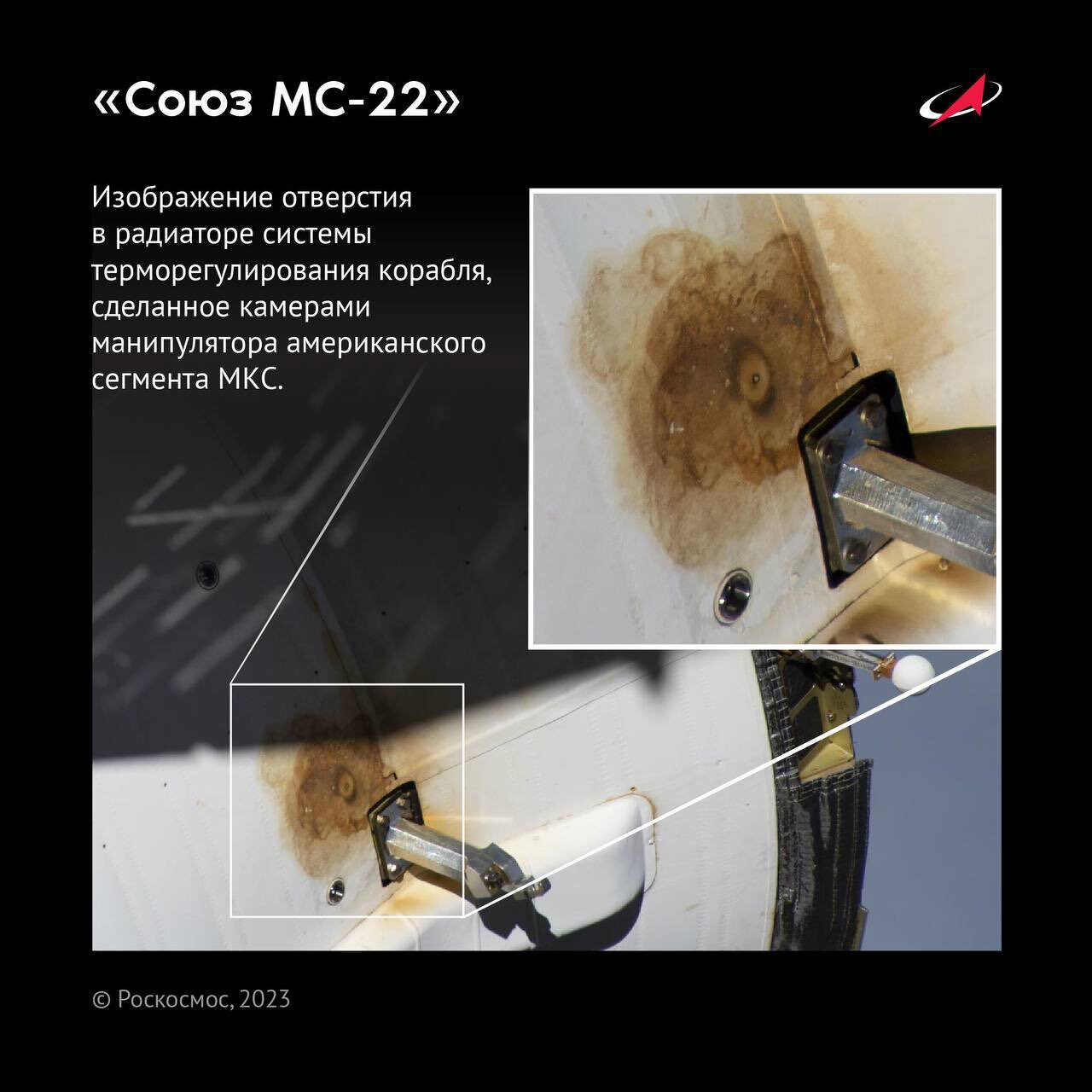
The coolant loop aboard the Soyuz spacecraft had lost all of its fluid, and a 0.8 mm hole was found in the vehicle’s service module. As a result, the ISS program had to make some important decisions quickly while the spacecraft’s damage was being analyzed. The Soyuz MS-23 flight would now launch to the Station in an automated mode, without crew, as the MS-22 crew’s stay would be extended from this spring to September.…
Before Soyuz MS-23 docked at the Station, Progress MS-21 also suffered a coolant leak of its own from its service module.The leaks on both spacecraft had occurred after approximately three months in orbit, and both the uncrewed Progress and crewed Soyuz vehicles use the same service module architecture…..
After the MS-22 coolant leak in December, it was thought that it was caused by a micrometeoroid impact. However, the Progress MS-21 leak caused speculation regarding a systemic fault in current Soyuz-based vehicles…..
Damaged Soyuz MS-22 craft returns home uncrewed
The Soyuz MS-22 spacecraft Konstantin Tsiolkovsky, which launched Expedition 68 crewmembers Sergey Prokopyev, Dmitry Petelin, and NASA’s Frank Rubio on Sept. 21, 2022, returned to Earth in automated mode after suffering a leak in a coolant loop last December.…
The coolant loop aboard the Soyuz spacecraft had lost all of its fluid, and a 0.8 mm hole was found in the vehicle’s service module. As a result, the ISS program had to make some important decisions quickly while the spacecraft’s damage was being analyzed. The Soyuz MS-23 flight would now launch to the Station in an automated mode, without crew, as the MS-22 crew’s stay would be extended from this spring to September.…
Before Soyuz MS-23 docked at the Station, Progress MS-21 also suffered a coolant leak of its own from its service module.The leaks on both spacecraft had occurred after approximately three months in orbit, and both the uncrewed Progress and crewed Soyuz vehicles use the same service module architecture…..
After the MS-22 coolant leak in December, it was thought that it was caused by a micrometeoroid impact. However, the Progress MS-21 leak caused speculation regarding a systemic fault in current Soyuz-based vehicles…..
Ecce Homo! Loquitur...
Joined: Jul 2000
Aviation Qualifications: Spotter
Posts: 24,540
Likes: 7,271
From: Peripatetic
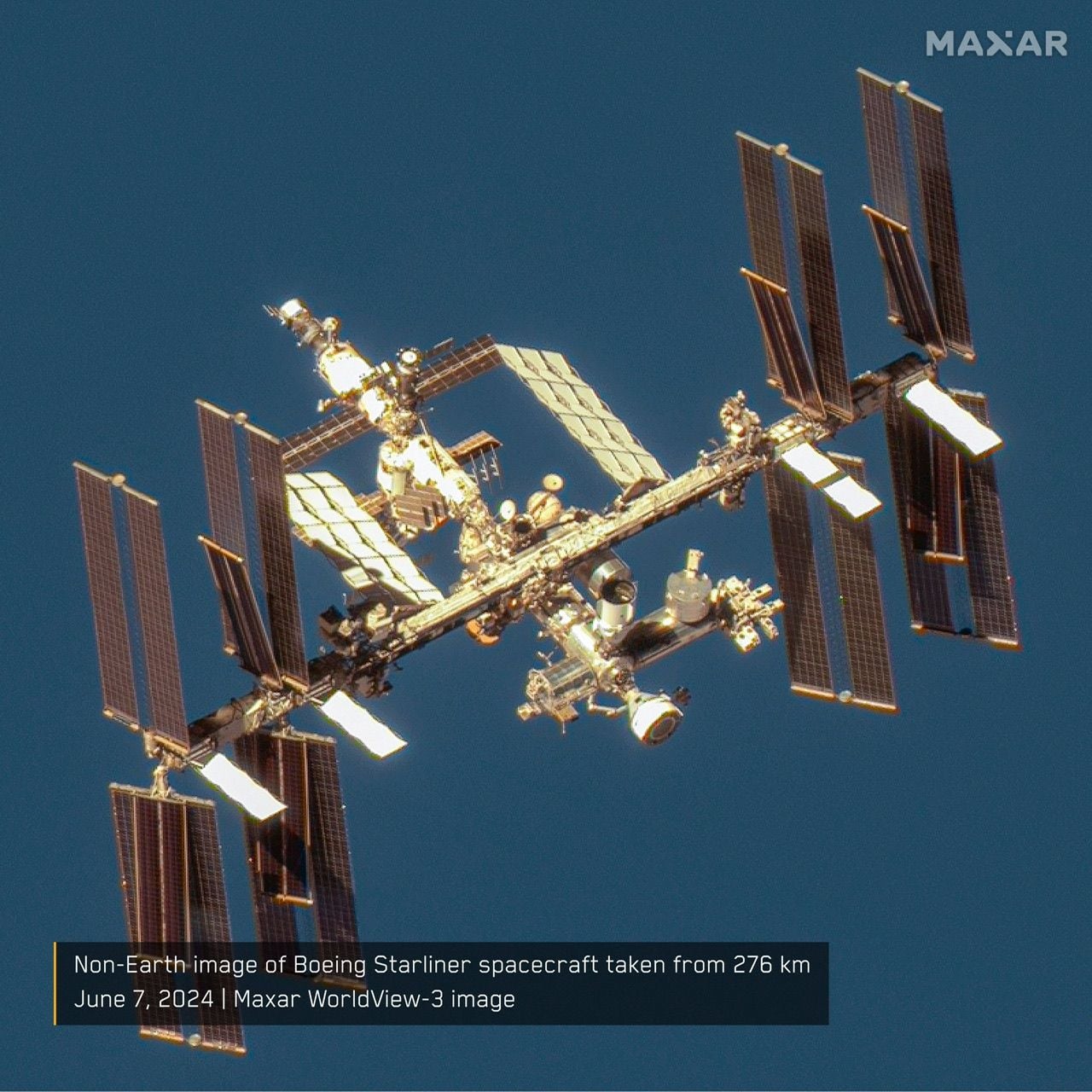
Incredible picture of the ISS by Maxar. Shows 6 different spacecraft docked for the first time ever: SpaceX Dragon, Boeing Starliner, Cygnus, Soyuz, 2x Progress.
They did it by taking one of their Legion satellites —which normally do Earth observation— and pointing it up towards LEO.
They did it by taking one of their Legion satellites —which normally do Earth observation— and pointing it up towards LEO.
Thread Starter
Gnome de PPRuNe
Joined: Jan 2002
Aviation Qualifications: Spotter
Posts: 15,188
Likes: 1,201
From: Too close to Croydon for comfort
Absolutely wonderful pic but I have to admit I have absolutely no idea which bits are docked and which bits are yer actual space station! 
It reminds me of the modern interpretation of Nick Mason's original cover illustration for Relics when Pink Floyd released it on CD...
It reminds me of the modern interpretation of Nick Mason's original cover illustration for Relics when Pink Floyd released it on CD...


Joined: Jan 2019
Aviation Qualifications: LAME
Posts: 804
Likes: 644
From: Cumbria

Joined: Mar 2002
Aviation Qualifications: CPL
Posts: 3,385
Likes: 317
From: near an aeroplane
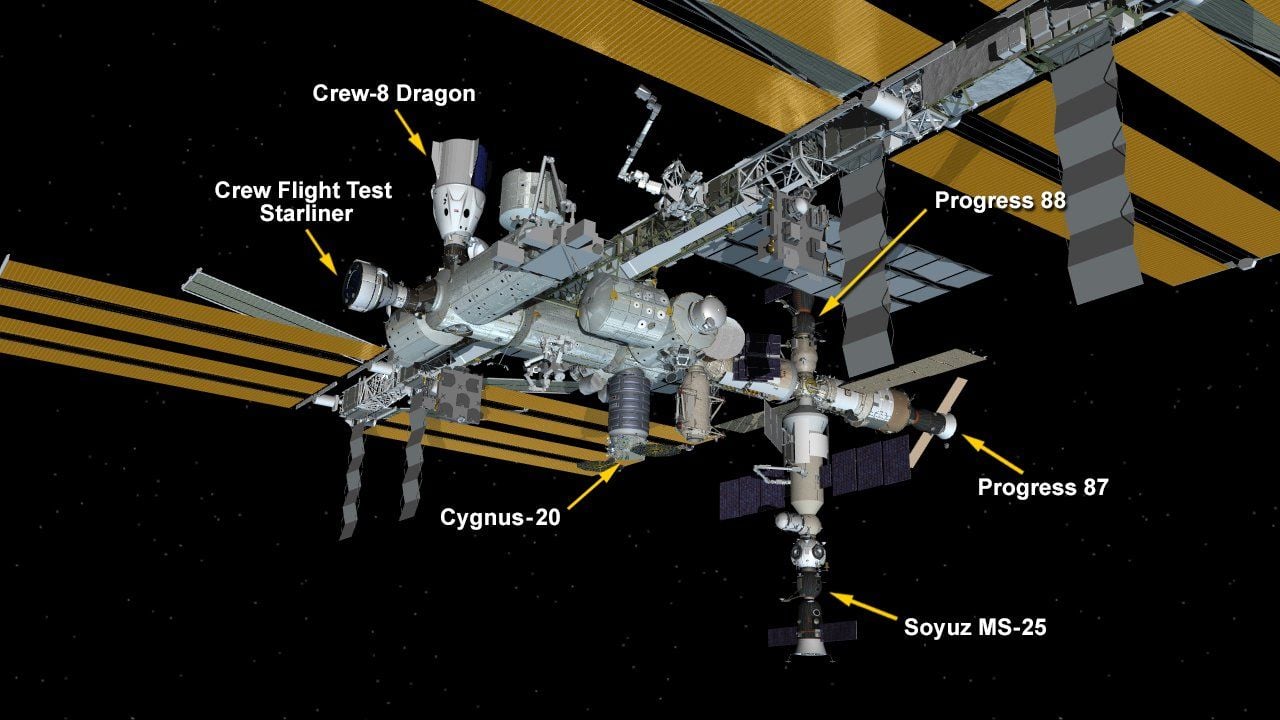
Does this help?
From:
The Maxar photo shows the Starliner at the bottom right with the Crew-8 Dragon just above it pointing towards the camera. The two Progress ships at the top left are also visible, the rest is hidden on the other side of the station.
From:
The Maxar photo shows the Starliner at the bottom right with the Crew-8 Dragon just above it pointing towards the camera. The two Progress ships at the top left are also visible, the rest is hidden on the other side of the station.
Ecce Homo! Loquitur...
Joined: Jul 2000
Aviation Qualifications: Spotter
Posts: 24,540
Likes: 7,271
From: Peripatetic
Mind you, the Starship has the same internal volume, so they can replace it at the same time…..
https://www.nasa.gov/news-release/na...orbit-vehicle/
NASA Selects International Space Station US Deorbit Vehicle
…..NASA announced SpaceX has been selected to develop and deliver the U.S. Deorbit Vehicle that will provide the capability to deorbit the space station and ensure avoidance of risk to populated areas.
“Selecting a U.S. Deorbit Vehicle for the International Space Station will help NASA and its international partners ensure a safe and responsible transition in low Earth orbit at the end of station operations. This decision also supports NASA’s plans for future commercial destinations and allows for the continued use of space near Earth,” said Ken Bowersox, associate administrator for Space Operations Mission Directorate at NASA Headquarters in Washington.
“The orbital laboratory remains a blueprint for science, exploration, and partnerships in space for the benefit of all.”
While the company will develop the deorbit spacecraft, NASA will take ownership after development and operate it throughout its mission. Along with the space station, it is expected to destructively breakup as part of the re-entry process……
https://www.nasa.gov/news-release/na...orbit-vehicle/
NASA Selects International Space Station US Deorbit Vehicle
…..NASA announced SpaceX has been selected to develop and deliver the U.S. Deorbit Vehicle that will provide the capability to deorbit the space station and ensure avoidance of risk to populated areas.
“Selecting a U.S. Deorbit Vehicle for the International Space Station will help NASA and its international partners ensure a safe and responsible transition in low Earth orbit at the end of station operations. This decision also supports NASA’s plans for future commercial destinations and allows for the continued use of space near Earth,” said Ken Bowersox, associate administrator for Space Operations Mission Directorate at NASA Headquarters in Washington.
“The orbital laboratory remains a blueprint for science, exploration, and partnerships in space for the benefit of all.”
While the company will develop the deorbit spacecraft, NASA will take ownership after development and operate it throughout its mission. Along with the space station, it is expected to destructively breakup as part of the re-entry process……
Ecce Homo! Loquitur...
Joined: Jul 2000
Aviation Qualifications: Spotter
Posts: 24,540
Likes: 7,271
From: Peripatetic
https://arstechnica.com/space/2024/0...emic-problems/
As leaks on the space station worsen, there’s no clear plan to deal with them
"We heard that basically the program office had a runaway fire on their hands."
NASA and the Russian space agency, Roscosmos, still have not solved a long-running and worsening problem with leaks on the International Space Station.
The microscopic structural cracks are located inside the small PrK module on the Russian segment of the space station, which lies between a Progress spacecraft airlock and the Zvezda module.
After the leak rate doubled early this year during a two-week period, the Russians experimented with keeping the hatch leading to the PrK module closed intermittently and performed other investigations. But none of these measures taken during the spring worked.
"Following leak troubleshooting activities in April of 2024, Roscosmos has elected to keep the hatch between Zvezda and Progress closed when it is not needed for cargo operations," a NASA spokesperson told Ars. "Roscosmos continues to limit operations in the area and, when required for use, implements measures to minimize the risk to the International Space Station."
What are the real risks?
NASA officials have downplayed the severity of the leak risks publicly and in meetings with external stakeholders of the International Space Station. And they presently do not pose an existential risk to the space station. In a worst-case scenario of a structural failure, Russia could permanently close the hatch leading to the PrK module and rely on a separate docking port for Progress supply missions.
However, there appears to be rising concern in the ISS program at NASA's Johnson Space Center in Houston. The space agency often uses a 5x5 "risk matrix" to classify the likelihood and consequence of risks to spaceflight activities, and the Russian leaks are now classified as a "5" both in terms of high likelihood and high consequence. Their potential for "catastrophic failure" is discussed in meetings.
In responding to questions from Ars by email, NASA public relations officials declined to make program leaders available for an interview. The ISS program is currently managed by Dana Weigel, a former flight director. She recently replaced Joel Montalbano, who became deputy associate administrator for the agency’s Space Operations Mission Directorate at NASA Headquarters in Washington.
One source familiar with NASA's efforts to address the leaks confirmed to Ars that the internal concerns about the issue are serious. "We heard that basically the program office had a runaway fire on their hands and were working to solve it," this person said. "Joel and Dana are keeping a lid on this."
US officials are likely remaining quiet about their concerns because they don't want to embarrass their Russian partners. The working relationship has improved since the sacking of the pugnacious leader of Russia's space activities, Dmitry Rogozin, two years ago. The current leadership of Roscosmos has maintained a cordial relationship with NASA despite the high geopolitical tensions between Russia and the United States over the war in Ukraine.
The leaks are a sensitive subject. Because of Russian war efforts, the resources available to the country's civil space program will remain flat or even decrease in the coming years. A dedicated core of Russian officials who value the International Space Station partnership are striving to "make do" with the resources they have to maintain its Soyuz and Progress spacecraft, which carry crew and cargo to the space station respectively, and its infrastructure on the station. But they do not have the ability to make major new investments, so they're left with patching things together as best they can.
Aging infrastructure
At the same time, the space station is aging. The Zvezda module was launched nearly a quarter of a century ago, in July 2000, on a Russian Proton rocket. The cracking issue first appeared in 2019 and has continued to worsen since then. Its cause is unknown.
"They have repaired multiple leak locations, but additional leak locations remain," the NASA spokesperson said. "Roscosmos has yet to identify the cracks’ root cause, making it challenging to analyze or predict future crack formation and growth."
NASA and Russia have managed to maintain the space station partnership since Russia's invasion of Ukraine in February 2022. The large US segment is dependent on the Russian segment for propulsion to maintain the station's altitude and maneuver to avoid debris. Since the invasion, the United States could have taken overt steps to mitigate against this, such as funding the development of its own propulsion module or increasing the budget for building new commercial space stations to maintain a presence in low-Earth orbit.
Instead, senior NASA officials chose to stay the course and work with Russia for as long as possible to maintain the fragile partnership and fly the aging but venerable International Space Station. It remains to be seen whether cracks—structural, diplomatic, or otherwise—will rupture this effort prior to the station's anticipated retirement date of 2030.
As leaks on the space station worsen, there’s no clear plan to deal with them
"We heard that basically the program office had a runaway fire on their hands."
NASA and the Russian space agency, Roscosmos, still have not solved a long-running and worsening problem with leaks on the International Space Station.
The microscopic structural cracks are located inside the small PrK module on the Russian segment of the space station, which lies between a Progress spacecraft airlock and the Zvezda module.
After the leak rate doubled early this year during a two-week period, the Russians experimented with keeping the hatch leading to the PrK module closed intermittently and performed other investigations. But none of these measures taken during the spring worked.
"Following leak troubleshooting activities in April of 2024, Roscosmos has elected to keep the hatch between Zvezda and Progress closed when it is not needed for cargo operations," a NASA spokesperson told Ars. "Roscosmos continues to limit operations in the area and, when required for use, implements measures to minimize the risk to the International Space Station."
What are the real risks?
NASA officials have downplayed the severity of the leak risks publicly and in meetings with external stakeholders of the International Space Station. And they presently do not pose an existential risk to the space station. In a worst-case scenario of a structural failure, Russia could permanently close the hatch leading to the PrK module and rely on a separate docking port for Progress supply missions.
However, there appears to be rising concern in the ISS program at NASA's Johnson Space Center in Houston. The space agency often uses a 5x5 "risk matrix" to classify the likelihood and consequence of risks to spaceflight activities, and the Russian leaks are now classified as a "5" both in terms of high likelihood and high consequence. Their potential for "catastrophic failure" is discussed in meetings.
In responding to questions from Ars by email, NASA public relations officials declined to make program leaders available for an interview. The ISS program is currently managed by Dana Weigel, a former flight director. She recently replaced Joel Montalbano, who became deputy associate administrator for the agency’s Space Operations Mission Directorate at NASA Headquarters in Washington.
One source familiar with NASA's efforts to address the leaks confirmed to Ars that the internal concerns about the issue are serious. "We heard that basically the program office had a runaway fire on their hands and were working to solve it," this person said. "Joel and Dana are keeping a lid on this."
US officials are likely remaining quiet about their concerns because they don't want to embarrass their Russian partners. The working relationship has improved since the sacking of the pugnacious leader of Russia's space activities, Dmitry Rogozin, two years ago. The current leadership of Roscosmos has maintained a cordial relationship with NASA despite the high geopolitical tensions between Russia and the United States over the war in Ukraine.
The leaks are a sensitive subject. Because of Russian war efforts, the resources available to the country's civil space program will remain flat or even decrease in the coming years. A dedicated core of Russian officials who value the International Space Station partnership are striving to "make do" with the resources they have to maintain its Soyuz and Progress spacecraft, which carry crew and cargo to the space station respectively, and its infrastructure on the station. But they do not have the ability to make major new investments, so they're left with patching things together as best they can.
Aging infrastructure
At the same time, the space station is aging. The Zvezda module was launched nearly a quarter of a century ago, in July 2000, on a Russian Proton rocket. The cracking issue first appeared in 2019 and has continued to worsen since then. Its cause is unknown.
"They have repaired multiple leak locations, but additional leak locations remain," the NASA spokesperson said. "Roscosmos has yet to identify the cracks’ root cause, making it challenging to analyze or predict future crack formation and growth."
NASA and Russia have managed to maintain the space station partnership since Russia's invasion of Ukraine in February 2022. The large US segment is dependent on the Russian segment for propulsion to maintain the station's altitude and maneuver to avoid debris. Since the invasion, the United States could have taken overt steps to mitigate against this, such as funding the development of its own propulsion module or increasing the budget for building new commercial space stations to maintain a presence in low-Earth orbit.
Instead, senior NASA officials chose to stay the course and work with Russia for as long as possible to maintain the fragile partnership and fly the aging but venerable International Space Station. It remains to be seen whether cracks—structural, diplomatic, or otherwise—will rupture this effort prior to the station's anticipated retirement date of 2030.
Ecce Homo! Loquitur...
Joined: Jul 2000
Aviation Qualifications: Spotter
Posts: 24,540
Likes: 7,271
From: Peripatetic
https://arstechnica.com/space/2025/0...o-launch-site/
After a spacecraft was damaged en route to launch, NASA says it won’t launch
Three weeks ago, NASA revealed that a shipping container protecting a Cygnus spacecraft sustained "damage" while traveling to the launch site in Florida.
Built by Northrop Grumman, Cygnus is one of two Western spacecraft currently capable of delivering food, water, experiments, and other supplies to the International Space Station. This particular Cygnus mission, NG-22, had been scheduled for June. As part of its statement in early March, the space agency said it was evaluating the NG-22 Cygnus cargo supply mission along with Northrop.
On Wednesday, after a query from Ars Technica, the space agency acknowledged that the Cygnus spacecraft designated for NG-22 is too damaged to fly, at least in the near term.
Loading up Dragon
"Following initial evaluation, there also is damage to the cargo module," the agency said in a statement. "The International Space Station Program will continue working with Northrop Grumman to assess whether the Cygnus cargo module is able to safely fly to the space station on a future flight." That future flight, NG-23, will launch no earlier than this fall.
As a result, NASA is modifying the cargo on its next cargo flight to the space station, the 32nd SpaceX Cargo Dragon mission, due to launch in April. The agency says it will "add more consumable supplies and food to help ensure sufficient reserves of supplies aboard the station" to the Dragon vehicle.
As it mulls stopgap measures, one option available to NASA may be to try to slot in a cargo mission on Boeing's Starliner spacecraft. After the propulsion issues experienced on Starliner's first crew flight to the space station last June, NASA is still evaluating whether the vehicle can be certified for an operational crew mission, or whether it would be better to perform an uncrewed test flight.
In such a scenario, Starliner could ferry cargo to the space station. However, Starliner would be competing with SpaceX crew missions for docking ports, and there would be limited time frames when the vehicle could fly.
Limited options amid development delays
NASA also has Sierra Nevada's Dream Chaser spacecraft on its internal schedule for a May launch this year. This is a new vehicle intended to carry cargo to the space station under the agency's Commercial Cargo program. However, that spacecraft is not yet ready for its debut flight, nor is there a Vulcan rocket available within the next several months to launch it. A Dream Chaser mission later this year remains possible, if unlikely.
All of the roads for cargo supply, therefore, lead back to Dragon. As a result of Dream Chaser's delays, Starliner's problems, and the dropped Cygnus, NASA is now almost entirely reliant on SpaceX's Falcon 9 rocket and Dragon spacecraft to get its astronauts to the space station and to feed them.
Crew Dragon remains the only vehicle certified by NASA for human flights to the station. On the cargo side, Northrop Grumman is developing a new rocket with Firefly, but in the meantime, has been using the Falcon 9 to launch Cygnus. With Cygnus now sidelined for at least half a year, every non-Russian vehicle flying to the space station will be built by SpaceX.
After a spacecraft was damaged en route to launch, NASA says it won’t launch
Three weeks ago, NASA revealed that a shipping container protecting a Cygnus spacecraft sustained "damage" while traveling to the launch site in Florida.
Built by Northrop Grumman, Cygnus is one of two Western spacecraft currently capable of delivering food, water, experiments, and other supplies to the International Space Station. This particular Cygnus mission, NG-22, had been scheduled for June. As part of its statement in early March, the space agency said it was evaluating the NG-22 Cygnus cargo supply mission along with Northrop.
On Wednesday, after a query from Ars Technica, the space agency acknowledged that the Cygnus spacecraft designated for NG-22 is too damaged to fly, at least in the near term.
Loading up Dragon
"Following initial evaluation, there also is damage to the cargo module," the agency said in a statement. "The International Space Station Program will continue working with Northrop Grumman to assess whether the Cygnus cargo module is able to safely fly to the space station on a future flight." That future flight, NG-23, will launch no earlier than this fall.
As a result, NASA is modifying the cargo on its next cargo flight to the space station, the 32nd SpaceX Cargo Dragon mission, due to launch in April. The agency says it will "add more consumable supplies and food to help ensure sufficient reserves of supplies aboard the station" to the Dragon vehicle.
As it mulls stopgap measures, one option available to NASA may be to try to slot in a cargo mission on Boeing's Starliner spacecraft. After the propulsion issues experienced on Starliner's first crew flight to the space station last June, NASA is still evaluating whether the vehicle can be certified for an operational crew mission, or whether it would be better to perform an uncrewed test flight.
In such a scenario, Starliner could ferry cargo to the space station. However, Starliner would be competing with SpaceX crew missions for docking ports, and there would be limited time frames when the vehicle could fly.
Limited options amid development delays
NASA also has Sierra Nevada's Dream Chaser spacecraft on its internal schedule for a May launch this year. This is a new vehicle intended to carry cargo to the space station under the agency's Commercial Cargo program. However, that spacecraft is not yet ready for its debut flight, nor is there a Vulcan rocket available within the next several months to launch it. A Dream Chaser mission later this year remains possible, if unlikely.
All of the roads for cargo supply, therefore, lead back to Dragon. As a result of Dream Chaser's delays, Starliner's problems, and the dropped Cygnus, NASA is now almost entirely reliant on SpaceX's Falcon 9 rocket and Dragon spacecraft to get its astronauts to the space station and to feed them.
Crew Dragon remains the only vehicle certified by NASA for human flights to the station. On the cargo side, Northrop Grumman is developing a new rocket with Firefly, but in the meantime, has been using the Falcon 9 to launch Cygnus. With Cygnus now sidelined for at least half a year, every non-Russian vehicle flying to the space station will be built by SpaceX.
Ecce Homo! Loquitur...
Joined: Jul 2000
Aviation Qualifications: Spotter
Posts: 24,540
Likes: 7,271
From: Peripatetic
https://arstechnica.com/space/2025/0...much-about-it/
There’s another leak on the ISS, but NASA is not saying much about it
There's another leak on the International Space Station, and NASA has already delayed one crew launch to the orbiting laboratory as a result.
Beyond that, the space agency is not offering much information about the unfolding situation in orbit. However, multiple sources have confirmed to Ars that the leak is a serious concern for the space agency as it deals with hardware that is approaching three decades in orbit.
To understand the current situation, it is important to review past leaks on the station, which has an aluminum structure. The station has had a slow but increasing leak since 2019. The air leaks are located in the transfer tunnel of the space station's Russian Zvezda service module, one of the oldest elements of the complex, the first elements of which were launched in 1998. The transfer tunnel, known by the Russian acronym PrK, connects the Zvezda module with a docking port where Soyuz crew and Progress resupply spacecraft attach to the station.
From time to time, Russian cosmonauts have experimented with repairs to the small cracks, but they have generally only slowed the progression of the leak, which amounts to a couple of pounds of air per day. The best solution has been to close the hatch leading to the PrK module except when spacecraft dock with the attached port.
So what’s going on?
Roscosmos recently confirmed that it completed its most recent repairs on the PrK module earlier this month, saying it had been "completely sealed." NASA has also said that repairs were recently wrapped up. After this, both Roscosmos and NASA said the leak rate inside the PrK module had halted.
This seems like good news. However, the overall air pressure in the space station at large continued to drop, according to two sources. So if the PrK module was not leaking, as it had been doing for half a decade, why was the space station still losing air pressure?
No one is certain. The best guess is that the seals on the hatch leading to the PrK module are, in some way, leaking. In this scenario, pressure from the station is feeding the leak inside the PrK module through these seals, leading to a stable pressure inside—making it appear as though the PrK module leaks are fully repaired.
At this point, NASA is monitoring the ongoing leak and preparing for any possibility. A senior industry source told Ars that the NASA leadership of the space station program is "worried" about the leak and its implications.
This is one reason the space agency delayed the launch of a commercial mission carrying four astronauts to the space station, Axiom-4, on Thursday.
"The postponement of Axiom Mission 4 provides additional time for NASA and Roscosmos to evaluate the situation and determine whether any additional troubleshooting is necessary," NASA said in a statement. "A new launch date for the fourth private astronaut mission will be provided once available."
One source indicated that the new tentative launch date is now June 18. However, this will depend on whatever resolution there is to the leak issue.
What’s the worst that could happen?
The worst-case scenario for the space station is that the ongoing leaks are a harbinger of a phenomenon known as "high cycle fatigue," which affects metal, including aluminum. Consider that if you bend a metal clothes hangar once, it bends. But if you bend it back and forth multiple times, it will snap. This is because, as the metal fatigues, it hardens and eventually snaps. This happens suddenly and without warning, as was the case with an Aloha Airlines flight in 1988.
The concern is that some of these metal structures on board the station could fail quickly and catastrophically. Accordingly, in its previous assessments, NASA has classified the structural cracking issue on the space station as the highest level of concern on its 5v5 risk matrix to gauge the likelihood and severity of risks to the space station.
In the meantime, the space agency has not been forthcoming with any additional information. Despite many questions from Ars Technica and other publications, NASA has not scheduled a press conference or said anything else publicly about the leaks beyond stating, "The crew aboard the International Space Station is safely conducting normal operations."
There’s another leak on the ISS, but NASA is not saying much about it
There's another leak on the International Space Station, and NASA has already delayed one crew launch to the orbiting laboratory as a result.
Beyond that, the space agency is not offering much information about the unfolding situation in orbit. However, multiple sources have confirmed to Ars that the leak is a serious concern for the space agency as it deals with hardware that is approaching three decades in orbit.
To understand the current situation, it is important to review past leaks on the station, which has an aluminum structure. The station has had a slow but increasing leak since 2019. The air leaks are located in the transfer tunnel of the space station's Russian Zvezda service module, one of the oldest elements of the complex, the first elements of which were launched in 1998. The transfer tunnel, known by the Russian acronym PrK, connects the Zvezda module with a docking port where Soyuz crew and Progress resupply spacecraft attach to the station.
From time to time, Russian cosmonauts have experimented with repairs to the small cracks, but they have generally only slowed the progression of the leak, which amounts to a couple of pounds of air per day. The best solution has been to close the hatch leading to the PrK module except when spacecraft dock with the attached port.
So what’s going on?
Roscosmos recently confirmed that it completed its most recent repairs on the PrK module earlier this month, saying it had been "completely sealed." NASA has also said that repairs were recently wrapped up. After this, both Roscosmos and NASA said the leak rate inside the PrK module had halted.
This seems like good news. However, the overall air pressure in the space station at large continued to drop, according to two sources. So if the PrK module was not leaking, as it had been doing for half a decade, why was the space station still losing air pressure?
No one is certain. The best guess is that the seals on the hatch leading to the PrK module are, in some way, leaking. In this scenario, pressure from the station is feeding the leak inside the PrK module through these seals, leading to a stable pressure inside—making it appear as though the PrK module leaks are fully repaired.
At this point, NASA is monitoring the ongoing leak and preparing for any possibility. A senior industry source told Ars that the NASA leadership of the space station program is "worried" about the leak and its implications.
This is one reason the space agency delayed the launch of a commercial mission carrying four astronauts to the space station, Axiom-4, on Thursday.
"The postponement of Axiom Mission 4 provides additional time for NASA and Roscosmos to evaluate the situation and determine whether any additional troubleshooting is necessary," NASA said in a statement. "A new launch date for the fourth private astronaut mission will be provided once available."
One source indicated that the new tentative launch date is now June 18. However, this will depend on whatever resolution there is to the leak issue.
What’s the worst that could happen?
The worst-case scenario for the space station is that the ongoing leaks are a harbinger of a phenomenon known as "high cycle fatigue," which affects metal, including aluminum. Consider that if you bend a metal clothes hangar once, it bends. But if you bend it back and forth multiple times, it will snap. This is because, as the metal fatigues, it hardens and eventually snaps. This happens suddenly and without warning, as was the case with an Aloha Airlines flight in 1988.
The concern is that some of these metal structures on board the station could fail quickly and catastrophically. Accordingly, in its previous assessments, NASA has classified the structural cracking issue on the space station as the highest level of concern on its 5v5 risk matrix to gauge the likelihood and severity of risks to the space station.
In the meantime, the space agency has not been forthcoming with any additional information. Despite many questions from Ars Technica and other publications, NASA has not scheduled a press conference or said anything else publicly about the leaks beyond stating, "The crew aboard the International Space Station is safely conducting normal operations."
Ecce Homo! Loquitur...
Joined: Jul 2000
Aviation Qualifications: Spotter
Posts: 24,540
Likes: 7,271
From: Peripatetic
………………
NG-23: The Brand-New Cygnus XL is facing some trouble with its engine.
NASA: "Early Tuesday morning, Cygnus XL’s main engine stopped earlier than planned during two burns designed to raise the orbit of the spacecraft".
Neither Northrop Grumman nor NASA has reported any reason for the premature shutdown, or an updated schedule forward. Flight controllers are currently working on an "alternate burn plan".
The previous Cygnus to actually fly, NG-21, also suffered thruster problems, missing its first burn, and then aborting the rescheduled burn after engine ignition due to a slightly low initial pressure state. NG-21 however was able to stick to its original schedule - NG-23 is not. This also follows NG-18 in 2022, when one of the solar arrays failed to deploy correctly.
On the ground, the NG-22 mission was delayed indefinitely following damage sustained during shipping from Italy to the United States.
NASA: "Early Tuesday morning, Cygnus XL’s main engine stopped earlier than planned during two burns designed to raise the orbit of the spacecraft".
Neither Northrop Grumman nor NASA has reported any reason for the premature shutdown, or an updated schedule forward. Flight controllers are currently working on an "alternate burn plan".
The previous Cygnus to actually fly, NG-21, also suffered thruster problems, missing its first burn, and then aborting the rescheduled burn after engine ignition due to a slightly low initial pressure state. NG-21 however was able to stick to its original schedule - NG-23 is not. This also follows NG-18 in 2022, when one of the solar arrays failed to deploy correctly.
On the ground, the NG-22 mission was delayed indefinitely following damage sustained during shipping from Italy to the United States.
At around 18:20 UTC this evening, MCC-Houston held a private conference with the crew aboard Station to discuss Cygnus. Details were little to none on the public loops, just that a "Cygnus conference" would take place on Space to Ground 3.
NSF has reached out to NASA and Northrop for more information.
NSF has reached out to NASA and Northrop for more information.
Ecce Homo! Loquitur...
Joined: Jul 2000
Aviation Qualifications: Spotter
Posts: 24,540
Likes: 7,271
From: Peripatetic
..............
Update: NASA and Northrop Grumman are targeting the safe arrival of the company’s Cygnus XL at approximately 7:18 a.m. EDT Thursday, Sept. 18, to the International Space Station.
The Cygnus XL will now conduct a series of burns to bring the spacecraft to the space station for its robotic capture and installation.
On Sept. 16, Cygnus XL commanded the main engine to shutdown earlier than planned during two, non-sequential rendezvous burns (delta velocity burns 3 and 5), designed to raise the orbit of the spacecraft for rendezvous with the space station. Cygnus XL’s trajectory placed the spacecraft a safe distance behind the space station while engineers assessed the spacecraft and developed its alternate burn plan.
Data shared by the spacecraft confirmed that Cygnus XL operated as intended during two planned maneuvers when an early warning system initiated a shutdown command and ended the main engine burn because of a conservative safeguard in the software settings.
The Cygnus XL will now conduct a series of burns to bring the spacecraft to the space station for its robotic capture and installation.
On Sept. 16, Cygnus XL commanded the main engine to shutdown earlier than planned during two, non-sequential rendezvous burns (delta velocity burns 3 and 5), designed to raise the orbit of the spacecraft for rendezvous with the space station. Cygnus XL’s trajectory placed the spacecraft a safe distance behind the space station while engineers assessed the spacecraft and developed its alternate burn plan.
Data shared by the spacecraft confirmed that Cygnus XL operated as intended during two planned maneuvers when an early warning system initiated a shutdown command and ended the main engine burn because of a conservative safeguard in the software settings.
Ecce Homo! Loquitur...
Joined: Jul 2000
Aviation Qualifications: Spotter
Posts: 24,540
Likes: 7,271
From: Peripatetic
ISS Reboost Abort: At ~17:39 UTC, a reboost using Dragon C211 was attempted. Per the nets, the expected burn time was 19.5 minutes.
Approximately 3.5 minutes in, the reboost was "stopped" due to "being on unexpected tanks".
The vehicle was in a safe state at cutoff.
Note: This burn has been planned since at least Monday - likely before.
Approximately 3.5 minutes in, the reboost was "stopped" due to "being on unexpected tanks".
The vehicle was in a safe state at cutoff.
Note: This burn has been planned since at least Monday - likely before.
Ecce Homo! Loquitur...
Joined: Jul 2000
Aviation Qualifications: Spotter
Posts: 24,540
Likes: 7,271
From: Peripatetic
ISS Reboost: Update from NASA. Nominal burn.
"The SpaceX Dragon cargo spacecraft fired its Draco thrusters, located in the vehicle’s trunk, for 15 minutes on Friday reboosting the International Space Station’s orbit for the third time this month.
"The reboost maneuvers lifted the orbital outpost’s altitude to prepare for Soyuz crew swap operations later this year."
"The SpaceX Dragon cargo spacecraft fired its Draco thrusters, located in the vehicle’s trunk, for 15 minutes on Friday reboosting the International Space Station’s orbit for the third time this month.
"The reboost maneuvers lifted the orbital outpost’s altitude to prepare for Soyuz crew swap operations later this year."
Ecce Homo! Loquitur...
Joined: Jul 2000
Aviation Qualifications: Spotter
Posts: 24,540
Likes: 7,271
From: Peripatetic
NASA Office of Inspector General: Astronauts depend on spacesuits to keep them safe when they perform spacewalks. But the current suits were designed more than 50 years ago!
Our new report reveals how this aging design creates challenges for NASA and its contractor, Collins Aerospace:
To ensure the continued operations of the International Space Station and the safety of the crew, NASA and its spacesuit support contractor must ensure the suits used for spacewalks, designed more than 50 years ago, are well-maintained and reliable.
The contractor, Collins Aerospace, has struggled to ensure sufficient life support components for the suits are delivered when needed and within budget and that meet quality expectations.
While Collins’ performance over the last several years has declined, NASA has limited leverage to incentivize improved performance.
Report: https://oig.nasa.gov/wp-content/uplo...=68dd08760d991
Our new report reveals how this aging design creates challenges for NASA and its contractor, Collins Aerospace:
To ensure the continued operations of the International Space Station and the safety of the crew, NASA and its spacesuit support contractor must ensure the suits used for spacewalks, designed more than 50 years ago, are well-maintained and reliable.
The contractor, Collins Aerospace, has struggled to ensure sufficient life support components for the suits are delivered when needed and within budget and that meet quality expectations.
While Collins’ performance over the last several years has declined, NASA has limited leverage to incentivize improved performance.
Report: https://oig.nasa.gov/wp-content/uplo...=68dd08760d991
Ecce Homo! Loquitur...
Joined: Jul 2000
Aviation Qualifications: Spotter
Posts: 24,540
Likes: 7,271
From: Peripatetic
This is not the simply rebooting the station, as already done by Dragon - it is recharging the ISS integral RCS system built into the Russian modules.
This requires docking at the Russian module, which would mean a major modification to Dragon. Soyuz uses a different docking system at their end of the station (i’s design precedes that of the IDDS and is a probe & drogue one.)
A probe version would have to be supplied by Russia and fitted to Dragon. Also, propellant lines would need to be run from the tanks at Dragon's base to the nose and suitable pumps installed as well as surge valves etc.
Probably not feasible at all, or at least within the remaining RCS supply and/or ISS life.
https://www.russianspaceweb.com/baik..._31.html#cabin
Russia's only pad for crew launches suffers major damage
According to multiple Russian sources, on Nov. 27, 2025, the launch of the Soyuz MS-28 crew vehicle caused the mobile service platformat Site 31 to collapse into the flame duct below the pad. It essentially rendered the only facility for Russian orbital crew launches unusable.
At the time, Roskosmos planned the launch of the Progress MS-33 cargo ship to the ISS on Dec. 21, 2025.
According to preliminary estimates, repairs of the service platform, known as 8U0216, could take up to two years and it was not immediately unclear whether some kind of makeshift arrangement would be possible to support multiple cargo and crew launches to the ISS in the interim.
There was some possibility that duplicate hardware could be borrowed from the mothballed Site 1 in Baikonur or from similar facilities at other launch sites.
There were four Soyuz pads in Plesetsk at one point, also one pad operated in Vostochny and one mothballed pad was in Kourou, French Guiana.
Several hours after the accident, Roskosmos distributed a statement claiming the availability of spare parts necessary for the repairs of the pad.

This requires docking at the Russian module, which would mean a major modification to Dragon. Soyuz uses a different docking system at their end of the station (i’s design precedes that of the IDDS and is a probe & drogue one.)
A probe version would have to be supplied by Russia and fitted to Dragon. Also, propellant lines would need to be run from the tanks at Dragon's base to the nose and suitable pumps installed as well as surge valves etc.
Probably not feasible at all, or at least within the remaining RCS supply and/or ISS life.
While astronauts can still get to ISS with SpaceX - the ISS attitude control system relies on progress spacecraft which use this pad.
Russia's only pad for crew launches suffers major damage
According to multiple Russian sources, on Nov. 27, 2025, the launch of the Soyuz MS-28 crew vehicle caused the mobile service platformat Site 31 to collapse into the flame duct below the pad. It essentially rendered the only facility for Russian orbital crew launches unusable.
At the time, Roskosmos planned the launch of the Progress MS-33 cargo ship to the ISS on Dec. 21, 2025.
According to preliminary estimates, repairs of the service platform, known as 8U0216, could take up to two years and it was not immediately unclear whether some kind of makeshift arrangement would be possible to support multiple cargo and crew launches to the ISS in the interim.
There was some possibility that duplicate hardware could be borrowed from the mothballed Site 1 in Baikonur or from similar facilities at other launch sites.
There were four Soyuz pads in Plesetsk at one point, also one pad operated in Vostochny and one mothballed pad was in Kourou, French Guiana.
Several hours after the accident, Roskosmos distributed a statement claiming the availability of spare parts necessary for the repairs of the pad.
Last edited by ORAC; 28th November 2025 at 05:28.
Ecce Homo! Loquitur...
Joined: Jul 2000
Aviation Qualifications: Spotter
Posts: 24,540
Likes: 7,271
From: Peripatetic
Close view of today's accident on Pad 31……
https://threadreaderapp.com/thread/1...530324222.html

https://threadreaderapp.com/thread/1...530324222.html