


Actually, flying is very safe.

Thread Starter
Joined: Jul 2013
Posts: 78
Likes: 0
From: UK
Actually, flying is very safe.
An interesting snippet from "The Spectator" magazine.
This, of course, will be of no comfort to those who have lost loved ones but may help us remember flying is still extraordinarily safe.
The loss of a second Malaysian Airways airliner means that the number of worldwide casualties in civilian air disasters — 827 so far this year — has already exceeded that of last year, when 459 died. But it does little to disturb the steady downwards trend. These are the deadliest years for air passengers since 1945:
1972 3,344 deaths
1985 2,962
1973 2,815
1999 2,798
1974 2,621
And these are the least fatal:
2013 459 deaths
2004 767
2012 800
2011 828
2008 952
1972 3,344 deaths
1985 2,962
1973 2,815
1999 2,798
1974 2,621
And these are the least fatal:
2013 459 deaths
2004 767
2012 800
2011 828
2008 952

Joined: Jan 2008
Posts: 1,191
Likes: 0
From: lancs.UK
On their own, these statistics are pretty meaningless. Comparing the number of deaths with everyday situations to which Joe Public can relate,is a far more relevant benchmark.
It is self-evident that Flying is safe- were it not so, there would not be so many willing to sit at the pointy-end, guiding the Aircraft to the scene.....
Flying would be like oil-well fire -extinguishing , the province of a very few.
The fact that Commercial Aviation is a mainstream worldwide form of transport, would tend to support this view.
So, what's new?
It is self-evident that Flying is safe- were it not so, there would not be so many willing to sit at the pointy-end, guiding the Aircraft to the scene.....
Flying would be like oil-well fire -extinguishing , the province of a very few.
The fact that Commercial Aviation is a mainstream worldwide form of transport, would tend to support this view.
So, what's new?

Joined: Apr 2014
Posts: 220
Likes: 45
From: EGMH
You need a graph. Obvs 2014 is (hopefully) a bit of an anomaly in the general trend, and it isn't shown here, but most people would be able to see the bigger picture from this.
I imagine the topic will be moved though
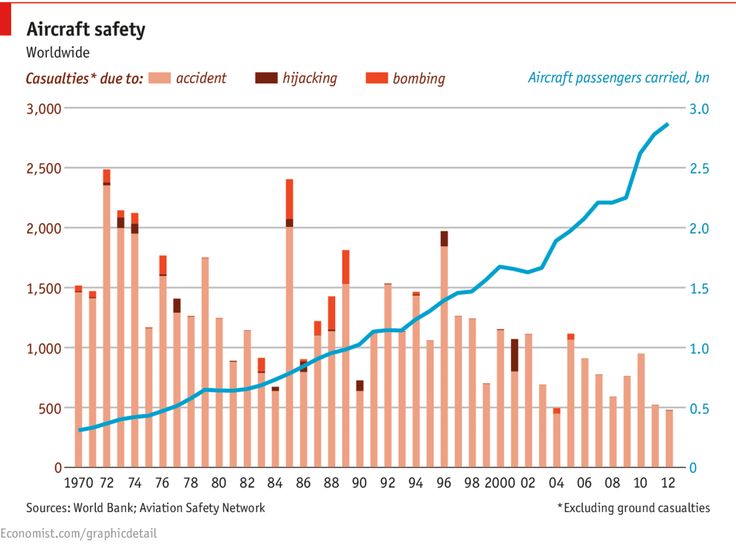
I imagine the topic will be moved though
Joined: Dec 2004
Posts: 618
Likes: 0
From: UK
But?
What if we do the calculation based on fatal accidents per unit of aircraft manufactured... Isn't it then alarmingly high?
For example if only 1,000 aircraft (of a given type) are produced, maybe 1% will be involved in fatal accidents over their life time.
Can we do the same calculation for ship, train, car, bus etc? Tens of thousands of cars, busses and trains are produced for example.
What if we do the calculation based on fatal accidents per unit of aircraft manufactured... Isn't it then alarmingly high?
For example if only 1,000 aircraft (of a given type) are produced, maybe 1% will be involved in fatal accidents over their life time.
Can we do the same calculation for ship, train, car, bus etc? Tens of thousands of cars, busses and trains are produced for example.
Joined: Mar 1999
Posts: 56
Likes: 0
From: on the road less travelled
Here is a risk statistic from US DOT.
http://www.phmsa.dot.gov/portal/site...gnextfmt=print
Every day ordinary folks should be able to grasp this statistic when it comes to risk of death in an air carrier accident. You would have to fly every day for 55,000 years (yes that number is correct) before you would be involved in a fatal aircraft accident.
http://www.phmsa.dot.gov/portal/site...gnextfmt=print
Every day ordinary folks should be able to grasp this statistic when it comes to risk of death in an air carrier accident. You would have to fly every day for 55,000 years (yes that number is correct) before you would be involved in a fatal aircraft accident.
Thread Starter
Joined: Jul 2013
Posts: 78
Likes: 0
From: UK
What if we do the calculation based on fatal accidents per unit of aircraft manufactured... Isn't it then alarmingly high?
For example if only 1,000 aircraft (of a given type) are produced, maybe 1% will be involved in fatal accidents over their life time.
For example if only 1,000 aircraft (of a given type) are produced, maybe 1% will be involved in fatal accidents over their life time.

Joined: Jan 2008
Posts: 17,687
Likes: 2,030
From: Reading, UK
You would have to fly every day for 55,000 years (yes that number is correct) before you would be involved in a fatal aircraft accident.

Hint: the word you are looking for is "average"

Joined: Feb 2012
Posts: 67
Likes: 0
From: England
I've seen similar stats before and know that when compared to, say, driving a car, you are more likely to die in a car crash than a plane crash. But whilst the statistics are logical, for many flying (& dying) are more emotional .
I also wonder if the perception that "flying is dangerous" may come about due to the sheer number of people who can die in a single plane crash (e.g. in the hundreds) whereas it's (usually) much less in a car crash.
(unfortunately none of the above apply to me - I'm terrified due to "control issues" )
)
I also wonder if the perception that "flying is dangerous" may come about due to the sheer number of people who can die in a single plane crash (e.g. in the hundreds) whereas it's (usually) much less in a car crash.
(unfortunately none of the above apply to me - I'm terrified due to "control issues"
)
Joined: Jan 2008
Posts: 1,191
Likes: 0
From: lancs.UK
also wonder if the perception that "flying is dangerous" may come about due to the sheer number of people who can die in a single plane crash (e.g. in the hundreds)
Ferry (Herald of free enterprise).......just a few examples where one does not have "control"....At least,the operators do their best to make sure their operators (drivers) are reasonably well trained, to beincharge of vehicles/vessels costing hundreds of thousands or even billions and carrying from ~50 to ~500 Pax.
Whereas any semi-literate cretin can buy a car and take his /her chances.
My late partner drove for around 40 years, Provisional license, no "l" plates, never got a "tug" and , AFAIK, never bothered with lessons or a driving test!.....There are plenty similar on UK roads that can't even speak the language!
For goodness sake, get your priorities right and worry about real risks!

Joined: Feb 2005
Posts: 4,581
Likes: 0
From: flyover country USA
Nakata77:
"per unit of aircraft manufactured" isn't too meaningful when the utilization of the aircraft is considered. I'm not up to date on annual numbers, but I wouldn't be surprised if a T7 might spend 50% of its time airborne - I.E. 4000 hours per year. How many cars are driven 4000 hrs in a year? Right away an apples-to-apples comparison doesn't work!
What if we do the calculation based on fatal accidents per unit of aircraft manufactured... Isn't it then alarmingly high?
For example if only 1,000 aircraft (of a given type) are produced, maybe 1% will be involved in fatal accidents over their life time.
For example if only 1,000 aircraft (of a given type) are produced, maybe 1% will be involved in fatal accidents over their life time.
Joined: Mar 2014
Posts: 11
Likes: 0
From: Tennessee
I also wonder if the perception that "flying is dangerous" may come about due to the sheer number of people who can die in a single plane crash (e.g. in the hundreds) whereas it's (usually) much less in a car crash
They also suggested not watching repeated showings of any air crashes. Just change the channel.

