3-bladed R44 or R66


Joined: Aug 2000
Posts: 2,111
Likes: 118
That is interesting insight, In aerodynamics, induced drag is the overwhelming factor that drive efficiency, Induced drag is generated by the blade tip vortices. As the result a long aspect ratio blade will always be more efficient (akin a high performance glider). Robinson blades are one of the highest aspect ratio blades around, and I contend that it is one the design choice that has driven the success of the R44 especially. Think about it, 4 passenger with 225hp (Astro and Raven I) could only be the result of a higher efficiency rotor. roughly computed:
R44 1089Kg 225hp 4.8Kg/hp
EC120 1715Kg 504hp 3.4Kg/hp
H500 1610Kg 425hp 3.8kg/hp
So even with the benefit of the lightweight turbine engine and a heavier airframe nobody come close to the weight carrying capability of the R44 per hp.
You bring a good subject, the drivers have changed, look at Archer aviation and Joby, their creative design make you think about blades differently, aiming for different drivers (noise)
R44 1089Kg 225hp 4.8Kg/hp
EC120 1715Kg 504hp 3.4Kg/hp
H500 1610Kg 425hp 3.8kg/hp
So even with the benefit of the lightweight turbine engine and a heavier airframe nobody come close to the weight carrying capability of the R44 per hp.
You bring a good subject, the drivers have changed, look at Archer aviation and Joby, their creative design make you think about blades differently, aiming for different drivers (noise)


Joined: Nov 2006
Posts: 1,951
Likes: 90
From: After all, what’s more important than proving to someone on the internet that they’re wrong? - Manson
That is interesting insight, In aerodynamics, induced drag is the overwhelming factor that drive efficiency, Induced drag is generated by the blade tip vortices. As the result a long aspect ratio blade will always be more efficient (akin a high performance glider). Robinson blades are one of the highest aspect ratio blades around, and I contend that it is one the design choice that has driven the success of the R44 especially. Think about it, 4 passenger with 225hp (Astro and Raven I) could only be the result of a higher efficiency rotor. roughly computed:
R44 1089Kg 225hp 4.8Kg/hp
EC120 1715Kg 504hp 3.4Kg/hp
H500 1610Kg 425hp 3.8kg/hp
So even with the benefit of the lightweight turbine engine and a heavier airframe nobody come close to the weight carrying capability of the R44 per hp.
You bring a good subject, the drivers have changed, look at Archer aviation and Joby, their creative design make you think about blades differently, aiming for different drivers (noise)
R44 1089Kg 225hp 4.8Kg/hp
EC120 1715Kg 504hp 3.4Kg/hp
H500 1610Kg 425hp 3.8kg/hp
So even with the benefit of the lightweight turbine engine and a heavier airframe nobody come close to the weight carrying capability of the R44 per hp.
You bring a good subject, the drivers have changed, look at Archer aviation and Joby, their creative design make you think about blades differently, aiming for different drivers (noise)
EC120 1715Kg 402hp 4.26 Kg/hp
H500 1610Kg 375hp 4.29 Kg/hp
Power figures with MGB TOP input.
For sure it is "a" metric but not really a practical one.

Joined: Jul 2014
Posts: 446
Likes: 100
From: South East Asia
There has been in the past experiments with ultra long blade design, so long that they would touch the ground when at rest. The rotor was turning so slow that you could follow the blades with your eyes. There is a historical movie about that, I cannot find it back.

Joined: Dec 2014
Posts: 550
Likes: 12
From: Africa
Fact remains that GR avoidance is not taught to Robinson pilots, as it is not a concern on this type.
Joined: Jul 2014
Posts: 446
Likes: 100
From: South East Asia
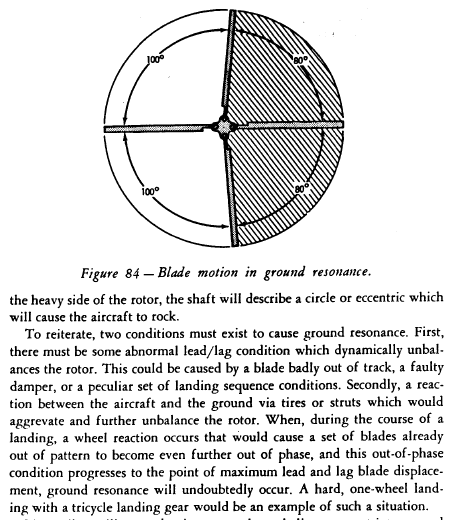
GR is when that lateral oscilation (undamped) comes in counter phase with fuselage oscilation.
In a 2-blade system, when a blade wants to drag back the other wants to drag forward, an about equal amount, because they are on oposite azimuth, thus the rotor system center of mass can hardly move I assume.
from a theoretical perspective, if blades we let to drag independently in a teetering head they have the power to displace the center of mass much more, is that why it is more suseptible ?...

Joined: Dec 2023
Posts: 55
Likes: 97
From: Torrance, CA
Cant post the direct link but Google this site and read the explanation.
spinningwing
/helicopter/ground-resonance

Joined: Nov 2000
Posts: 4,330
Likes: 74
From: White Waltham, Prestwick & Calgary
I would hardly call that a reasonable layman's explanation. My comment above was based on one of those old POF texts- I will try to find the reference, but I believe it was Ray Prouty.

Joined: Mar 2005
Posts: 1,289
Likes: 289
From: Poplar Grove, IL, USA
If I remember correctly, the classic Sikorsky Blue Book shows ground resonance happening because of lead-lag making the effective center of mass move off the rotor shaft centerline. That puts a moment on the shaft which makes the aircraft move and the gear responds to that movement. I've also read a bunch of Ray Prouty's work. The teetering rotor is locked rigidly with the blades 180 degrees apart so they don't have the same issue as the articulated rotor. That's also what I was taught in groundschool.
Joined: Nov 2000
Posts: 4,330
Likes: 74
From: White Waltham, Prestwick & Calgary
And it's correct - teetering blades have reinforced blade roots so they don't need dampers, There is a natural resonance (linked with phase lag) when the blades go all the way to the hub which may be part of his thinking.
I don't know where pylon rock fits in with that.
I don't know where pylon rock fits in with that.

Joined: Sep 2002
Aviation Qualifications: CPL
Posts: 4,721
Likes: 637
From: Great South East, tired and retired
Isn't there also a requirement for the landing gear to be fitted with dampers, or to be on wheels (one tyre to be under-inflated) with oleos that are out of adjustment.
Most teetering head helos are on skids on crosstubes, which are not really susceptible to GR. However, a really ham-fisted pilot might be able to get it. Squirrels (different head) could bounce easily on those blades at the back of the skids.
Most teetering head helos are on skids on crosstubes, which are not really susceptible to GR. However, a really ham-fisted pilot might be able to get it. Squirrels (different head) could bounce easily on those blades at the back of the skids.

Joined: Sep 2018
Posts: 5
Likes: 2
From: Cape Town
this is not correct. Below is a reasonable layman’s explanation of why 2 bladed teetering hubs are not susceptible to GR.
Cant post the direct link but Google this site and read the explanation.
spinningwing
/helicopter/ground-resonance
Cant post the direct link but Google this site and read the explanation.
spinningwing
/helicopter/ground-resonance
 Drop some more teases please...!
Joined: Dec 2023
Posts: 55
Likes: 97
From: Torrance, CA
Joined: Mar 2005
Posts: 1,289
Likes: 289
From: Poplar Grove, IL, USA