


Can you refuel a rotary in flight?

Thread Starter
Joined: Jul 2005
Posts: 297
Likes: 0
From: Orstralia
Can you refuel a rotary in flight?
First, I drive a car not an aircraft...
I was wondering: can a helicopter be refuelled in flight? It would have to be by another rotary, I suppose.
On the other hand, are there helitankers to refuel fixed wings? (wait a minte, silly question, forget that one..)
I was wondering: can a helicopter be refuelled in flight? It would have to be by another rotary, I suppose.
On the other hand, are there helitankers to refuel fixed wings? (wait a minte, silly question, forget that one..)
Last edited by RJM; 29th September 2008 at 02:12. Reason: Question even dumber than I thought

Joined: Aug 2008
Posts: 138
Likes: 0
From: New York
of course they can click on the link, YouTube - AR Flightdeck CH-53
It actually pretty cool, until there is too much cyclic forward and the rotor blades make contact with the extended fuel probe...then things can get messy!
YouTube - Helicopter refueling accident
It actually pretty cool, until there is too much cyclic forward and the rotor blades make contact with the extended fuel probe...then things can get messy!
YouTube - Helicopter refueling accident
Joined: Oct 2007
Posts: 230
Likes: 0
From: An Irish dude in Houston, TX. I miss home!!!
Yeah, check out this pic on wikipedia. I've never heard of helo to helo refueling. I'd imagine the tail rotor would get in the way.
edit; you beat me to it DenizD, was off looking for a pic.
edit; you beat me to it DenizD, was off looking for a pic.
Joined: Aug 2006
Posts: 418
Likes: 0
From: Below Escape Velocity
Many naval helicopters can, and are, refueled from ships while in a high hover. Usually there is a reason they can't land aboard to do fuel, such as being too big or the sea state is too nasty.
YouTube - HIFR Heilocopter Inflight Refueling... NAVY
YouTube - HIFR Heilocopter Inflight Refueling... NAVY
Joined: Dec 2001
Posts: 943
Likes: 0
From: Gold Coast, Queensland
In the 1964 Farnborough airshow a Wessex 5 trailed a fuel hose from its cabin which was picked up by the winch on the following Wessex 5 using a crappling hook.. All this was done within the airfield boundry......no problem!


Joined: May 2001
Aviation Qualifications: ATPL
Posts: 169
Likes: 0
From: in the north country fair

From another thread:
http://www.pprune.org/rotorheads/135...ml#post3923450
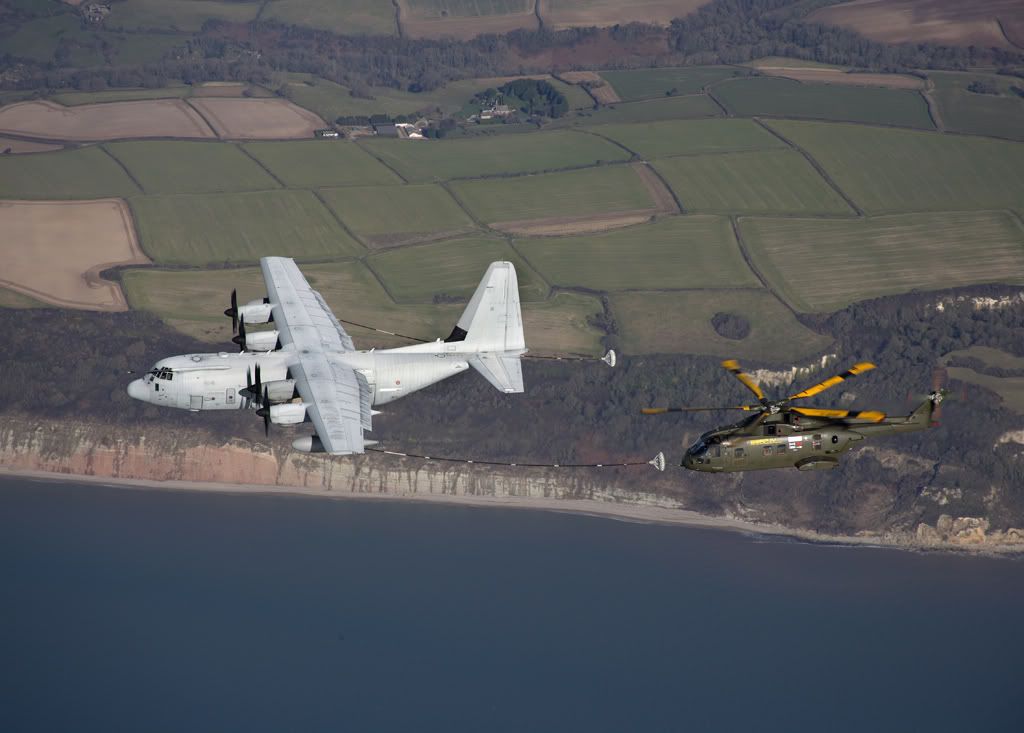
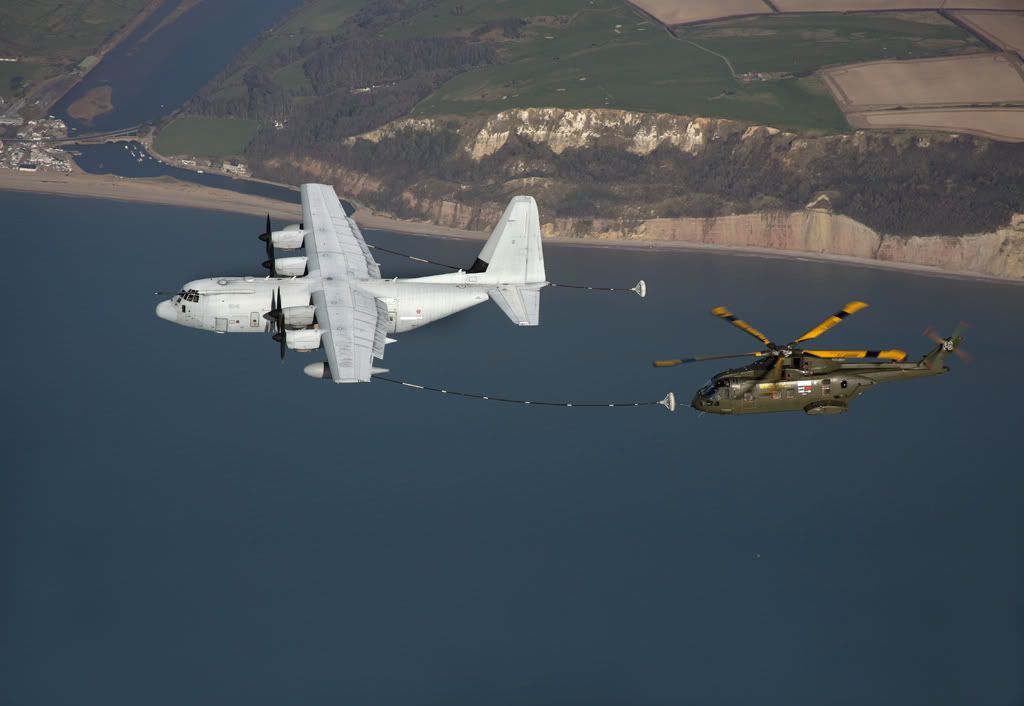
And when you just want to show off:

RD
http://www.pprune.org/rotorheads/135...ml#post3923450
And when you just want to show off:
RD
Joined: Nov 2007
Posts: 178
Likes: 0
From: Poland
Wonder what is the record for helicopter non-stop flight.
I know about the two HH-3Es flying across Atlantic to Le Bourget air show in the 60's - the flight took 30 hours. Both then flew to Thailand and operated as CSAR machines, and one of those helicopters was crashed during Son Tay Raid on 21st November 1970. Don't know what happened to the other one.

I know about the two HH-3Es flying across Atlantic to Le Bourget air show in the 60's - the flight took 30 hours. Both then flew to Thailand and operated as CSAR machines, and one of those helicopters was crashed during Son Tay Raid on 21st November 1970. Don't know what happened to the other one.


Joined: Feb 2006
Posts: 1,067
Likes: 40
From: On the big blue planet
Are they trained to hold back or is there something I don't know?
skadi
Avoid imitations


Joined: Nov 2000
Aviation Qualifications: ATPL
Posts: 15,110
Likes: 1,083
From: Wandering the FIR and cyberspace often at highly unsociable times
It's even more fun at night, lights out, on night vision goggles. Been there. The static discharge spark to the basket makes you jump a bit, the first time you see it in the dark. 

Joined: Apr 2006
Posts: 300
Likes: 0
From: USA (PA)
...and sometimes things don't go as planned! 
See DennisD's post:
http://www.pprune.org/rotorheads/345...ml#post4427148
EDITED: due to blindness disregard my post... (thanks Monk!)
See DennisD's post:
http://www.pprune.org/rotorheads/345...ml#post4427148
EDITED: due to blindness disregard my post... (thanks Monk!)
Last edited by Phil77; 4th October 2008 at 19:48. Reason: somebody posted the same link well before me... tststs

Joined: Aug 2006
Posts: 418
Likes: 0
From: Below Escape Velocity
Brilliant Stuff-
Depends somewhat on the machine. On the HH-3F, there was a standard single-point receptacle on the outside of the fuselage below the sliding door. Awkward to say the least. Crewman lay on his belly for the hookup.
On the HH-65, there is a lift-up door in the deck of the cabin just inside the door with a special HIFR single-point receptacle (it fits the nozzle end of the Navy standard HIFR rig which is seen in the photo Hedge 36 so graciously provided). Most naval helicopters have a similar arrangement.
It is very important that the hoist operator/winchman get the procedures correct. Basically, it's (probably varies slightly by type/model/series):
Lower the bare hook to the deck, where it is grounded and the rig attached (as per the picture);
Raise the rig and two-block the hoist hook into the stop;
Open the deck door and positively fit the nozzle to the receptacle;
and here's the important bit...
Open the ball valve on the HIFR rig at the nozzle;
Give the ship the 'ready for pumping signal'.
There is an emergency breakaway function on the HIFR rig. The hose will part and the ends will close at the large coupling you see immediately below the hoist hook, leaving the saddle and a couple meters of hose attached to the aircraft... this is considered better than ripping the fuel fitting out of the aircraft. Depending upon the rig, it may or may not have a manual breakaway in addition to an automatic breakaway which is dependent upon hose tension.
To stop, essentially reverse the procedure. Here's why that procedural thing is important...
Some dozen or so years ago, when I was involved in this sort of thing, some lads were out doing a practice HIFR. If memory serves, it was at night. When the pilot informed the hoist operator that he had enough fuel and to secure, the hoist operator made the mistake of closing the ball valve in the HIFR rig before signaling the ship to stop pumping. There was a pinhole leak in one of the fittings upstream of the nozzle. While fuel was flowing into the aircraft, the static pressure at the nozzle wasn't sufficient to cause the leak to be (it being night) noticeable or significant (the pump is generally 12-15m below the height to which the fuel is being pumped), but as soon as that valve closed, the static pressure in the hose went up, fuel was atomized up and under the hoist operator's visor, all over the inside of the cabin. So, here you are, in a hovering helicopter, at sea, at night, attached to the ship by a heavy fuel-filled hose, the hoist operator can't see, there's fuel spraying all over the inside of the machine and possibly into some of the sensitive hot bits up top, and the pump is still running. Nobody's idea of a good time.
Here is where my recollection grows fuzzy. I believe the deck crew was on the case and shut the pump off. I also believe the hoist operator operated the emergency breakaway. Landed safely and many lessons learned.
Fueling in flight, whether from an airplane or a ship... not for the timid.
Depends somewhat on the machine. On the HH-3F, there was a standard single-point receptacle on the outside of the fuselage below the sliding door. Awkward to say the least. Crewman lay on his belly for the hookup.
On the HH-65, there is a lift-up door in the deck of the cabin just inside the door with a special HIFR single-point receptacle (it fits the nozzle end of the Navy standard HIFR rig which is seen in the photo Hedge 36 so graciously provided). Most naval helicopters have a similar arrangement.
It is very important that the hoist operator/winchman get the procedures correct. Basically, it's (probably varies slightly by type/model/series):
Lower the bare hook to the deck, where it is grounded and the rig attached (as per the picture);
Raise the rig and two-block the hoist hook into the stop;
Open the deck door and positively fit the nozzle to the receptacle;
and here's the important bit...
Open the ball valve on the HIFR rig at the nozzle;
Give the ship the 'ready for pumping signal'.
There is an emergency breakaway function on the HIFR rig. The hose will part and the ends will close at the large coupling you see immediately below the hoist hook, leaving the saddle and a couple meters of hose attached to the aircraft... this is considered better than ripping the fuel fitting out of the aircraft. Depending upon the rig, it may or may not have a manual breakaway in addition to an automatic breakaway which is dependent upon hose tension.
To stop, essentially reverse the procedure. Here's why that procedural thing is important...
Some dozen or so years ago, when I was involved in this sort of thing, some lads were out doing a practice HIFR. If memory serves, it was at night. When the pilot informed the hoist operator that he had enough fuel and to secure, the hoist operator made the mistake of closing the ball valve in the HIFR rig before signaling the ship to stop pumping. There was a pinhole leak in one of the fittings upstream of the nozzle. While fuel was flowing into the aircraft, the static pressure at the nozzle wasn't sufficient to cause the leak to be (it being night) noticeable or significant (the pump is generally 12-15m below the height to which the fuel is being pumped), but as soon as that valve closed, the static pressure in the hose went up, fuel was atomized up and under the hoist operator's visor, all over the inside of the cabin. So, here you are, in a hovering helicopter, at sea, at night, attached to the ship by a heavy fuel-filled hose, the hoist operator can't see, there's fuel spraying all over the inside of the machine and possibly into some of the sensitive hot bits up top, and the pump is still running.
Nobody's idea of a good time.Here is where my recollection grows fuzzy. I believe the deck crew was on the case and shut the pump off. I also believe the hoist operator operated the emergency breakaway. Landed safely and many lessons learned.
Fueling in flight, whether from an airplane or a ship... not for the timid.
Joined: Jul 2002
Aviation Qualifications: ATPL(H)
Posts: 3,054
Likes: 57
From: UK
And then, of course, there are the stories of refuelling H500s in flight. (With jerry cans whilst standing on the skids, if you were wondering.)
Apocryphal, no doubt (I hope)...
)Apocryphal, no doubt (I hope)...