


aerodynamic theory question

Joined: Sep 2004
Posts: 57
Likes: 0
From: UK
Over Egging the Pudding
Thank you Aser/Griffin for the video ... I had seen something similar which I was led to believe was a Huey blade and was staggered by the amount of "movement / flexing" the blade experiences in flight...
However, I fear there is a danger of over-egging the pudding here in that The Controller was looking for a simple answer to their question.
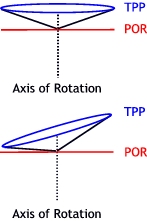
The simple answer is drawn by simple PofF vector diagrams showing a difference between the POR and TPP.
Link fixed.
H.
However, I fear there is a danger of over-egging the pudding here in that The Controller was looking for a simple answer to their question.
The simple answer is drawn by simple PofF vector diagrams showing a difference between the POR and TPP.
Link fixed.
H.
Last edited by FlightOops; 30th October 2006 at 15:24.

Passion Flying Hobby Science Sponsor Work
Joined: Apr 2004
Posts: 461
Likes: 0
From: Belgium
Tip Path
FlightOops
Thinking back at Nick's analogy of defining MSL by filtering out the ocean waves, the tip path is obtained by filtering out higher order bending and flapping harmonics.
So, one way to obtain the simple and clear picture, you refer to, is to restrict the flapping to the first order harmonic behaviour (that is those sin-waves that have the same frequency as the MR).
So the tip plane is defined by the first order flapping harmonic.....
did it again.... cheers...
d3
Thinking back at Nick's analogy of defining MSL by filtering out the ocean waves, the tip path is obtained by filtering out higher order bending and flapping harmonics.
So, one way to obtain the simple and clear picture, you refer to, is to restrict the flapping to the first order harmonic behaviour (that is those sin-waves that have the same frequency as the MR).
So the tip plane is defined by the first order flapping harmonic.....
did it again.... cheers...
d3
Last edited by delta3; 30th October 2006 at 12:04.
Joined: Nov 2005
Posts: 58
Likes: 0
From: New South Wales
From a mechanics point of view- the tip path plane is the path that an individual blade travels around the plane of rotation. I've tracked and balanced many rotors over the years and can quite happily say that the POR and the TPP are rarely the same. Hence when a blade is out of track, it's because it is not flying in the same TPP. When often adjust blades out of track to reduce vibrations and depending on what vibe equipment you use, the plane of rotation generally comes from a master blade on the head. On some aircraft, you adjust the blades from the master and on others, from a median. I hope that makes sense.
