


Another move toward Generation II Rotorcraft?

Thread Starter
Joined: Apr 2003
Posts: 1,635
Likes: 1
From: Vancouver, BC, Canada
 Another move toward Generation II Rotorcraft?
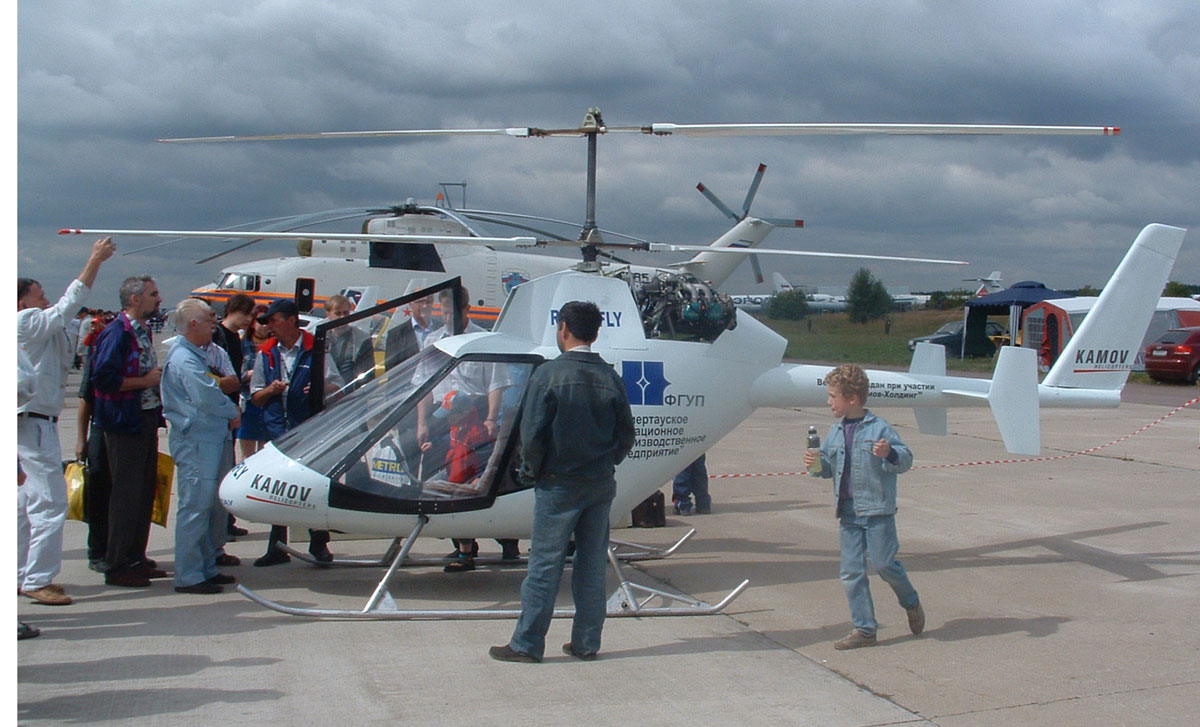
 `
` 
____________________________________
OOPS! It ain't a real Kamov.

The Kamov - Ka 56 is offered as a substitute.

Edited to add OOPS.
Last edited by Dave_Jackson; 27th August 2005 at 22:17.

Joined: Dec 2001
Posts: 1,835
Likes: 3
From: Philadelphia PA
Also note the lack of controls for the rotor heads, so my guess is that this yet another co-axial machine that controls lift soley by RPM.
The consequences of an engine failure with no ability to enter autorotation are pretty catastrophic...
The consequences of an engine failure with no ability to enter autorotation are pretty catastrophic...
Joined: Nov 2004
Posts: 1,334
Likes: 0
From: Cambridgeshire, UK
"Also note the lack of controls for the rotor heads ... controls lift soley by RPM."
Sounds like a job for tip servos, although i couldn't see any...
General coaxial question: How is the lower rotor pitch set, relative to upper rotor pitch? I am curious in light of NL's point about the difficulty in using downwash for tail rotor anti-torque. Do these machines inherently suffer more buffet?
Hmmm, high speed options seem to be as follows:
1. Coaxial, with potential downwash instability in foward flight.
2. Synchropter (Stepniwski rot), with blade slap or rotor vibration.
3. Interleaving, with complex drivetrain and wider planform.
4. Tiltrotor, with poor performance and horrendous complexity.
Anyone else beginning to see insurmountable aerodynamic limitations?
Mart
Sounds like a job for tip servos, although i couldn't see any...
General coaxial question: How is the lower rotor pitch set, relative to upper rotor pitch? I am curious in light of NL's point about the difficulty in using downwash for tail rotor anti-torque. Do these machines inherently suffer more buffet?
Hmmm, high speed options seem to be as follows:
1. Coaxial, with potential downwash instability in foward flight.
2. Synchropter (Stepniwski rot), with blade slap or rotor vibration.
3. Interleaving, with complex drivetrain and wider planform.
4. Tiltrotor, with poor performance and horrendous complexity.
Anyone else beginning to see insurmountable aerodynamic limitations?
Mart
Last edited by Graviman; 29th August 2005 at 18:57.
Joined: Jan 2005
Posts: 202
Likes: 0
From: UK
Stuff-all use if you don't speak Russian, but: http://delta.wtr.ru/wtboard/40671.shtml may have some tech specs.
Is that a Rotax 912 ultralight engine in there, btw?
Si
Is that a Rotax 912 ultralight engine in there, btw?
Si
Thread Starter
Joined: Apr 2003
Posts: 1,635
Likes: 1
From: Vancouver, BC, Canada
General coaxial question: How is the lower rotor pitch set, relative to upper rotor pitch?
He then adjusts a control that changes the collective difference between the two rotors and thereby
removes any tendency of the craft to yaw.
insurmountable aerodynamic limitations?
1. Single main rotor and tail rotor.
2. Rigid rotor with 3+ blades, for greater controllability.
3. Twin laterally displaced main rotors; for flight symmetry.
4. Advancing Blade Concept w/ pusher propeller; for increased forward speed.
5. Large Chord and Low Tip Speed; for increased forward speed.
6. 'Absolutely' Rigid Rotors; for reduced cross-coupling.
7. Active Blade Twist; for greater L/D ratio, increased forward speed and reduced vibration.
8. Reverse Velocity Utilization; for greater L/D ratio and increased forward speed.
9. High Frequency Leading + Trail Edge Flaps; for reduced vibration.
Joined: Nov 2004
Posts: 1,334
Likes: 0
From: Cambridgeshire, UK
"Kamovs that are used for logging in BC ... adjusts a control that changes the collective difference between the two rotors ... yaw."
Ok so this is to compensate for variable air density in hover, but i don't see the system being so benign in forward flight. Any ideas how Sikorsky overcame this with the S69? Perhaps ABC means the downwash patterns from each rotor don't interfere, but i bet there is still a speed where buffeting was unavoidable.
"Twin laterally displaced main rotors; for flight symmetry."
To me it still looks like feathered retreating synchropter (Stepniewski rotation) is still the overall winner - since it provides the most stable downwash pattern in all flight regimes. There is no parasitic downthrust associated with this concept either (like interleaver). The exact lift/pitch distribution and rotor positioning will require meticulous wind tunnel work (or cfd), but it may be possible to find the perfect compromise. The potential vibrations inherent in this concept are certainly justification for active pitch trimming though, and it will need gyro aumentation at least.
I can just see the board presentation about spiralling costs...
Mart
BTW just noticed the MIL 26 in the background - nicely shows the contrast in scale.
Ok so this is to compensate for variable air density in hover, but i don't see the system being so benign in forward flight. Any ideas how Sikorsky overcame this with the S69? Perhaps ABC means the downwash patterns from each rotor don't interfere, but i bet there is still a speed where buffeting was unavoidable.
"Twin laterally displaced main rotors; for flight symmetry."
To me it still looks like feathered retreating synchropter (Stepniewski rotation) is still the overall winner - since it provides the most stable downwash pattern in all flight regimes. There is no parasitic downthrust associated with this concept either (like interleaver). The exact lift/pitch distribution and rotor positioning will require meticulous wind tunnel work (or cfd), but it may be possible to find the perfect compromise. The potential vibrations inherent in this concept are certainly justification for active pitch trimming though, and it will need gyro aumentation at least.
I can just see the board presentation about spiralling costs...
Mart
BTW just noticed the MIL 26 in the background - nicely shows the contrast in scale.
Last edited by Graviman; 31st August 2005 at 19:09.
Thread Starter
Joined: Apr 2003
Posts: 1,635
Likes: 1
From: Vancouver, BC, Canada
Thread Starter
Joined: Apr 2003
Posts: 1,635
Likes: 1
From: Vancouver, BC, Canada
IHL;
Information on this particular helicopter came from;
http://www.rotaryforum.com/forum/showthread.php?t=7031
Other sources are; searching the net, patent research, rotorcraft technical books and associations etc.,
plus people hit my web site and then email information that they feel might be of interest.
Dave
Information on this particular helicopter came from;
http://www.rotaryforum.com/forum/showthread.php?t=7031
Other sources are; searching the net, patent research, rotorcraft technical books and associations etc.,
plus people hit my web site and then email information that they feel might be of interest.
Dave
Last edited by Dave_Jackson; 29th December 2005 at 01:34.
Joined: Jan 2005
Posts: 202
Likes: 0
From: UK
I'm curious.. If it's capable of lifting three guys (albeit hanging out the sides) then why did they design it as a single seater in the first place? Is it to fit within ultralight weight limits, or just to keep things simple for starters?
A viable (cheap) two seat personal helicopter. Now that I'd downsize my house for!!
Si
A viable (cheap) two seat personal helicopter. Now that I'd downsize my house for!!
Si

Joined: Mar 2005
Posts: 1,289
Likes: 289
From: Poplar Grove, IL, USA
Nifty looking machine, cool video. What I'm curious about is why do they seem to be following the beginner hang-glider pilot's altitude rule, i.e. never fly higher than you are willing to fall.
-- IFMU
-- IFMU
Joined: Oct 2001
Posts: 100
Likes: 0
From: ULLI
It was me who posted this video and some info to rotaryforum, and I have some information about this helo from the first hand - from the test pilot who made these flights.
Simon853: it is two-place tandem with back seat staggered to the right side.
IFMU: this video is from the very first test flights so flight were short, guys made some adjustments after each flight. And, aftre all they didn't try to get new altitude record
Somebody told it has no control rods to rotors. They exist - inside the mast. Rotors are controllable even more than usually. In this control scheme each rotor pitch can be adjusted inflight. Such control system was invented by one of Kamov employee years ago, but wasn't accepted by Kamov (I thnk just to some personal reasons). It's patented now. This time I'm translating some more detailed technical information in English about it - will post here when ready.
Simon853: it is two-place tandem with back seat staggered to the right side.
IFMU: this video is from the very first test flights so flight were short, guys made some adjustments after each flight. And, aftre all they didn't try to get new altitude record
Somebody told it has no control rods to rotors. They exist - inside the mast. Rotors are controllable even more than usually. In this control scheme each rotor pitch can be adjusted inflight. Such control system was invented by one of Kamov employee years ago, but wasn't accepted by Kamov (I thnk just to some personal reasons). It's patented now. This time I'm translating some more detailed technical information in English about it - will post here when ready.
