


Non FMS equipped jets

Thread Starter
Joined: Mar 2004
Posts: 41
Likes: 0
From: South East England
Non FMS equipped jets
Just curious
Are there currently any jet transport aircraft in the UK that operate without a FMS? (is this a manufacturer specific term? I'm referring to automation devices that allow you to set high level goals)
Is it common/possible to refit older gen. aircraft with such avionics?
I'm in need of education!
Are there currently any jet transport aircraft in the UK that operate without a FMS? (is this a manufacturer specific term? I'm referring to automation devices that allow you to set high level goals)
Is it common/possible to refit older gen. aircraft with such avionics?
I'm in need of education!

Joined: Dec 2004
Posts: 24
Likes: 0
From: Brisbane
further curious
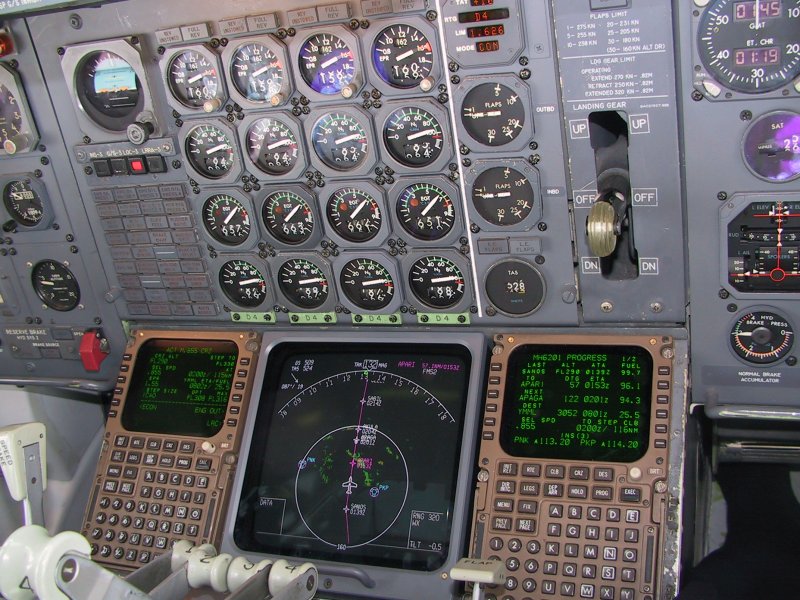
When BA operated the DC10 and the B747-236 were they entirely clockwork? Taking the 747 it had some sort of ADC and 2 (3?) carousel iv ins platforms (it remembered 9 waypoints so you had to load them in batches of 8). prior to 1997 did BA's or anybody's 747's DC10's have Omega and Loran? Fid they subsequently receive GPS bolt-ons? Was there some kind on FMS such as the UNS1B as an upgrade? I'm curious too.

Joined: Jul 2002
Posts: 156
Likes: 0
From: On a park bench near an airport
18-Wheeler, Nice - They're even the correct shade of 'Boeing' Brown!
Cx are currently retro fitting their classic (747) freighters with Honeywell kit, but I think it may be more akin to the GNS system then a true FMS....
Cx are currently retro fitting their classic (747) freighters with Honeywell kit, but I think it may be more akin to the GNS system then a true FMS....


Joined: Mar 2000
Posts: 8,571
Likes: 3
From: Arizona USA
Running out of fuel?
Hardly.
Just yesterday, while cruisin' along at M.865 in the big three holer Lockheed, was asked by a young lad (yes, FD vists here are OK) just why we were passing the airplane below.
Simple answer.
THIS airplane is made in America (with proper RR engines of course).
Airboos aircraft perform like they were dragging a boat anchor.
A big laugh here all 'round.
Hardly.
Just yesterday, while cruisin' along at M.865 in the big three holer Lockheed, was asked by a young lad (yes, FD vists here are OK) just why we were passing the airplane below.
Simple answer.
THIS airplane is made in America (with proper RR engines of course).
Airboos aircraft perform like they were dragging a boat anchor.
A big laugh here all 'round.


Joined: Jan 2001
Posts: 1,693
Likes: 161
From: home
411a,
I hardly think cruising at FL290 at M0.86 is fuel efficient especially in a Classic. My comment was made tongue-in-cheek. Maybe they were on a special flight plan to recover delayed time. Certainly should not be the norm!
I hardly think cruising at FL290 at M0.86 is fuel efficient especially in a Classic. My comment was made tongue-in-cheek. Maybe they were on a special flight plan to recover delayed time. Certainly should not be the norm!
Joined: Feb 2004
Posts: 228
Likes: 0
From: Europe

Just to inform those who do not fly a 747 "Classic". long range cruise for heavy weights starts at close to M.860 and high twenties. So M.855 and FL290 combination is actually very efficient. If you take a careful look at lft CDU you may observe that a step to a higher level is less than 10 minutes away and they are only slightly below optimum.
Efficiency has never been a sole fuel consumption figure, rather a combination of various factors such as schedule, importance of load, ATC etc. Cost Index and way it works gives a pretty good idea of what is reuired to keep a flight efficient.
AD
Efficiency has never been a sole fuel consumption figure, rather a combination of various factors such as schedule, importance of load, ATC etc. Cost Index and way it works gives a pretty good idea of what is reuired to keep a flight efficient.
AD
Joined: Jan 2001
Posts: 1,693
Likes: 161
From: home
A-D,
I handed my 747 books back a few years ago. (albeit of the -400 variety) so I cannot be too sure of the figures, but I struggle to believe that M0.86 at 290 is efficient. The only definite example I have is an experience I had coming back from Florida. Getting our clearance we were held down at FL290 because of traffic crossing to Portugal. We had M0.86 selected ready for our expected higher level, and our arrival fuel which had been calculated as approx 10 t (based on FL370), dropped to -1.5 T when we changed the cruise level in the FMC.
If the FMC in this case is like the -400 one then the CI is being ignored anyway as it is in SEL SPD. Being close to the optimum cruise level does not mean you are flying the aircraft in the most efficient manner it just means that you are flying at the optimum level for the speed selected. Anyway as said before there must a reason to fly that fast low down, probably a delayed flight or even maybe ATC speed contraint.
Apologies for the thread creep.
I handed my 747 books back a few years ago. (albeit of the -400 variety) so I cannot be too sure of the figures, but I struggle to believe that M0.86 at 290 is efficient. The only definite example I have is an experience I had coming back from Florida. Getting our clearance we were held down at FL290 because of traffic crossing to Portugal. We had M0.86 selected ready for our expected higher level, and our arrival fuel which had been calculated as approx 10 t (based on FL370), dropped to -1.5 T when we changed the cruise level in the FMC.
If the FMC in this case is like the -400 one then the CI is being ignored anyway as it is in SEL SPD. Being close to the optimum cruise level does not mean you are flying the aircraft in the most efficient manner it just means that you are flying at the optimum level for the speed selected. Anyway as said before there must a reason to fly that fast low down, probably a delayed flight or even maybe ATC speed contraint.
Apologies for the thread creep.
Last edited by Right Way Up; 22nd June 2005 at 11:54.
Joined: Mar 2000
Posts: 8,571
Likes: 3
From: Arizona USA
\\411a,
I hardly think cruising at FL290 at M0.86 is fuel efficient especially in a Classic. My comment was made tongue-in-cheek. Maybe they were on a special flight plan to recover delayed time. Certainly should not be the norm!\\
Well, as usual, it depends.
Now I don't fly the B747, but I do operate the Lockheed TriStar, and have done so for a very long time.
The heavy weight models of these (-200. -250) have an FMS which specifies a rather high speed cruise, M.86, even at lower altitudes...FL290/310, for example, at higher enroute weights.
This is the 'min cost' provision, which takes into account fuel cost, among several other variables.
The TriStar was designed as a high speed cruiser, and was the first wide-body jet transport to use a true laminar flow wing.
As the fuel on longer flights is consumed, higher altitudes are requested, but the speed remains fairly constant, until closer to TOD, where a lower speed (M.84) is commanded by the FMS, in the thrust management mode of operation, using min cost.
Any slower, and the deck angle becomes excessive...then the fuel flows really go up...ugh.
The -500 model is the exception. On this model (using an extended span wing, with active ailerons for gust load alleviation), the high speed cruise is M.84, reducing to M.83 at lighter weights...again using min cost.
Darn Airboos aircraft keep getting in the way.
I hardly think cruising at FL290 at M0.86 is fuel efficient especially in a Classic. My comment was made tongue-in-cheek. Maybe they were on a special flight plan to recover delayed time. Certainly should not be the norm!\\
Well, as usual, it depends.
Now I don't fly the B747, but I do operate the Lockheed TriStar, and have done so for a very long time.
The heavy weight models of these (-200. -250) have an FMS which specifies a rather high speed cruise, M.86, even at lower altitudes...FL290/310, for example, at higher enroute weights.
This is the 'min cost' provision, which takes into account fuel cost, among several other variables.
The TriStar was designed as a high speed cruiser, and was the first wide-body jet transport to use a true laminar flow wing.
As the fuel on longer flights is consumed, higher altitudes are requested, but the speed remains fairly constant, until closer to TOD, where a lower speed (M.84) is commanded by the FMS, in the thrust management mode of operation, using min cost.
Any slower, and the deck angle becomes excessive...then the fuel flows really go up...ugh.
The -500 model is the exception. On this model (using an extended span wing, with active ailerons for gust load alleviation), the high speed cruise is M.84, reducing to M.83 at lighter weights...again using min cost.
Darn Airboos aircraft keep getting in the way.
Last edited by 411A; 24th June 2005 at 18:06.
Joined: Jun 2001
Posts: 2,627
Likes: 2
From: UTC +8
A common misconception among many pilots is that a slower cruise speed will somehow always translate into lesser fuel burn.
Initial LRC figures for a 742 at FL290 after a max t/o departure [377kgs] would be no less than M.855 at ISA+10.
Needless to say, some pilots just can't read numbers, or they just can't believe what numbers they read.
Initial LRC figures for a 742 at FL290 after a max t/o departure [377kgs] would be no less than M.855 at ISA+10.
Needless to say, some pilots just can't read numbers, or they just can't believe what numbers they read.
