


Need a new wing

Joined: Apr 2009
Aviation Qualifications: Non-Aircrew
Posts: 1,571
Likes: 646
From: DM33
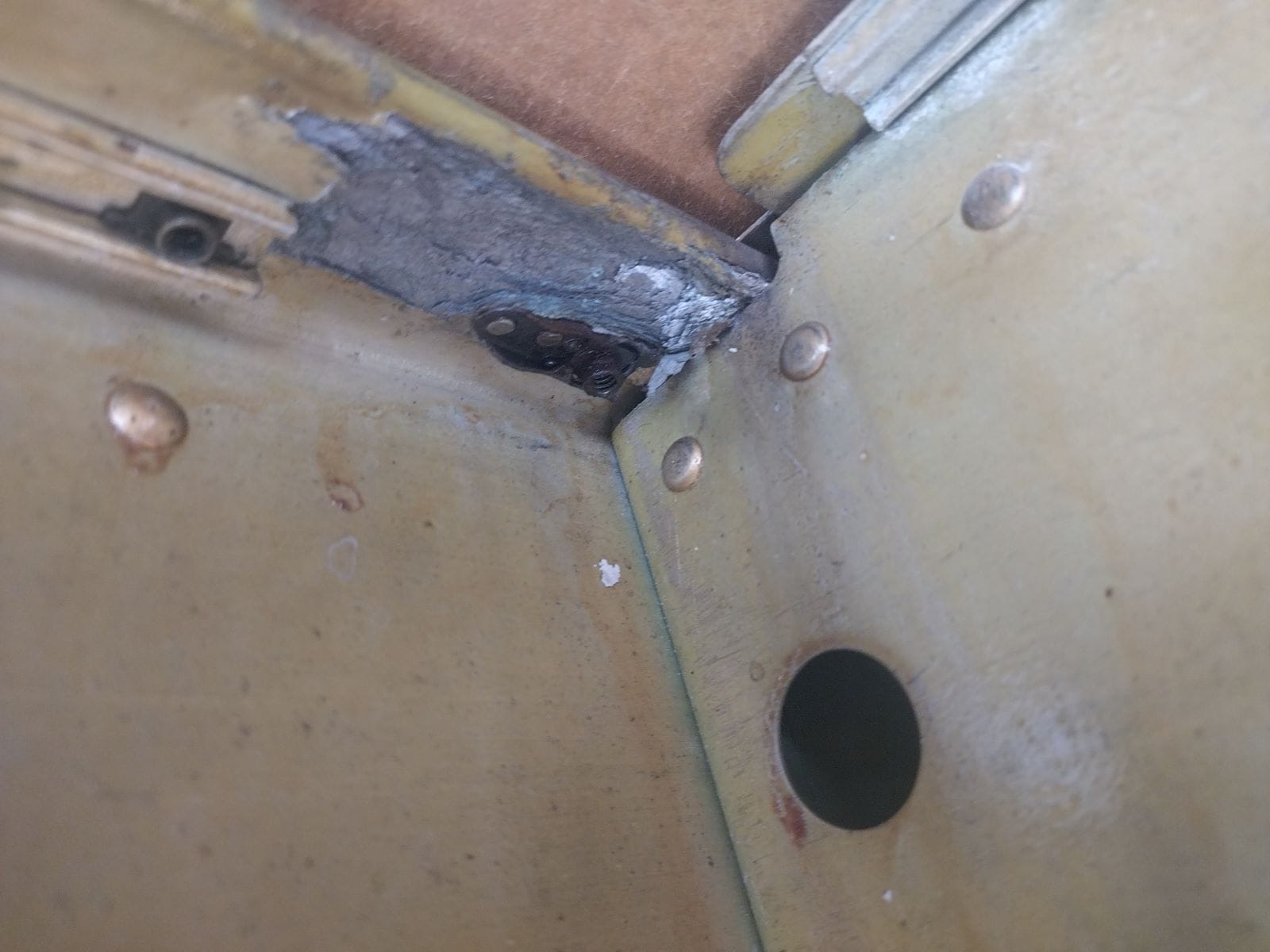
In this photo (PA-28-180 spar), there is exfoliation corrosion on the top edge of the spar, which is blatantly obvious. To the left of the bulkhead fitting, corrosion is obvious. But, the bubbled paint all the way around the fitting is also corrosion, just the paint hasn't flaked off yet.



Joined: Apr 2009
Aviation Qualifications: Non-Aircrew
Posts: 1,571
Likes: 646
From: DM33
Help me get oriented please. I assume the top two photos show corrosion of the spar cap which was exposed after removal of the fuel tank. Are we looking at the lower spar cap or the upper spar cap? If the staining indicates flow of water (or something else) I assume this is the upper cap. If that's true then what trapped water there.
Fleet Manager


Joined: Aug 2006
Aviation Qualifications: CPL
Posts: 7,081
Likes: 2,938
From: Ontario, Canada
Was this area painted in an attempt to hide existing corrosion?
Ebbie,
The corrosion in your photos has been there for many years. That type of corrosion does not "suddenly appear". As it is intergranular exfoliation corrosion, once it starts, it's really hard to stop. Corrosion preventing liquid is the best hope, but that spar is way past that!

Joined: Feb 2006
Aviation Qualifications: LAME
Posts: 1,129
Likes: 168
From: Station 42
Ebbie: Re post #22
I've seen wing spar corrosion in the fuel tank area a few times before on PA28s. Looks like galvanic action caused by the steel anchor nut may have set that off. All for want of a decent coat of primer or smear of jointing compound ...
I'm curious whether your previous few Annual Inspections had called for tank removal? Good inspection should have caught the corrosion in its early stage.
I've seen wing spar corrosion in the fuel tank area a few times before on PA28s. Looks like galvanic action caused by the steel anchor nut may have set that off. All for want of a decent coat of primer or smear of jointing compound ...
I'm curious whether your previous few Annual Inspections had called for tank removal? Good inspection should have caught the corrosion in its early stage.
Joined: Apr 2009
Aviation Qualifications: Non-Aircrew
Posts: 1,571
Likes: 646
From: DM33
Have any of the PA-28 with spar corrosion hidden by the fuel tanks been hangared or were all kept outside in the weather?
Joined: Feb 2006
Aviation Qualifications: LAME
Posts: 1,129
Likes: 168
From: Station 42
The fuel tanks have not been removed from my PA-28-180 in at least the last 20 years. Several different inspectors have signed off this aircraft and none has required removal of the tanks. None of the Piper mandatory SB or resulting AD has, to the best of my knowledge, required removal of the fuel tanks. If this was a commnon problem I would have expected a mandatory SB and an AD.
Joined: Apr 2009
Aviation Qualifications: Non-Aircrew
Posts: 1,571
Likes: 646
From: DM33
I'd be very concerned in that case, you could be flying on borrowed time. Google Piper SB 1006 and EASA Airworthiness Directive 2005-0032. The hidden spars are supposed to be inspected at seven year intervals. Your maintenance technical records department should be aware of that.
That reference says recent compliance with SB 1006 is not sufficient to meet the requirements of that AD.
I'm not saying that removal of the fuel tanks every 7 years isn't a good idea. I'm just saying that I'm not aware of any FAA requirement to do so. I don't doubt there are many PA-28 flying in USA that are not compliant with SB 1006.
Thread Starter

Joined: Jul 2012
Posts: 419
Likes: 0
From: Barbados
I saw a few queries.
Not sure why it was missed on previous annuals, especially the one immediately after it sat on the ground on Guadeloupe for over a year.
The tank has been off for sure - in 2018 it got a hole poked through the wing when it slipped off a wing jack - got repaired in St. Barths - took the opportunity to do the training to land there (long expired as they last on six months - didn't find it difficult to land there, Canefield in Dominica is much scarier, especially landing south to north)
That said, it is what it is.
The donor plane a 1984 is about to get inspected, seems the A&P has been very busy.
Fingers crossed that the wing is good, I have a couple of photos but they don't show just where I am keen on getting looked at.
Not sure why it was missed on previous annuals, especially the one immediately after it sat on the ground on Guadeloupe for over a year.
The tank has been off for sure - in 2018 it got a hole poked through the wing when it slipped off a wing jack - got repaired in St. Barths - took the opportunity to do the training to land there (long expired as they last on six months - didn't find it difficult to land there, Canefield in Dominica is much scarier, especially landing south to north)
That said, it is what it is.
The donor plane a 1984 is about to get inspected, seems the A&P has been very busy.
Fingers crossed that the wing is good, I have a couple of photos but they don't show just where I am keen on getting looked at.
Joined: Oct 2006
Aviation Qualifications: A&P
Posts: 1,346
Likes: 270
From: USA

Joined: Jan 1999
Posts: 1,377
Likes: 174
From: England
Have there been many instances of in-flight structural failure of older Cessna and Piper airframes due to corrosion?
In the UK do corrosion inspections form part of the maintenance schedule for ARC renewal?
In the UK do corrosion inspections form part of the maintenance schedule for ARC renewal?
Fleet Manager
Joined: Aug 2006
Aviation Qualifications: CPL
Posts: 7,081
Likes: 2,938
From: Ontario, Canada
An Australian Cessna 210 lost a wing due to failure directly attributable to corrosion:
https://www.atsb.gov.au/publications...ir/ao-2019-026
There have been other structural failures in Cessna and Pipers where corrosion of primary structure was a factor. In the case of Cessnas, the "SID" inspections are pretty thorough in defining what inspections should be done. Whether mandatory or not, a GA airplane owner would be foolish to dismiss these inspections as not necessary. The Cessna SIDs, in particular, are really well written, and obviously based on a true understanding of the vulnerable areas of the structure of the legacy planes based on decades of experience.
https://www.atsb.gov.au/publications...ir/ao-2019-026
There have been other structural failures in Cessna and Pipers where corrosion of primary structure was a factor. In the case of Cessnas, the "SID" inspections are pretty thorough in defining what inspections should be done. Whether mandatory or not, a GA airplane owner would be foolish to dismiss these inspections as not necessary. The Cessna SIDs, in particular, are really well written, and obviously based on a true understanding of the vulnerable areas of the structure of the legacy planes based on decades of experience.
Joined: Oct 2006
Aviation Qualifications: A&P
Posts: 1,346
Likes: 270
From: USA
Joined: Apr 2009
Aviation Qualifications: Non-Aircrew
Posts: 1,571
Likes: 646
From: DM33
There have been PA-28 wing separation accidents due to fatigue cracking and also due to structural overload. However, I am not aware of any PA-28 structual failures that were attributed to wing corrosion.
If there are any perhaps someone would provide references.
If there are any perhaps someone would provide references.
Joined: Aug 2007
Posts: 3,130
Likes: 53
From: 4DME
Is there a report for the Pa 25 accident at a wedding in South America where the wing folded during a stunt. Plane flew over and dumped the contents of its hopper after which a wing folded. Is there any similarity in the Pa 25 and Pa 28 wing.
Joined: Mar 2005
Posts: 1,289
Likes: 289
From: Poplar Grove, IL, USA
Not even close! The PA25 is a strut-braced, fabric covered wing and the PA28 is an all aluminum cantilever wing.

Joined: Oct 2006
Aviation Qualifications: A&P
Posts: 1,346
Likes: 270
From: USA
No. The PA-25 used top braced PA-18 Super Cub wings which became metal-covered in later models. And doubt you'll ever see a report out of MX on that PA-25 accident.
